FAA Pilot Records Database: What Pilots Can See and What Airlines Review
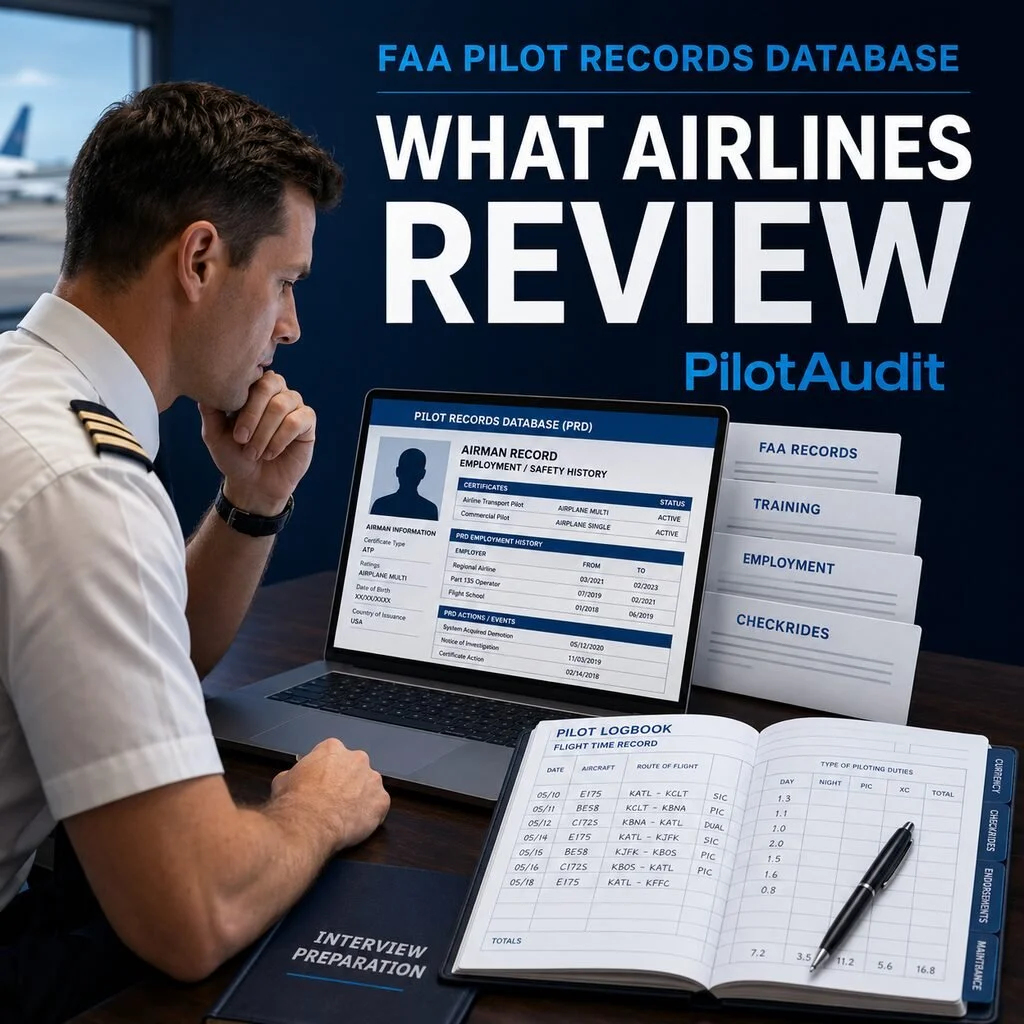
The FAA Pilot Records Database gives eligible pilots a way to review records about themselves and authorize a hiring operator to retrieve those records. It also replaced the old Pilot Records Improvement Act process that many outdated articles still describe as current.
The important part is understanding what the PRD is—and what it is not. The PRD is not your pilot logbook, not your complete medical file and not a public background-check database. It contains defined FAA and employer-reported records used in covered pilot-employment reviews.
That distinction matters before an airline application. A pilot can have an accurate PRD record and still have logbook totals that do not reconcile. A pilot can also have a clean, accurate logbook while an employer, training or separation record in the PRD needs attention. One review does not replace the other.
This guide explains what pilots can see, what a covered airline or operator must evaluate, how consent works, which records remain outside the PRD and what to do if a record is inaccurate.
Information checked against current FAA, eCFR and U.S. Department of Transportation sources on August 31, 2026.
The Short Answer
An eligible pilot can review all records in the FAA Pilot Records Database that pertain to that pilot. A covered reviewing entity must receive the pilot's written consent before retrieving the pilot's PRD information.
Under 14 CFR 111.105, the reviewing entity evaluates:
All applicable FAA records in the PRD
All records submitted to the PRD by reporting entities
Required motor-vehicle records obtained through the National Driver Register and applicable states
The pilot's employment history entered in the PRD
The substantive state driving records are obtained outside the PRD. The PRD also does not contain the pilot's flight-time totals, duty and rest records, recent flight experience or complete medical file.
The controlling rule is 14 CFR Part 111. The FAA maintains a current Pilot Records Database portal and a separate PRD resources page with forms and pilot job aids.
PRD Replaced PRIA: The Date Older Articles Often Miss
The Pilot Records Improvement Act process did not continue indefinitely alongside the completed PRD.
The FAA's current PRIA page says PRIA ceased to be effective beginning September 9, 2024. In a separate FAA transition notice, the agency says the PRD was fully implemented on September 9, 2024, and that beginning September 10, 2024, PRIA and FAA Form 8060-12 no longer applied.
That means a current article telling pilots to use the old five-year PRIA paper-request process is no longer describing the controlling hiring-records system. The Part 111 review now runs through the PRD.
The FAA still lists Advisory Circular 120-68J as active guidance, but it was issued in 2021 while PRD implementation and PRIA were still overlapping. For the current post-transition position, pilots and operators should rely on the current eCFR, the FAA's updated PRD pages and the agency's September 2024 transition guidance rather than treating older PRIA instructions as current.
Important exception: The end of PRIA did not eliminate every separate records check. The FAA specifically says PRD reporting and querying do not satisfy the drug-and-alcohol history requirements in 49 CFR 40.25 or the related FAA requirements. A hiring employer still requests specified DOT drug-and-alcohol information from DOT-regulated employers that employed the applicant during the preceding two years.
Not every FAA Form 8060 series form disappeared. FAA Form 8060-14 remains active for PRD consent or revocation, and FAA Form 8060-15 remains active for a PRD record dispute. The form the FAA identified as no longer applicable after the transition was Form 8060-12.
What Is the FAA Pilot Records Database?
The PRD is an FAA-managed electronic database designed to support pilot-employment safety reviews. It combines defined FAA records with records reported by covered air carriers, operators and other reporting entities. It also gives pilots a way to inspect records about themselves and authorize a particular reviewing entity to retrieve them.
Covered reviewing entities include Part 119 certificate holders authorized to operate under Parts 121, 125 or 135, Part 91K fractional operators and air-tour operators under Section 91.147. Part 111 also imposes reporting requirements on additional operators and entities, including certain Part 91 and public-aircraft operations.
Reporting duties depend on the type of employer and operation. That is why a blank employer category should not automatically be treated as proof that no employment or event existed. In some cases, Part 111 requires a reviewing entity to send a request through the PRD when the pilot's employment history suggests that a previous covered employer may hold applicable records that have not yet been uploaded.
The database is not public. Under 14 CFR 111.120, a reviewing entity may not retrieve a pilot's PRD information before receiving that pilot's written consent.
Who Can Access Their Own PRD Record?
The FAA's current electronic pilot portal is labeled for holders of Commercial, Airline Transport Pilot or Remote Pilot certificates. The page says the portal is not for private pilots and displays a valid FAA medical requirement for registration.
For a typical airline applicant holding a Commercial or ATP certificate, the practical process is to use the portal's current eligibility prompts and enter the certificate information exactly as the FAA requests. The FAA's grant-consent job aid tells pilots to enter their pilot certificate number and date of issuance—not a flight instructor certificate number.
Part 111 also provides a non-electronic review route. 14 CFR 111.315(c) says a pilot may review all PRD records pertaining to that pilot without electronic access by submitting an FAA-provided form that confirms the pilot's identity. Subpart D applies to individuals employed as pilots by, or seeking pilot employment with, operators or entities covered by Part 111.
Do not wait for an interview invitation to start. Section 111.305 says the electronic-access application must be submitted at least seven days before the pilot seeks access. Identity, certificate-number or account issues can take time to resolve.
What Records Can a Pilot See in the PRD?
Once electronic access is established, 14 CFR 111.315 allows the pilot to review all PRD records pertaining to that pilot. Those records fall into two broad groups: FAA records and employer- or operator-reported records.
FAA Records
Under 14 CFR 111.135, the FAA-record portion includes:
Current pilot and medical certificate information, ratings and limitations. This is certificate-status information, not the pilot's complete underlying medical file.
Failed practical tests required for a certificate or type rating under Part 61. In normal pilot language, this includes applicable checkride failures maintained by the FAA.
FAA enforcement records resulting in a finding of a violation that was not subsequently overturned.
Aviation accident or incident records involving the individual acting as pilot in command or second in command. The presence of a record identifies the pilot's role; it should not, by itself, be read as a determination of fault.
Specified drug-and-alcohol testing history, including verified positive drug tests, alcohol misuse violations such as a confirmed alcohol concentration of 0.04 or greater and refusals to test.
Employer and Operator Records
Covered reporting entities submit defined employment-related pilot records. The categories most likely to matter to an applicant include:
Training, qualification and proficiency events. These can include FAA-required and employer-required training, checking, testing and proficiency events. Reported records can include the event result and comments or evaluations made by a check pilot or evaluator.
Final disciplinary actions related to pilot performance. The record can identify a written warning, suspension or termination; whether the pilot was temporarily or permanently removed from aircraft operations; the date; and whether additional relevant documents are available.
Final separation from employment. The record identifies the reason category, including performance-related termination, another employer-initiated separation, medical disqualification, resignation or retirement, along with the date and whether relevant documents are available.
Employer drug-and-alcohol records required by Part 111. Depending on the event, these can include positive or refused tests, alcohol misuse and return-to-duty or follow-up results.
The pilot's PRD date of hire and applicable historical records.
Part 111 requires current covered records generated on or after June 10, 2022, to be reported under the current system. For specified historical employer records, Section 111.255 reaches back to August 1, 2005 for some Part 121 and 135 air-carrier records and August 1, 2010 for the broader operator categories described by the rule. Those historical reporting periods run through June 10, 2022.
A PRD entry may state that additional documents are available without placing every page of the underlying file on the main record screen. For final disciplinary and final separation records, covered reporting entities must retain relevant supporting documents for five years, if available, and provide them within 14 days after a proper request from the reviewing entity or the pilot.
What Does a Hiring Airline or Operator Review?
The regulation is more precise than the common phrase “the airline pulls your PRD.”
Under Section 111.105, a covered reviewing entity generally may not permit an individual to begin service as a pilot until it has evaluated all relevant information in four categories:
All FAA records in the PRD described by Section 111.135
All records in the PRD submitted by reporting entities
All motor-vehicle driving records the reviewing entity is required to obtain under Section 111.110
The employment history the pilot provides to the PRD
The motor-vehicle process deserves special attention. Where Section 111.110 applies, the reviewing entity obtains the pilot's separate written consent, queries the National Driver Register and requests relevant records from any state identified by that search. The substantive state driving information is not uploaded to the PRD; the operator documents in the PRD that the required search and evaluation occurred.
The pilot's PRD consent must also affirm that the preceding five years of employment history are accurate and complete. If the history is incomplete, the pilot must update it to list all past employers before providing consent.
The pilot selects the employer receiving access. The FAA job aid instructs the pilot to choose the correct employer, specify the number of days for which the records will be released and then notify the employer that the records are available. This is consent for the selected entity and release period—not standing permission for every airline to search the pilot whenever it wants.
What Is Not in the PRD?
Understanding the exclusions is just as important as understanding the record categories.
14 CFR 111.225(b) prohibits reporting the following as employer training, qualification or proficiency records:
Flight time, duty time and rest time
Recent flight experience
Records demonstrating compliance with physical-examination requirements or other protected medical records
Records protected under an FAA-designated voluntary safety reporting program under Part 193
Substantive state motor-vehicle information is also not stored in the PRD. A covered reviewing entity completes the required NDR and state-record process separately. A pilot who provided the required consent may request copies of the state records from the reviewing entity, and the entity must provide those copies within 30 days of receiving the pilot's request.
The exclusions prevent several common misunderstandings. A PRD review does not confirm the pilot's total time, PIC, SIC, turbine, cross-country, instrument, night or aircraft-category totals. It does not establish recent landing or instrument currency. It does not display the pilot's complete medical history. Those subjects belong to other records and processes.
Does the PRD Replace a Pilot Logbook?
No. Part 111 expressly excludes flight time and recent flight experience from the employer training records reported to the PRD.
An airline may review the PRD and the pilot's logbooks for different reasons. The PRD is a regulated employment and safety record. The logbook is the pilot's flight-experience record and remains central to applications, qualification questions and many airline interviews.
That is also the boundary of PilotAudit's work. We do not retrieve, change or certify a pilot's PRD. Our Professional Pilot Logbook Audit reviews the flight records the pilot provides for totals, categories, consistency and items worth verifying before an application or interview.
If the underlying issue is a missing flight, conflicting total, incomplete entry or complicated paper-to-digital history, our guide to fixing pilot logbook problems explains how to work through the separate logbook record without guessing or creating a new discrepancy.
How to Review and Share Your PRD Record
The FAA's current pilot workflow can be reduced to five practical steps:
Create the required access account. Visit the PRD pilot portal, establish the required FAA sign-in access and register for the pilot role using the exact pilot-certificate information requested by the FAA.
Review the complete record before granting consent. Read every displayed FAA and employer category. Do not assume a blank category is an error without checking which reporting rules applied to that employer.
Review at least five years of pilot employment history. Select the correct employer from the PRD list or add an employer when the FAA workflow allows it. The five-year history must be accurate and complete when consent is given.
Grant consent to the correct reviewing entity. Confirm the operator's legal name with the employer if there is any doubt, then specify the release period.
Tell the employer the record is available. Consent makes retrieval possible; the hiring team still must complete its review.
If a pilot cannot access the electronic PRD to grant consent, the FAA's current job aid directs the pilot to submit active FAA Form 8060-14. Follow the current FAA form and the employer's instructions rather than using an old PRIA release found online.
What Should You Do If Your PRD Record Is Wrong?
Do not wait until an airline asks about the record. Part 111 gives pilots a correction and dispute path, but the process may require the reporting entity to investigate.
Identify the exact record and reporting source. Save the wording shown in the PRD, the event date, the employer and any indication that supporting documents are available.
Gather source documents without altering them. Training records, notices, final decisions, separation documents and contemporaneous correspondence can help the reporting entity evaluate the claimed error.
Report the error through the PRD process. 14 CFR 111.320 requires the pilot to report an identified error or inaccuracy in the form and manner accepted by the FAA. FAA Form 8060-15 is the agency's active Pilot Record Dispute form.
Track the response. Under 14 CFR 111.250, a reporting entity that discovers or is informed of a perceived error must correct the record within 10 days of identification or initiate dispute resolution. If the entity determines that it does not agree the record is inaccurate, it must begin an investigation within 30 days of that determination, provide a final disposition within a reasonable time and document that disposition in the PRD.
Request relevant supporting documents when appropriate. For final disciplinary or separation records, the reporting entity may be required to provide retained supporting documents within 14 days of a proper pilot request.
A dispute is not an instant deletion. The reporting entity may agree and correct the record, or it may investigate and document a different final disposition. Identify the claimed inaccuracy precisely, keep the issue factual and preserve the documents supporting your position.
A Practical PRD Checklist Before an Airline Application
Register early enough to resolve identity, certificate-number or account issues.
Confirm that your name and certificate information match current FAA records.
Read every FAA, employer, training, disciplinary and separation category displayed.
Confirm that the preceding five years of pilot employment history are complete and use the correct legal employer names.
Compare the employers and dates with your resume and airline applications.
Treat a practical-test, training, accident, enforcement, discipline or separation record as a prompt to collect the facts and documents—not as a reason to guess.
Start the correction or dispute process as soon as you identify a specific inaccuracy.
Review your logbook and application totals separately; the PRD will not reconcile them for you.
Grant consent only to the correct operator and for the intended release period.
Frequently Asked Questions
Can a Pilot See Everything an Airline Sees in the PRD?
Yes. Section 111.315 allows a pilot to review all PRD records pertaining to that pilot. A covered airline's broader hiring process can also involve records outside the PRD, including state motor-vehicle records, the separate DOT drug-and-alcohol history request, the pilot's application and logbooks. A pilot who consented to the motor-vehicle search may request copies of the state records from the reviewing entity.
Does the PRD Show Failed Checkrides?
Yes. The FAA-record category includes failed attempts to pass a practical test required for a certificate or type rating under Part 61. Employer-reported training, checking, qualification and proficiency records can also contain event results and evaluator comments. That does not mean every knowledge-test score or informal training setback is necessarily a PRD record.
Does the PRD Show a Pilot's Medical History?
The PRD includes current pilot and medical certificate information, including limitations. Part 111 separately prohibits employers from reporting protected medical records and records demonstrating compliance with physical-examination requirements as training or qualification records. Certificate-status information is not the same as the pilot's complete medical file.
Can an Airline Access the PRD Without Pilot Consent?
No. A reviewing entity must receive the pilot's written consent before retrieving that pilot's PRD information. The pilot identifies the reviewing entity and, under the FAA's current consent workflow, specifies the number of days for the release.
How Far Back Does the PRD Go?
There is no single start date for every record category. Section 111.40 says the FAA maintains a pilot's PRD records for the life of the pilot, but that does not mean every category reaches back to the beginning of the pilot's career. Specified historical employer records reach back to August 1, 2005 or August 1, 2010 depending on the operator category, while current reporting rules cover required records generated on or after June 10, 2022.
Does the PRD Include Flight Hours or the Pilot's Logbook?
No. Part 111 prohibits reporting flight time, duty time, rest time and recent flight experience under the employer training-record provision. Airline application totals and pilot logbooks remain a separate review.
Is PRIA Still Used for Pilot Hiring Records?
No. The FAA says PRIA ceased to be effective beginning September 9, 2024, and that PRIA and FAA Form 8060-12 no longer applied beginning September 10, 2024. Separate requirements—including the two-year DOT drug-and-alcohol history check under 49 CFR 40.25—remain in force.
Can a Pilot Get Copies of State Driving Records Reviewed by the Airline?
Yes, when the pilot provided the required consent for the NDR search. Sections 111.120 and 111.315 allow the pilot to request copies of the state motor-vehicle records obtained by the reviewing entity. The reviewing entity must provide the copies within 30 days of receiving the request.
The Bottom Line
The PRD gives pilots something the old paper-based process did not provide as cleanly: a direct opportunity to inspect the federal database record that a covered hiring operator will use.
Use that opportunity before an application deadline. Confirm the employment history, review every record category, request supporting documents where appropriate and begin the formal correction process if you identify a real inaccuracy.
Just keep the record systems separate. The PRD helps an airline evaluate defined FAA and employment-safety records. Your logbook supports your flight experience. A careful airline candidate reviews both because neither substitutes for the other.
If you want a separate review of the logbooks and flight-time figures you will present, PilotAudit's Pilot Interview Logbook Prep Package combines a professional logbook audit with an organized printed interview binder for pilots in North America.
