DGCA Pilot Logbook Requirements in India: What to Record and Mistakes to Avoid
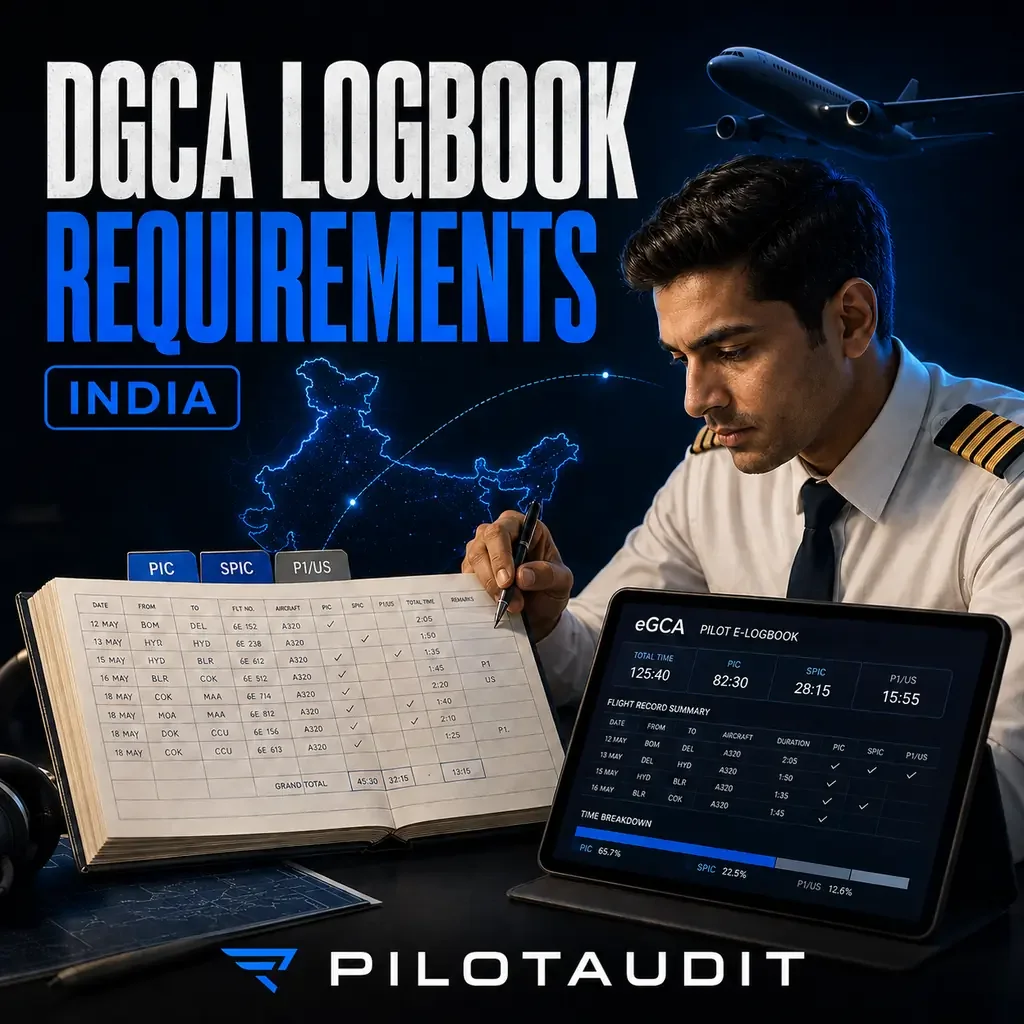
A pilot logbook is more than a running total of flying hours. In India, it is the record used to support the flying experience claimed for a licence, rating, renewal, conversion or professional opportunity.
That means an entry can be mathematically correct and still cause a problem if the pilot function is wrong, the remarks are incomplete, the certification is missing or the figure does not agree with the source record or eGCA entry.
The central rule is straightforward: record each flight accurately, classify the time according to the function actually performed and keep the record easy to verify.
This guide explains the current DGCA pilot logbook requirements, what to enter after each sortie, how PIC, SPIC, P1 under supervision, co-pilot, dual and instrument time differ, and which mistakes deserve attention before an eGCA or licence submission.
Information in brief: Rule 67A requires licensed flight crew to maintain a personal logbook and log all flight time. It also sets rules for ink entries, retention, monthly certification, dual-instruction certification, quarterly certification and the way several categories of flight time may be logged.
Which DGCA Source Governs Your Logbook?
Four sources do different jobs. Keeping them separate prevents a portal label or a generic online answer from being treated as the rule itself.
Rule 67A governs the maintenance of personal flight-crew logbooks and the logging of flight time.
Schedule II contains licence- and rating-specific experience requirements. For example, Section J covers the Commercial Pilot's Licence (Aeroplanes).
Current eGCA instructions explain how an applicant enters and routes records for a particular service. They do not, by themselves, decide whether DGCA will credit the time.
Operator or Flying Training Organisation (FTO) instructions govern the source records, approvals and workflow that apply to that pilot's flying, subject to the Aircraft Rules and DGCA requirements.
When two records appear to disagree, start with the facts of the flight and the applicable rule. Then check the Schedule II requirement and the current eGCA service instructions. That source hierarchy is more reliable than choosing the category that produces the most favourable total.
What Does DGCA Require in a Pilot Logbook?
Rule 67A of the Aircraft Rules, 1937 establishes the main personal-logbook requirements for flight crew licensed under the rules.
In practical terms, Rule 67A says that:
every licensed flight crew member must maintain a personal logbook in the form prescribed by the Director-General;
all flight time must be logged;
paper-logbook entries must be made in ink;
the logbook must be kept for at least five years after the date of the last entry;
the flight crew member must certify the accuracy of flight-time entries at least at the end of each calendar month;
the pilot-in-command must certify the relevant flight-time entry during dual instruction;
the logbook must be certified for correctness at the end of March, June, September and December by the authority applicable to the pilot; and
flight time must be placed in the correct category, including dual, PIC, co-pilot, instructor and instrument time.
DGCA also states that the evidence normally required as proof of flying experience is a personal logbook, or a prescribed certified extract, certified by the appropriate authority.
The important word is evidence. A total written on a summary page does not prove itself. The individual entries, certifications, source records and eGCA data should lead to the same supportable result.
If you want that trail checked before an application, PilotAudit's professional pilot logbook audit is designed to identify discrepancies, unsupported classifications, missing information and totals that need the pilot's attention.
What Information Should Each DGCA Logbook Entry Contain?
Rule 67A creates the obligation to maintain the prescribed record, while the fields shown in a physical logbook or eGCA workflow can vary with the licence service and type of flying.
At a practical level, each entry should allow a reviewer to determine:
When the flight occurred. Enter the date and the time information in the format required by the applicable logbook or eGCA workflow.
Which aircraft was flown. Record the aircraft type and registration accurately and consistently.
Where the flight operated. Enter the departure and arrival aerodromes and any route or cross-country detail required for the exercise.
How much flight time was completed. Record the duration in the same time format used throughout the record.
How the time was divided. Record day and night time separately when a sortie includes both.
What pilot function was performed. Use the correct category, such as solo, dual, PIC, P1 under supervision, SPIC, co-pilot or instructor, as applicable to that flight and the current instructions.
Whether instrument time was involved. Keep instrument flight time and instrument ground time separately identifiable.
Why the flight was conducted. Record the training exercise, test, check, commercial or non-commercial function, or other purpose when required.
Who provided instruction, supervision or examination. Include the name and required certification or validation details.
What needs explanation. Use the remarks or comments field for instructor details, supervision, approaches, unusual routing, corrections or other facts needed to understand the entry.
For training records, do not reduce the remarks to a generic word such as “training” if the current format expects the nature of the instruction. Rule 67A specifically requires the pilot giving instruction to make entries showing the nature of the instruction given.
Before submitting anything through eGCA, compare the portal fields with the original record. The purpose is to transfer and classify the underlying flight correctly—not to create a new version of the pilot's history.
How to Log PIC, SPIC, P1 Under Supervision and Co-Pilot Time
Pilot-function errors are among the most consequential logbook problems because they can change whether a pilot appears to meet an experience requirement.
Pilot-in-command time
Rule 67A permits the holder of a Private Pilot Licence, Commercial Pilot Licence or Airline Transport Pilot Licence to log PIC for the flight time during which the pilot acts as pilot-in-command, subject to the privileges and limitations that apply.
Do not use PIC as a general label for “the time I was handling the aircraft.” Acting as PIC is a defined function and must be supported by the licence, rating, authorisation, aircraft operation and facts of the flight.
Student solo time
Rule 67A says that an SPL holder may generally log PIC only for the portion of flight time during which the student is the sole occupant, subject to the rule's specific exception for aircraft requiring more than one pilot.
In the eGCA training workflow, selecting Solo causes PIC to be selected automatically. That does not make every flight performed without physical assistance a solo flight. Solo means the pilot was the sole occupant.
SPIC and P1 under supervision
These labels require care because the applicable rule, Schedule II requirement and eGCA workflow must be read together.
In the relevant aeroplane-licensing context, Schedule II of the Aircraft Rules says that the student logbook should identify student pilot-in-command time in the remarks column as SPIC, together with the instructor's name.
Rule 67A also addresses flight time spent performing the duties and functions of PIC under the supervision of a pilot-in-command. It may be logged as PIC only when the person is entitled and authorised to fly in command of that aircraft type by virtue of the ratings and privileges of the pilot's licence. In other cases, the time is logged as co-pilot with an appropriate note in remarks.
Current eGCA instructions also use P1/US for particular skill-test entries. Do not assume SPIC, P1/US and unrestricted PIC are interchangeable labels, or that every supervised sortie receives the same credit for every licence or rating. Record the function required by the current service instruction and preserve the instructor or examiner detail that supports it.
Co-pilot time
A CPL or ATPL holder logs co-pilot time when acting as co-pilot. Rule 67A further says that supervised PIC duties which do not satisfy its conditions for logging PIC must be logged as co-pilot with an appropriate indication in remarks.
Do not move time from co-pilot to PIC simply because a later application values PIC more highly. The correct category comes from the flight as operated, not from the total the pilot is trying to reach.
Dual instruction
Time under dual instruction must be logged as dual. The pilot giving instruction must record the nature of the instruction, and the pilot-in-command must certify the relevant flight-time entry.
For the eGCA FTO training workflow, the student selects Dual and identifies the instructor as the PIC. A common mistake is to import a foreign logbook convention that allows overlapping categories without checking how DGCA requires the flight to be entered.
Instructor and examiner time
Rule 67A allows a flight instructor to log PIC while acting as an instructor, but the remarks must indicate that the flight was flown as instructor. It also provides for an examiner to log PIC while acting in that role when appropriately entitled and authorised on the type.
The role should remain visible. A bare PIC total that hides instructor or examiner activity makes the record harder to interpret.
How to Log Instrument and Simulator Time
Instrument time is not simply any flight conducted under IFR or any period spent in cloud.
Under Rule 67A:
instrument flight time may be logged by the pilot manipulating the controls only when the aircraft is flown solely by reference to instruments under actual or simulated instrument conditions;
over-the-top flying must not be logged as instrument flight time; and
instrument ground time may be logged while flying solely by reference to instruments in a recognised synthetic device that simulates instrument conditions.
Keep aircraft flight time and synthetic-device time separate. A simulator session should not increase the aircraft-flight total, even when the session is creditable toward a training, rating or checking requirement.
In eGCA, use the simulator e-logbook route that applies to the service and follow that service's current document checklist. Device approval, instructor or examiner validation and session-report requirements can differ by application. Do not assume that a simulator entry accepted in one workflow will satisfy a different licence or rating requirement.
Monthly and Quarterly Logbook Certification
The certification cycle is easy to overlook when pilots focus only on individual entries.
Rule 67A requires the flight crew member to certify the accuracy of flight-time entries at least at the end of every calendar month. It separately requires quarterly certification for correctness at the end of March, June, September and December.
The quarterly certifying authority depends on the pilot's situation:
for professional pilots, a competent authority such as the Operations Manager, Deputy Operations Manager or Chief Pilot of the air transport undertaking;
for members of an FTO, the Chief Flying Instructor; and
for other persons, an officer designated by DGCA.
Do not wait until a licence application is due to discover that several quarters were never certified. Retrospective certification may require records, personnel or organisations that are no longer easy to access.
A sensible month-end routine is to:
confirm that every sortie for the month is present;
compare entries with the FTO authorisation register, roster, flight report, tech log or operator record that applies;
confirm that day and night time, pilot function and instrument time are correctly separated;
recalculate the page or monthly totals;
certify the entries; and
obtain the separate quarterly certification when the month is March, June, September or December.
This routine catches errors while the source records and people involved are still available.
Physical Pilot Logbook and eGCA: Keep One Consistent Record
eGCA does not remove the need for a reliable source record.
DGCA's instructions for filling the pilot e-logbook advise applicants to read Rules 67, 67A and 67B before making entries. The instructions also state that flight details are to be entered carefully and separately, and that approved entries are not amendable through the ordinary workflow.
For flying completed at an FTO in India, the eGCA instructions direct the applicant to use the relevant FTO workflow and the source format or authorisation register applicable to that training. Other routes exist for foreign FTO or ATO flying, defence experience, operators and different licensing services.
Pilots employed by scheduled air operators should follow the process issued for their operation rather than applying the student or FTO route. DGCA lists Operations Circular 3 of 2024, “e-LogBooks of pilots employed with scheduled air operators”. The operator's current procedure and source records therefore remain important for airline flying.
The practical rule is simple: the physical logbook, eGCA entry, FTO or operator record and application should not describe the same flight in four different ways.
Before submitting an eGCA batch, check:
date and time format;
aircraft registration and type;
departure, arrival and multi-leg routing;
day and night split;
duration;
pilot function;
instructor, examiner or PIC name;
purpose or exercise selection;
take-offs and landings where required; and
totals produced by the submitted entries.
Submission of e-logbook hours does not, by itself, establish that the applicant has met a licence or rating requirement. DGCA still applies the governing rules and verifies the supporting record. Treat eGCA as a submission and validation workflow, not as permission to reclassify the underlying flight.
The Most Common DGCA Logbook Mistakes
1. Treating total time as the only number that matters
Two pilots can have the same total hours and very different creditable experience. PIC, co-pilot, dual, SPIC, P1/US, night, cross-country, instrument and simulator time must remain separately traceable.
2. Logging the same flight in incompatible pilot-function categories
Do not double-count one block of time merely because a foreign system permits overlapping classifications. Apply the DGCA rule and current eGCA instruction to the flight as it was actually conducted.
3. Calling supervised time unrestricted PIC
SPIC or P1/US should not disappear inside a generic PIC total without the supporting classification and remarks. Whether supervised time receives credit depends on the applicable rule and the purpose for which the hours are being assessed.
4. Missing the instructor or examiner detail
Dual, SPIC, P1/US and test entries often need the other pilot's name, role and certification or validation. A number without that context can be difficult to support later.
5. Leaving training remarks too vague
Rule 67A requires the nature of dual instruction to be shown. “Training” alone may not explain which exercise was completed or why the time was logged in a particular category.
6. Mixing instrument flight time with instrument ground time
Both may be relevant, but they are not the same. Keep synthetic-device time outside the aircraft-flight total and preserve the device and session information.
7. Missing monthly or quarterly certification
An otherwise accurate book can still be incomplete if the required certifications are absent. Check the end of every month and quarter instead of attempting to repair several years at once.
8. Copying physical entries into eGCA without reconciling them
A transcription error can change a date, registration, route, duration or pilot function. Compare every submitted batch with the source before approval, because approved eGCA entries may not be amendable through the normal workflow.
9. Using inconsistent time formats
Hours and minutes are not decimal hours. 1:30 means one hour and thirty minutes; 1.30 as a decimal is one hour and eighteen minutes. Decide which format the record requires and convert deliberately.
10. Allowing carry-forward totals to drift
A single addition error can affect every later page. If the current grand total is wrong, find the first incorrect carry-forward rather than forcing the latest page to match an application figure.
11. Overwriting or obscuring the original paper entry
Rule 67B of the Aircraft Rules addresses destruction, mutilation and false or fraudulent entries in logbooks. If a correction is needed, preserve transparency and follow the correction method accepted by the relevant organisation or authority. Do not erase the history in a way that makes the original entry impossible to understand.
12. Discarding the physical logbook after digitising it
Rule 67A requires preservation for at least five years after the last entry, and older records may remain important long after that minimum. Keep the original book even after creating a digital record.
How to Audit a DGCA Pilot Logbook Before Submission
A useful audit does more than add the last page.
Work in this order:
Preserve the source. Keep the original paper books, electronic exports, FTO records, operator summaries and supporting certificates unchanged.
Check continuity. Look for missing dates, pages, page numbers, sectors and unexplained gaps.
Recalculate from the beginning. Verify page totals, carry-forwards and opening balances instead of trusting the current grand total.
Review pilot function. Test PIC, co-pilot, dual, SPIC, P1/US and instructor entries against Rule 67A and the facts of each flight.
Separate nested categories. Confirm that night, cross-country and instrument time sit within the relevant flight total and are not added again as separate flying time.
Reconcile eGCA. Compare the submitted or approved portal data with the physical logbook and relevant source record.
Check certifications. Identify missing monthly, dual and quarterly certifications.
Trace application figures backwards. Every number claimed for a licence, rating, conversion or employer should lead to specific entries or a supported summary.
Document differences. If two legitimate records use different conventions, record the reason instead of silently changing the source.
Back up the completed record. Store more than one secure copy and retain the originals.
For a short training record, the pilot and FTO may be able to complete this process directly. For a long record involving several books, operators, conversions or data imports, independent review is often the cleaner option.
PilotAudit is a pilot-owned logbook specialist serving pilots internationally. Our professional logbook audit service works from the entry-level record: we trace totals back to the flights, identify breaks in continuity, test category logic and report discrepancies clearly instead of checking only the final summary page.
For a pilot preparing a DGCA-facing record, that means the review can focus on the points that most often create difficulty—PIC, co-pilot, dual, SPIC or P1/US classification; physical-logbook and eGCA differences; missing certifications; and totals that cannot be reproduced from the source. The result is an independent technical review the pilot can act on before relying on the figures.
PilotAudit does not issue DGCA credit, determine licence eligibility or replace an FTO, operator, examiner or DGCA official. The pilot remains responsible for the entries and for following the current application instructions.
Converting a Paper Pilot Logbook to Digital
A searchable digital record makes it easier to isolate PIC, night, cross-country, instrument, aircraft-type and recency totals. It also makes carry-forward errors and missing sectors easier to find.
The conversion must preserve the underlying evidence. It should not flatten SPIC into PIC, combine simulator and aircraft time, or discard remarks and certification details merely to produce a tidy spreadsheet.
PilotAudit's paper-to-digital pilot logbook conversion converts handwritten flight entries into a structured digital record for pilots in India and other aviation markets. The conversion preserves entry-level detail so that a pilot can search a long flying history, reconcile records with eGCA or prepare traceable totals for a future application.
Keep the original paper books after conversion. The digital file is a working record and backup; it does not erase the evidentiary value or retention requirements of the originals.
Official Sources Checked for This Guide
PilotAudit cross-checked the regulatory and eGCA statements in this article against first-party Government of India and DGCA material rather than relying on forum posts or generic summaries:
the Aircraft Rules, 1937, including Rules 67A and 67B and Schedule II, together with DGCA's Aircraft Rules index;
DGCA's general provision on proof of flying experience;
DGCA's pilot e-logbook instructions; and
the DGCA Operations Circulars page, which lists Operations Circular 3 of 2024 for e-logbooks of pilots employed with scheduled air operators.
Because DGCA can revise portal workflows and issue new directions, the “Last fact-checked” date matters. Before a live submission, compare this guidance with the current eGCA service page and any instructions issued by the relevant FTO, operator, examiner or DGCA office.
Frequently Asked Questions
What is the main DGCA rule for pilot logbooks?
Rule 67A of the Aircraft Rules, 1937 is the main rule for personal flight crew logbooks and logging flight time. It covers the obligation to maintain a logbook, ink entries, retention, certification and the treatment of several flight-time categories.
How long must a DGCA pilot logbook be kept?
Rule 67A requires the logbook to be preserved for at least five years after the date of the last entry. Many pilots keep complete career records for longer because old entries may still be needed to support licence, conversion or employment figures.
How often does a pilot need to certify the logbook?
The pilot must certify the accuracy of the flight-time entries at least at the end of every calendar month. The logbook must also receive the applicable competent-authority certification at the end of March, June, September and December.
Is there one DGCA pilot logbook format for every pilot?
The correct DGCA logbook format is the prescribed record applicable to the pilot and service—not a generic template downloaded online. Rule 67A requires a personal logbook in the form prescribed by the Director-General, while the fields and routing used in eGCA depend on the service and source of flying. Use the current record format required by the FTO or operator and the eGCA instructions applicable to the application.
Does eGCA replace the physical pilot logbook?
Not automatically. DGCA uses an e-logbook workflow in eGCA for licensing services, but the exact route and validation depend on the source of the flying and the service requested. Maintain the prescribed underlying record, follow the current eGCA instructions and retain the physical logbook and supporting records when applicable.
Can approved eGCA logbook entries be edited?
DGCA's e-logbook instructions warn that entries once approved by the competent authority are not amendable through the ordinary process. Check every field carefully before submission and approval, and follow the current helpdesk or DGCA process if a genuine error is discovered later.
Does SPIC or P1 under supervision count as PIC?
Not automatically for every purpose. Rule 67A sets conditions for logging PIC duties performed under supervision, Schedule II uses SPIC in specific training contexts, and eGCA uses P1/US for particular entries. Keep the supervised category and supporting remarks visible, then apply the definition used by the licence, rating or application concerned.
What is the difference between dual and PIC time?
Dual is flight time during which the pilot is under instruction. PIC is time during which the pilot acts as pilot-in-command within the applicable privileges and authorisations. Rule 67A requires dual time to be entered as dual and certified by the pilot-in-command.
Does IFR flight time automatically count as instrument time?
No. Rule 67A permits instrument flight time when the pilot manipulating the controls flies solely by reference to instruments under actual or simulated instrument conditions. Filing or operating under IFR does not, by itself, make the entire flight instrument time.
Can PilotAudit review a logbook for a DGCA application?
Yes. PilotAudit audits logbooks for pilots worldwide, including records being prepared for DGCA-related applications. Our audit checks the customer-provided entries, classifications and totals and flags discrepancies for the pilot to address. It does not certify DGCA compliance or decide how DGCA will credit an entry.
Can PilotAudit convert handwritten logbooks for pilots in India?
Yes. PilotAudit converts paper flight records into structured digital logbooks for pilots internationally. The original paper books should still be retained.
Final Thoughts
A strong DGCA pilot logbook is not simply neat. It is consistent, certified and traceable.
Record each sortie while the details are fresh. Keep PIC, co-pilot, dual, SPIC, P1/US, instrument and simulator time distinct. Complete the monthly and quarterly certifications on schedule. Before submitting entries through eGCA, reconcile them with the physical logbook and the FTO or operator source.
Most serious problems begin as small ones: a missing instructor name, a misplaced pilot function, an incorrect carry-forward or a portal entry approved before anyone checked it. Correcting the workflow early is far easier than rebuilding years of flying history under a deadline.
When the record is long, mixed-format or difficult to reconcile, PilotAudit's detailed logbook audit provides an independent review before the pilot relies on the totals. If the history is still on paper, our professional logbook conversion service creates a searchable digital record while preserving the original evidence.
The objective is simple: every important number should be easy to find, easy to explain and supported by the record behind it.
