CASA PICUS (ICUS) Hours Explained: What Counts Towards an ATPL(A)?
If your Australian logbook has an ICUS column and you are working towards an ATPL(A), it is tempting to treat every supervised or pilot-flying sector as command-under-supervision time. That is the trap.
Under CASA Part 61, pilot in command under supervision (PICUS) has a specific legal test. The pilot must hold a pilot licence, perform all the duties of the pilot in command for the flight and be supervised through one of the arrangements in CASR 61.095. Pilot flying, handling pilot and right-seat time do not automatically meet that test.
That distinction matters when you are building command experience for an Australian ATPL(A). A sector can feel like command practice and still fail the PICUS definition. On the other hand, properly classified PICUS can make an important contribution to the ATPL(A) command and cross-country requirements.
Australian pilots and logbooks also use the term ICUS, meaning in-command under supervision. This guide explains how ICUS relates to the regulated PICUS category, when those hours count, how they differ from PIC, co-pilot and dual time, and how to keep the logbook trail strong enough to support the total later.
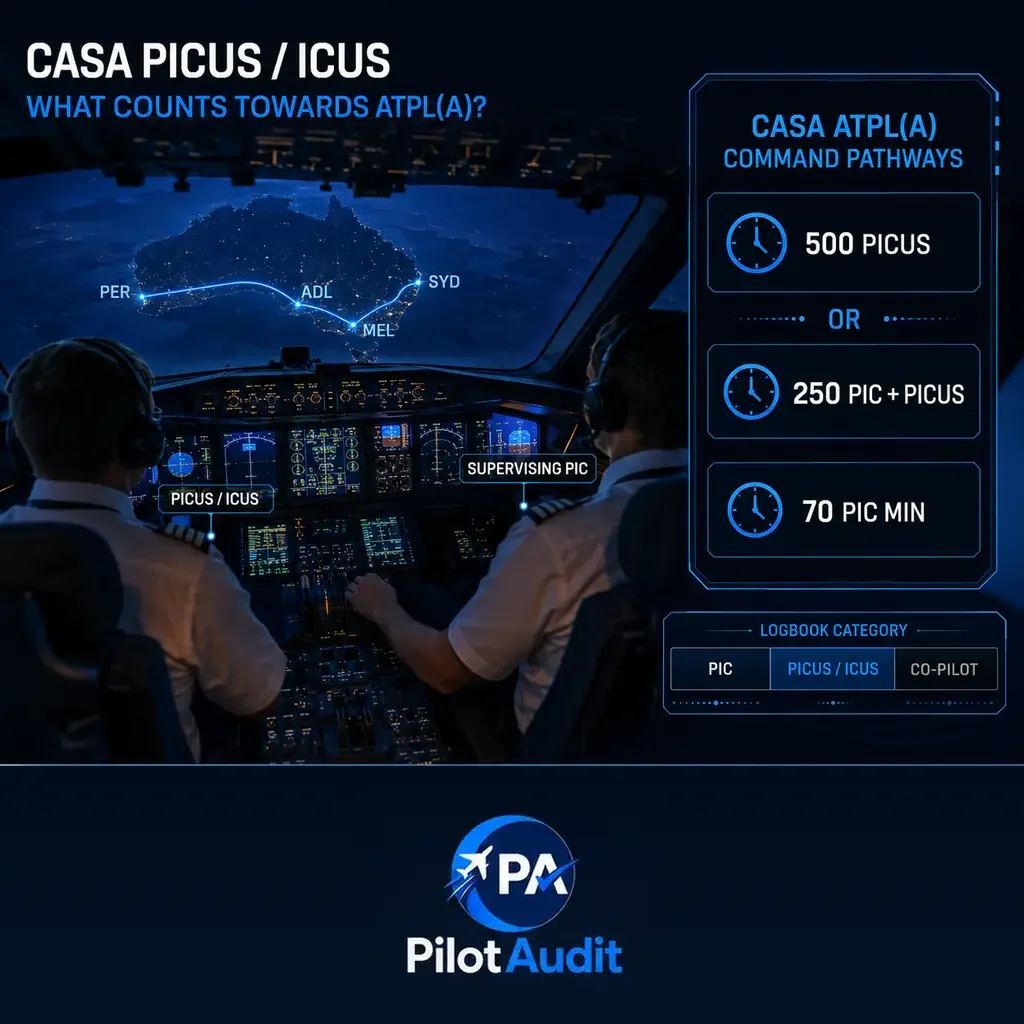
Information in brief: Under CASR 61.095, PICUS requires a pilot licence, performance of all PIC duties for the flight and qualifying supervision by an authorised operator PIC, flight instructor or flight examiner. For an ATPL(A), CASR 61.705 provides either 500 hours of aeroplane PICUS, or 250 hours of aeroplane PIC and PICUS combined with at least 70 hours PIC.
Accuracy note: We checked this guide against the Civil Aviation Safety Regulations 1998 compilation in force on 30 June 2026 and current CASA guidance reviewed on 23 August 2026. The legislation is the controlling source. Operator procedures, instructor or examiner requirements and CASA application instructions can add practical requirements or change, so check the current material that applies to your flight and intended use.
What Do PICUS and ICUS Mean Under CASA?
The legal starting point is CASR 61.095, which defines flight time as pilot in command under supervision for Part 61.
A flight is PICUS only when all of the following are true:
The person holds a pilot licence.
The person performs all the duties of the PIC for the flight. Simply being the pilot flying for a sector is not enough.
One of the regulation's supervision pathways applies. The supervision must meet subregulation 61.095(2) or 61.095(3).
The two supervision pathways are:
Operator pathway: the flight is conducted by an operator with training and checking responsibilities, and the actual PIC is authorised by the operator or the operator's Part 142 operator to supervise the person.
Instructor or examiner pathway: the person is supervised by a flight instructor or flight examiner and is not receiving flight training.
The words all the duties do a fair bit of work here. PICUS is not established merely because the supervised pilot handled the controls, completed the take-off and landing or was listed as pilot flying. The full set of PIC duties applicable to that flight must be performed. What that involves will depend on the flight and the operator's procedures.
The actual PIC remains the PIC of the aircraft. The supervised pilot records a separate Part 61 capacity: PICUS.
Why Australian Pilots Often Say ICUS Instead of PICUS
Australian pilots will hear both PICUS and ICUS.
CASA's official glossary expands ICUS as “In-command Under Supervision”. The regulation itself uses the full expression pilot in command under supervision, and CASA's flight crew logbook page abbreviates that capacity as PICUS.
You may therefore see ICUS on an Australian paper-logbook column, electronic record or operator report. In this guide, PICUS refers to the regulated Part 61 capacity and ICUS refers to the familiar Australian shorthand for in-command under supervision.
The label does not create the credit. An operator document headed “ICUS”, a roster remark or an employment record does not, by its title alone, prove that every sector satisfies 61.095. The duties, supervision and authorisation behind the entry are what establish the Part 61 classification.
PIC vs PICUS vs Co-pilot vs Dual Flight Time
CASA requires these capacities to be recorded separately. They should not be moved between columns simply because a later licence or job application values one more highly.
PIC
Core Part 61 test: The person is the pilot in command of the aircraft for the flight
What it is not: A supervised pilot who performs PIC duties while another pilot remains the actual PIC
PICUS (often ICUS in Australian records)
Core Part 61 test: Licensed pilot performs all PIC duties and the 61.095 operator or instructor/examiner supervision pathway applies
What it is not: Ordinary co-pilot time, pilot-flying time or dual training
Co-pilot
Core Part 61 test: Person performs co-pilot duties in an aircraft that the regulations require to be flown by at least two pilots, other than while acting as PICUS
What it is not: Any right-seat flight, or PICUS recorded a second time
Pilot receiving flight training
Core Part 61 test: Person receives flight training during the flight
What it is not: PICUS under the instructor/examiner pathway
Under CASR 61.080, qualifying PIC, PICUS, co-pilot and training time can all form part of flight time as a pilot. That broader treatment does not merge the categories. CASR 61.085 expressly defines co-pilot time as co-pilot duties performed other than as PICUS, while CASR 61.090 reserves PIC time for the person who is actually PIC.
Think of the logbook as a record of what legally and operationally occurred, not a menu of labels to choose from at application time.
When Can an Australian Pilot Log ICUS or PICUS?
1. A qualifying operator PICUS sector
The operator pathway can apply when:
the supervised person holds a pilot licence;
the operator has training and checking responsibilities;
the actual PIC is authorised by the operator or its Part 142 operator to conduct the supervision; and
the supervised pilot performs all PIC duties for the flight.
An operator's process should make the authorisation and responsibilities clear. A captain informally letting a co-pilot run a sector does not, by itself, turn the sector into PICUS. Neither does being rostered as pilot flying.
For a current Australian air transport example, section 12.13 of the Part 135 Manual of Standards requires command training to include supervised line flying as PICUS for the number of flight hours stated in the aeroplane operator's exposition. That is a Part 135 command-training requirement, not blanket permission to classify every supervised sector as PICUS; the flight must still satisfy CASR 61.095 and the operator's documented process.
If you expect to rely on operator PICUS years later, retain the records that explain the scheme. As a record-keeping recommendation, useful evidence may include the applicable operator procedure, the supervising PIC's authorisation, training and checking records, sector records, progress sheets and completion documentation. The exact paperwork will depend on the operator.
2. Supervision by a flight instructor or flight examiner without training
The second pathway applies when a licensed pilot is supervised by a flight instructor or flight examiner and is not receiving flight training.
The no-training condition is crucial. The same flight can involve an instructor in the other seat, but its classification changes if the pilot receives training. In that case, it is not PICUS under 61.095(3).
3. A flight review with no training
CASA gives a practical example in its current flight review guidance:
if the pilot does not receive training during the flight review, CASA says to log the flight as PICUS under 61.095(3); and
if the review requires flight training, CASA says to record the time as dual.
That is a good illustration of why the facts of the flight matter more than the event title. Writing only “flight review” in the remarks may not preserve whether the flight was assessment without training or a training flight. Record the capacity accurately and retain the instructor's associated record.
When You Cannot Log CASA PICUS or ICUS Hours
PICUS should not be claimed merely because:
you were pilot flying or handling pilot;
you occupied the command seat or right-hand seat;
a captain observed your sector informally;
two qualified pilots were on board;
you completed the take-off and landing;
you were receiving flight training from an instructor or examiner and were relying on the 61.095(3) pathway;
you were carrying out ordinary co-pilot duties; or
you later needed more command time for an ATPL(A) calculation.
The most common trap in multi-crew records is to start with pilot-flying sectors and relabel them as PICUS. Pilot flying is a crew-allocation concept. PICUS is a Part 61 flight-time classification with separate duties and supervision conditions.
Another trap is the presence of an instructor. Instructor on board does not automatically mean PICUS. If training occurred, the instructor/examiner pathway in 61.095(3) is not satisfied. CASA's flight-review guidance makes that distinction explicit.
If the records do not show what occurred, do not guess. Flag the entry and check it against the operator, instructor or examiner record while that evidence is still available.
How Do PICUS and ICUS Hours Count Towards an Australian ATPL(A)?
Under CASR 61.705, an applicant for an aeroplane-category ATPL needs at least 1,500 hours of aeronautical experience and the required subcategory totals.
For the PIC/PICUS component, the current regulation provides two alternatives:
Pathway 1: 500 hours of aeroplane PICUS
The applicant has at least 500 hours of flight time in an aeroplane as PICUS.
Pathway 2: 250 hours of aeroplane PIC and PICUS, including 70 PIC
The applicant has at least 250 hours of flight time in an aeroplane as PIC or PICUS, of which at least 70 hours are PIC.
CASA's public ATPL minimum-hours table summarises this row as “500 or 250 if at least 70 are PIC”. The regulation gives the precise structure: the 500-hour alternative is specifically aeroplane PICUS; the 250-hour alternative combines aeroplane PIC and PICUS with the 70-hour PIC floor.
Here are three simplified examples:
Example 1
Aeroplane PIC: 80 hours
Aeroplane PICUS (ICUS): 190 hours
Result for 61.705(1)(c): Meets Pathway 2: 270 combined, including at least 70 PIC
Example 2
Aeroplane PIC: 20 hours
Aeroplane PICUS (ICUS): 510 hours
Result for 61.705(1)(c): Meets Pathway 1: at least 500 PICUS
Example 3
Aeroplane PIC: 120 hours
Aeroplane PICUS (ICUS): 100 hours
Result for 61.705(1)(c): Does not yet meet either: 220 combined and less than 500 PICUS
These examples address only the PIC/PICUS line. Every hour still needs to satisfy its underlying Part 61 definition, be completed in a registered or recognised aeroplane and fit within a record that meets the other ATPL(A) requirements.
If the individual PICUS entries, operator records and summary totals do not reconcile, a professional pilot logbook audit can trace the figures back to the pilot-provided record and identify the entries that still need confirmation. The service does not decide whether CASA will grant credit.
For the full 1,500-hour breakdown, use PilotAudit's separate guide to CASA ATPL flight time requirements. Keeping the broad ATPL calculation and the detailed PICUS test on separate pages makes each question easier to verify.
Does ICUS or PICUS Count as PIC in Australia?
No. PICUS is not converted into PIC simply because 61.705 allows the categories to be combined for one ATPL(A) pathway.
CASR 61.345 requires PIC and PICUS to be recorded as separate flight-time capacities. The ATPL(A) rule then gives PICUS specified credit for the command-experience requirement and for cross-country PIC/PICUS. That credit does not rewrite the original capacity.
This matters outside the licence calculation as well. An operator, employer, insurer or overseas authority may ask for actual PIC, command, captain or PICUS figures using its own definitions. Credit towards an Australian ATPL(A) under CASA rules does not guarantee that another organisation will treat PICUS as PIC. Report the categories honestly and follow the current instructions for the particular form.
Does Co-pilot Time Count Towards an Australian ATPL(A)?
Qualifying co-pilot time is flight time as a pilot under CASR 61.080 and may contribute to the broader pilot-flight and aeroplane totals. It does not fill the PIC or PICUS bucket in 61.705(1)(c).
CASR 61.085 also limits co-pilot time to flight in an aircraft that the regulations require to be flown by at least two pilots, while the person performs co-pilot duties other than PICUS. Merely occupying a second control seat in a single-pilot aeroplane does not create co-pilot time.
One period should not be entered as both ordinary co-pilot and PICUS. If a qualifying supervised-command sector occurs within a multi-crew operation, classify and support it according to what actually happened and the operator's authorised process.
How PICUS and ICUS Fit Into Other ATPL(A) Hour Requirements
Properly logged PICUS can also matter beyond the main 500/250-hour line:
Cross-country: 61.705 requires 200 hours of aeroplane cross-country, including at least 100 hours of aeroplane cross-country as PIC or PICUS.
Night: the ATPL(A) requires 100 hours of night flight time as pilot of an aeroplane other than dual. PICUS may contribute when the flight separately meets the night requirement and was not dual.
Instrument: a PICUS flight may also contain qualifying instrument flight time, but the instrument definition must be satisfied independently.
These are overlapping attributes, not extra hours. A 1.5-hour aeroplane sector can be PICUS, cross-country, night and instrument at the same time if the facts support every category. It remains 1.5 hours of total flight time.
Do not create the combinations afterwards from summary totals. Entry-level data is what allows a pilot to isolate, for example, cross-country PICUS in aeroplanes without double-counting the flight.
Where older ICUS time exists only in handwritten books, an entry-by-entry paper-to-digital logbook conversion can preserve the aircraft, route, capacity, day/night and instrument details needed to rebuild those combinations. A single balance-forward figure usually cannot do that job.
How to Record ICUS or PICUS in a CASA Logbook
CASR 61.345 requires a licensed pilot to keep a personal logbook and, as soon as practicable after each flight, record information including:
the date the flight began;
aircraft type;
single-engine or multi-engine status;
nationality and registration marks;
take-off and landing points for the flight and each segment;
flight time by capacity, including PIC, co-pilot, PICUS or pilot receiving training;
relevant instructor or examiner time;
day or night;
instrument flight time; and
instrument approach information.
Use a dedicated PICUS or ICUS field that remains clearly separable from PIC, co-pilot and dual. Do not bury the only indication of supervised command in a free-text remark while placing the time in another capacity column.
Part 61 does not prescribe one universal “supervisor signature” box for every PICUS entry. An operator, instructor or examiner may nevertheless require countersignatures, forms, progress records or other supporting documentation. Follow that process. As a practical PilotAudit recommendation, a useful PICUS remark identifies the supervised-command event or scheme and the supervising person without replacing the formal supporting record.
CASA accepts paper and electronic logbooks. Its flight crew logbook guidance also reminds pilots that entries must be correct and not misleading, the logbook must be retained for seven years after the last entry, and an up-to-date copy must be produced within seven days if CASA directs. If the logbook is electronic, the directed production is a printed copy with each page certified by the holder as a true copy.
What Evidence Should You Keep for PICUS?
The personal logbook is the core record, but a bare total may not explain why the flight met 61.095. Keep the source documents that can establish the supervision and duties later.
Depending on the pathway, that may include:
operator PICUS or ICUS procedures;
evidence that the supervising PIC was authorised for the role;
rosters, sector records or operational flight records;
training and checking records;
progress sheets and completion records;
flight-review records;
instructor or examiner records and endorsements;
paper logbook pages, scans and dated electronic exports; and
correspondence that resolves an unclear classification.
Do not alter old source records to make them line up with a newer summary. Preserve the original and document any supported correction transparently. CASR 61.355 requires logbook entries to remain unaltered during the seven-year retention period, while 61.360 prohibits false or materially misleading entries and allows CASA to direct a correction.
For a career logbook, retaining the evidence beyond the minimum period is sensible. Old PICUS can still matter at a later command course, licence application, operator change or overseas conversion.
Common PICUS and ICUS Logbook Errors
Pilot flying is treated as PICUS
The pilot-flying designation does not establish all PIC duties or qualifying supervision. Check 61.095, not just the roster.
Co-pilot and PICUS are both claimed for the same time
Part 61 treats them as distinct capacities, and 61.085 excludes PICUS from co-pilot time.
Training is recorded as PICUS
Under the instructor/examiner pathway, the pilot must not be receiving flight training. CASA says a flight review involving training is recorded as dual.
The 500-hour ATPL pathway is described as “PIC or PICUS”
The first alternative in 61.705(1)(c) is 500 hours of aeroplane PICUS. The second is 250 hours of aeroplane PIC and PICUS combined with at least 70 PIC.
ICUS and PICUS are mixed without a category map
Older operator reports may use ICUS while the electronic logbook uses PICUS. Map the terminology to the underlying records rather than adding two totals together and risking duplication.
Cross-country PICUS cannot be isolated
A single PICUS total will not prove the separate requirement for 100 hours of aeroplane cross-country as PIC or PICUS. Route and capacity must be connected at entry level.
A balance-forward hides the flights
A lump-sum conversion may preserve total PICUS but lose aircraft, route, day/night and instrument combinations. That weakens future ATPL reporting.
Paper, digital and operator totals disagree
Do not pick the highest figure. Find the first point of difference and determine whether the cause is an omitted sector, duplicate, decimal error, category map or unsupported entry.
This is where PilotAudit's professional logbook audit service is most useful: we compare the records supplied by the pilot, trace how the totals were built and flag uncertainty rather than silently changing an entry.
CASA PICUS and ICUS Audit Checklist
Before relying on PICUS for an ATPL(A), work through the record in this order:
Preserve every source. Save the original paper books, exports, operator records and training or checking documents.
Identify every PICUS entry. Do not begin with the summary total.
Confirm the pilot licence condition. PICUS under 61.095 requires the person to hold a pilot licence.
Confirm all PIC duties. Check what the pilot actually did, not only who handled the controls.
Identify the supervision pathway. Separate operator-supervised sectors from instructor/examiner-supervised flights.
Check authorisation. For the operator pathway, verify the supervising PIC's required authorisation from the operator or its Part 142 operator.
Exclude training where required. Instructor/examiner PICUS cannot include time during which the pilot received flight training.
Remove co-pilot overlap. The same period should not sit in both ordinary co-pilot and PICUS totals.
Filter for aeroplanes. The ATPL(A) PICUS requirement is aeroplane-specific.
Calculate both 61.705 pathways. Test 500 PICUS and 250 combined PIC/PICUS with at least 70 PIC.
Rebuild cross-country PIC/PICUS. Verify the route and capacity for the 100-hour subtotal.
Reconcile every format. Paper, digital, operator and application totals should be traceable to the same flights.
Flag unresolved entries. Ask the operator, instructor, examiner or CASA rather than making an assumption.
Keep a dated audit snapshot. Save the reviewed export, calculations and source list together.
How PilotAudit Reviews Australian PICUS and ICUS Records
PICUS problems are rarely solved by checking one totals page. The useful work happens at entry level: identifying the sectors, testing the capacity logic, comparing paper and digital records, isolating cross-country PICUS and tracing discrepancies back to the source.
PilotAudit is pilot-owned and works with records maintained under the CASA framework. Through our professional pilot logbook audit, we review the records supplied by the pilot for category consistency, calculation and carry-forward issues, missing or duplicated entries, paper-to-digital differences and items that need clarification.
For an Australian PICUS review, the audit can organise the findings around the 61.095 conditions and 61.705 ATPL(A) experience requirements. That makes the result more useful than a generic total-time check: the pilot can see which entries support each subtotal and which ones need evidence or confirmation before being relied on.
We do not grant PICUS credit, certify CASA compliance or decide licence eligibility. CASA retains the licensing role, and the relevant operator, instructor or examiner remains the right source for its authorisations and records. Our role is to make the pilot-provided record organised, reproducible and ready for those conversations.
If your PICUS history is split across handwritten books, spreadsheets and operator reports, PilotAudit's paper-to-digital logbook conversion can transfer readable entry-level details into a structured digital record and flag unclear information rather than guessing. Keeping PICUS, PIC, co-pilot, cross-country, night and instrument fields separate makes future CASA calculations far easier.
Digitising does not make the original paper books disposable. Keep the originals and the supporting supervision records after conversion.
Official Sources Checked for This Guide
We used primary Australian sources for the regulatory claims in this article:
the current Civil Aviation Safety Regulations 1998, especially CASR 61.080, 61.085, 61.090, 61.095, 61.345 to 61.365 and 61.705;
the current Part 135 Manual of Standards, section 12.13, for its operator command-training example;
CASA's ATPL minimum-hours guidance;
CASA's flight crew logbook requirements;
CASA's flight review guidance, including its PICUS-versus-dual example; and
CASA's ICUS glossary entry.
The article does not use forum answers, flight-school summaries, job adverts or overseas rules as authority for Australian flight-time credit. Where CASA's plain-English ATPL table compresses the PICUS alternatives, this guide follows the exact wording of the current regulation.
Frequently Asked Questions
What is ICUS or PICUS under CASA rules?
CASA's glossary expands ICUS as in-command under supervision. Part 61 uses pilot in command under supervision, commonly abbreviated PICUS. Under CASR 61.095, the pilot must hold a pilot licence, perform all the PIC duties for the flight and be supervised through the qualifying operator or instructor/examiner pathway.
How many PICUS or ICUS hours do you need for an Australian ATPL(A)?
CASR 61.705 provides two alternatives: at least 500 hours of aeroplane PICUS, or at least 250 hours of aeroplane PIC and PICUS combined with at least 70 hours PIC. Those are only part of the full ATPL(A) experience requirements.
Do I need 500 PICUS hours if I already have enough aeroplane PIC?
No. A pilot who has at least 250 hours of aeroplane PIC and PICUS combined, including at least 70 hours PIC, can use the second pathway in 61.705(1)(c). The separate 500-hour pathway is the alternative based on aeroplane PICUS.
Is ICUS the same as PICUS in Australia?
CASA's glossary expands ICUS as “In-command Under Supervision”, while Part 61 uses “pilot in command under supervision” and CASA's logbook page uses PICUS. In industry conversation the terms may refer to the same supervised-command concept, but the flight must still satisfy CASR 61.095 before it is logged and credited as PICUS.
Can pilot-flying sectors be logged as PICUS?
Not automatically. Pilot flying describes who handles the aircraft for a sector. PICUS requires all PIC duties plus one of the specific supervision arrangements in 61.095. An operator's authorised PICUS process may include pilot-flying sectors, but the designation alone is not enough.
Can I log co-pilot and PICUS for the same sector?
Do not claim the same period twice as ordinary co-pilot and PICUS. CASR 61.085 defines co-pilot time as co-pilot duties performed other than as PICUS. Record the capacity that accurately reflects the flight and supporting operator process.
Is a CASA flight review logged as PICUS?
CASA says a flight review is logged as PICUS when the pilot does not receive training. If the flight review requires flight training, CASA says to record that time as dual.
Does ICUS or PICUS count as PIC time?
No. PIC and PICUS remain separate logbook capacities. CASR 61.705 allows them to be combined for one ATPL(A) pathway and for the cross-country PIC/PICUS minimum, but that does not convert PICUS into actual PIC.
Does cross-country PICUS count towards an ATPL(A)?
Yes, when the flight is qualifying aeroplane cross-country and the capacity genuinely satisfies the PICUS definition. The ATPL(A) requires 100 hours of aeroplane cross-country as PIC or PICUS within the 200-hour aeroplane cross-country minimum.
Does PICUS need to be signed by the supervising pilot?
CASR 61.345 does not prescribe one universal supervisor-signature line for every PICUS entry. An operator, instructor or examiner may require a sign-off, form or supporting record under its procedure. Follow those requirements and retain the evidence connecting the supervisor and flight to the PICUS entry.
Can PICUS be kept in an electronic logbook?
Yes. CASA permits paper or electronic personal logbooks. Keep PICUS as a distinct capacity, preserve the underlying entries and supporting records, and remember that CASA may direct an electronic logbook holder to produce a printed copy with each page certified as a true copy.
Can PilotAudit confirm that my PICUS will be accepted by CASA?
PilotAudit can review the records you supply, recalculate PICUS and ATPL(A) subtotals, compare formats and flag entries that need clarification. It cannot grant legal credit, certify compliance or guarantee CASA acceptance. CASA makes the licensing decision.
Are the PICUS requirements the same for an ATPL(H)?
The definition in CASR 61.095 applies to Part 61 PICUS generally, but the ATPL(H) experience figures are different. CASR 61.710 contains the helicopter-specific minimums. Do not apply the aeroplane totals in this guide to an ATPL(H) application.
Final Thoughts
The cleanest PICUS record answers three questions without a detective job: Did the pilot perform all PIC duties? Who provided the qualifying supervision? Where is the evidence?
If those answers are clear at entry level, the ATPL(A) calculation becomes straightforward. You can test both 61.705 pathways, identify cross-country PICUS, keep co-pilot time separate and explain the record consistently to an operator, examiner or CASA.
If they are not clear, do not patch the total at the last minute. Go back to the source record while the people and paperwork are still available.
Our professional CASA logbook audit is built for that detailed reconciliation. It gives Australian pilots a structured review of the records they provide, including PIC, PICUS/ICUS, co-pilot and ATPL-relevant categories, without inventing missing information or pretending to replace the regulator.
For handwritten histories, the professional paper-to-digital conversion service creates a searchable entry-level record while preserving unclear items for pilot confirmation. The objective is simple: every important hour should be correctly classified, reproducible and easy to support when it matters.
