Wizz Air Pilot Logbook Requirements: Factorised Hours, PICUS and Flight-Time Guide
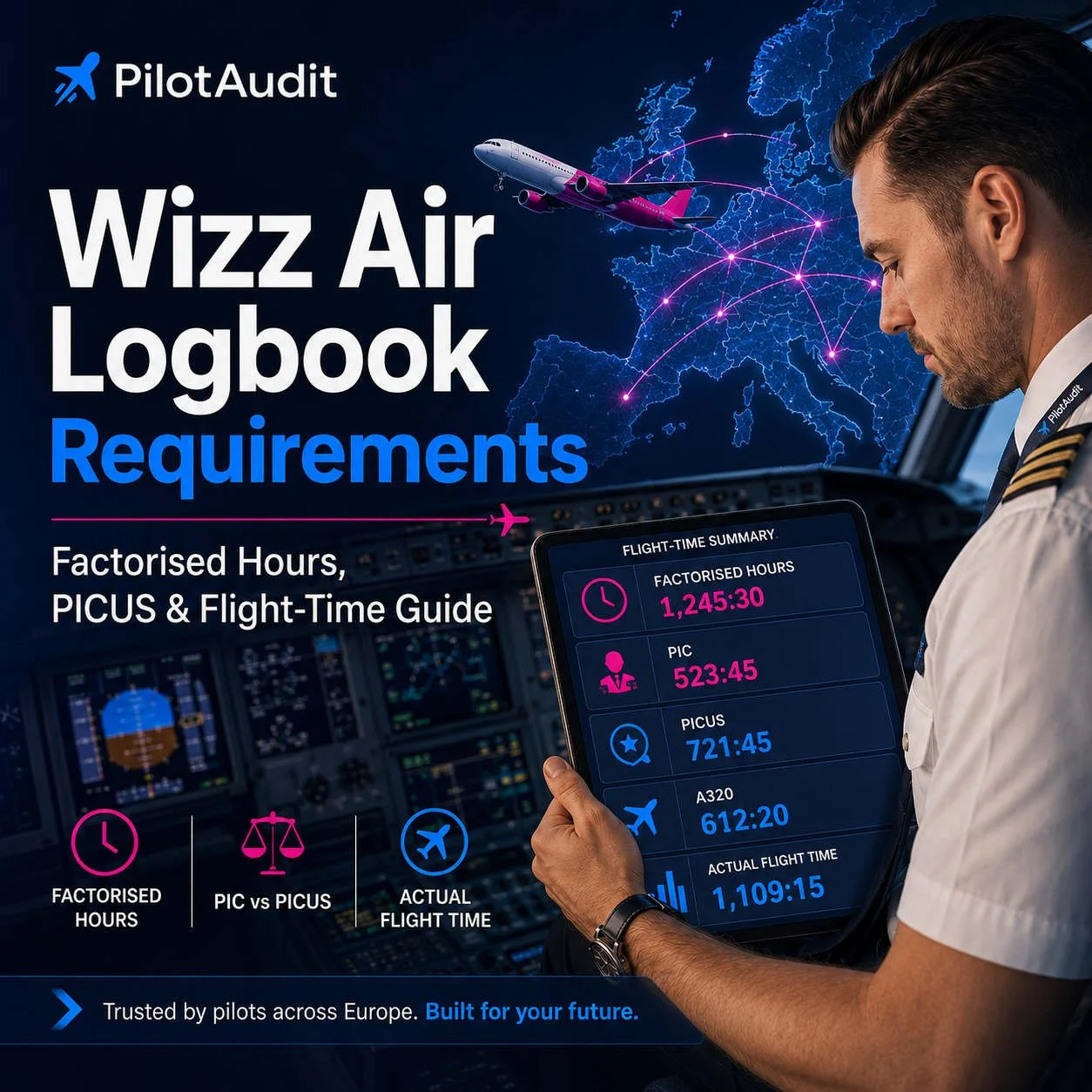
How to prepare your pilot logbook for a Wizz Air application, understand factorised hours, separate PIC from PICUS and make sure your flight-time figures are ready for the Pilot Scoring Form.
If you are preparing an application to Wizz Air, your logbook matters before you reach the assessment.
Wizz Air’s current Pilot Application Form tells applicants to have their pilot logbook prepared so they are able to enter their previous experience. After the initial application, candidates receive a link to the Pilot Scoring Form, and Wizz states that every mandatory field must be completed before the form can be submitted.
For an experienced pilot, that can involve considerably more than knowing your total flight time.
Depending on the position, Wizz Air may ask you to demonstrate actual aircraft time, PIC, time on type or experience within a particular multi-pilot environment. Commander applicants may also need to calculate factorised hours, while some current Direct Entry Captain requirements explicitly exclude PICUS from the required PIC figure. Simulator hours are also excluded from a number of Wizz Air’s published actual-flight-time requirements.
For a pilot whose career spans several operators, aircraft types or record-keeping systems, those figures may not all appear neatly on one summary page.
The purpose of this guide is to help you prepare the underlying flight-time record properly before you begin entering figures into the Wizz Air application.
Important: Wizz Air recruitment requirements can change. This guide reflects the official Wizz Air information reviewed on 21 August 2026. Always check the current Wizz Air careers information and the requirements for the particular position and AOC before submitting your application.
What Does Wizz Air Ask You to Prepare?
Wizz Air’s current Pilot Application Form asks applicants to have their CV, passport, flight crew licence, Class 1 medical and pilot logbook ready during the application process.
The instruction concerning the logbook is particularly relevant: Wizz tells applicants to have the Pilot Logbook prepared, so you are able to enter your previous experience.
That wording gives a useful indication of what matters at this stage.
On the current public application and pilot-recruitment pages reviewed for this guide, Wizz Air does not specify a particular printed-logbook format, tabbing system or binder presentation.
The immediate priority is the underlying flight-time information.
Before beginning the Pilot Scoring Form, you should be able to identify the experience Wizz Air asks you to report without having to reconstruct your flying career while completing the application.
Your logbook is the source record. The figures entered into the application should be derived from that record using the definitions relevant to the Wizz Air position for which you are applying.
Why the Wizz Air Pilot Scoring Form Makes Logbook Preparation Important
Wizz Air states that all mandatory fields in the Pilot Scoring Form must be completed before the form can be submitted.
A professional pilot may know total flight time immediately while still needing to calculate several more specific figures.
For example, you may need to establish how much previous experience belongs in Wizz Air’s short-haul jet category, how much was flown as PIC, how much falls within the application’s “Other” category, whether simulator time is contained within a type total, or how much recorded PIC represents PICUS.
The difficulty is often not the grand total itself.
It is whether the underlying experience can still be separated into the categories Wizz Air asks for.
That is why this work is best completed before the application becomes time-critical.
If your records contain several thousand hours across different operators or aircraft, calculate the relevant figures from the underlying logbook rather than relying solely on an old CV, memory or a previously completed airline application.
PilotAudit specialises in this type of flight-time reconciliation. Our Professional Pilot Logbook Audit can review customer-provided logbook totals and airline application figures, identify category discrepancies and flag entries that may need further investigation before they are submitted.
Understanding Wizz Air Factorised Hours
One of the more distinctive features of the Wizz Air pilot application is its use of factorised hours.
Wizz Air explains that factors are applied to previous pilot flying hours to determine minimum experience for Commander positions. Hours within each applicable category are multiplied by the relevant factor and the resulting figures are added together.
Factorised hours are therefore not the same as actual flight time.
They are a recruitment calculation used by Wizz Air to give different types of previous flying experience different weight when determining whether a candidate satisfies certain Commander experience requirements.
Current Wizz Air Factorised-Hours Categories
Wizz Air currently publishes the following factors.
Wizz Air experience: PIC 1.0; Other 1.0.
Airline short-haul jet: PIC 1.0; Other 0.8.
Airline long-haul jet: PIC 0.8; Other 0.7.
Airline turbine, multi-crew: PIC 0.8; Other 0.7.
Military fast jet: PIC 0.7; Other 0.7.
Non-airline MET, propeller or jet, at or above 5.7 tonnes MTOW: PIC 0.7; Other 0.5.
Multi-pilot helicopter: PIC 0.5; Other 0.5.
SEP / MEP: PIC 0.3; Other 0.3.
SET, propeller or jet: PIC 0.3; Other 0.3.
MET, propeller or jet, below 5.7 tonnes MTOW: PIC 0.3; Other 0.3.
Single-pilot helicopter: PIC 0.3; Other 0.3.
Airline cruise pilot above FL200: PIC 0.2; Other 0.2.
Wizz’s public factorised-hours table labels the second column “Other” rather than defining it more specifically on that page. If you are uncertain how a particular category of your own experience should be entered, it is better to clarify that with Wizz Pilot Recruitment than to assume what the field is intended to include.
What Do Factorised Hours Mean in Practice?
Suppose you have 2,000 actual hours that belong within Wizz Air’s Airline Short-haul Jet – Other category.
The current factor for that category is 0.8.
The calculation would therefore be:
2,000 × 0.8 = 1,600 factorised hours
You still have 2,000 hours of actual flying experience.
The 1,600-hour figure is simply the value assigned to that experience when Wizz applies its factorisation method for the relevant Commander requirement.
Do not apply one factor to your entire logbook
This is where pilots with varied flying backgrounds need to take particular care.
If your history includes an Airbus type, regional turboprop operations, business aviation, light-aircraft flying and another airline jet, those periods may belong in different Wizz Air categories and therefore receive different factors.
Separate the underlying experience first.
Then apply the appropriate factor to each category.
Do not take total flight time and multiply the entire figure by whichever factor appears closest to your current position.
If the correct category for a particular aircraft or operation is unclear, seek clarification from Wizz Pilot Recruitment rather than selecting the category that produces the most favourable result.
PIC and PICUS: An Important Wizz Air Distinction
For EASA pilots, this is one of the most important parts of the Wizz Air application to understand.
Under EASA’s current flight-time recording framework, PICUS forms part of the PIC pilot-function record. AMC1 FCL.050 lists PIC as including solo, SPIC and PICUS time.
That regulatory treatment does not mean that an airline must treat PICUS as actual command experience for recruitment purposes.
Wizz Air makes this distinction explicit within two of its current Direct Entry Captain requirements.
For the A320 Type-Rated Direct Entry Captain pathway, Wizz requires at least 1,000 hours actual flight time as PIC on Airbus A3xx full-FBW aeroplanes and specifically states that the PIC hours do not include PICUS.
The current Non-Type-Rated Direct Entry Captain requirement contains the same PICUS exclusion for its qualifying PIC minimum.
That is exactly why copying the total at the bottom of an EASA PIC column can produce the wrong figure on an airline application.
A Simple Example
Suppose your flight-time record contains:
850 hours actual PIC
and
400 hours PICUS
The EASA flight-time record may legitimately include the qualifying PICUS within the PIC pilot-function record.
But if the Wizz Air requirement asks for actual PIC and specifically states that PICUS is not included, you should not enter 1,250 hours for that particular requirement.
The application figure needs to be calculated according to Wizz Air’s definition.
The original logbook does not need to be changed.
What matters is preserving enough detail in the underlying record to distinguish actual command experience from supervised command when that distinction is requested.
If a substantial part of your historic PIC record is PICUS and the split is no longer obvious, PilotAudit’s Professional Pilot Logbook Audit can help review customer-provided PIC, PICUS and application figures and identify inconsistencies requiring further attention.
Simulator Time: Check What Is Included in the Figure
Another phrase that appears repeatedly in Wizz Air’s current experience requirements is actual flight time.
For several experienced-pilot pathways, Wizz expressly excludes simulator hours from the relevant minimum experience.
For example, the current A320 Type-Rated Experienced First Officer requirement calls for at least 500 hours on the Airbus A320, with simulator hours excluded.
The Non-Type-Rated Experienced First Officer requirement calls for at least 500 hours on a certified MPA MET aeroplane in a CAT operator environment, again with simulator hours excluded.
Wizz Air also excludes simulator hours from the applicable actual-flight-time requirements published for its Direct Entry Captain pathways.
This does not make simulator records any less important.
FSTD training and checking are a normal part of a professional pilot’s record. The point is simply that the figure supplied to Wizz must answer the question Wizz is asking.
Before using any summary figure from a paper or electronic logbook, confirm which entries are included in that total.
If the requirement says actual aircraft flight time, make sure the figure you submit reflects actual aircraft flight time.
Current Wizz Air Direct Entry Captain Requirements
Wizz Air currently publishes several pathways for experienced pilots seeking command positions.
The criteria are not identical, so it is important to establish which pathway applies to your background before calculating flight-time figures.
A320 Type-Rated Direct Entry Captain
Wizz currently publishes the following principal flight-experience criteria:
Minimum 3,500 factorised hours
Minimum 500 hours actual flight time on the Airbus A320
Minimum 1,000 hours actual flight time as PIC on Airbus A3xx full-FBW aeroplanes
The candidate must also hold the relevant current Airbus A3xx full-FBW type rating and IR.
Wizz states that simulator hours are excluded and that the required PIC hours do not include PICUS.
Non-Type-Rated Direct Entry Captain
For the current Non-Type-Rated Direct Entry Captain pathway, Wizz publishes:
Minimum 3,500 factorised hours
and
Minimum 1,000 hours flight time as PIC on a certified MPA MET jet/fan aeroplane above 50 tonnes MTOW in a public CAT operator environment, excluding business/corporate operations
A current multi-engine class or type rating combined with IR is also required.
Again, Wizz expressly excludes simulator hours and states that the required PIC figure does not include PICUS.
Direct Entry Captain Programme — Airbus FBW Experience
Wizz also currently publishes a Direct Entry Captain Programme route for pilots with Airbus full-FBW experience.
The principal experience requirements include:
Minimum 3,500 factorised hours
and
Minimum 3,000 hours actual flight time plus 100 landings on Airbus A320, A330, A340, A350 or A380 aeroplanes, which may be combined
A current Airbus A3xx full-FBW type rating and IR are also required.
Simulator hours are excluded from the stated flight-time requirement.
Direct Entry Captain Programme — Turbojet
For the current Turbojet pathway, Wizz publishes a minimum of 3,500 factorised hours and a current multi-engine class or type rating with IR.
The candidate then needs either:
1,500 hours flight time on a certified MPA MET jet/fan aeroplane above 50 tonnes MTOW in a public CAT operator environment, excluding business/corporate operations
or
500 hours flight time as PIC on a certified MPA MET jet/fan aeroplane at or above 20 tonnes MTOW in a CAT operator environment, including business/corporate operations
Simulator hours are excluded.
It is worth noting that Wizz Air does not attach the same explicit PICUS-exclusion wording to this Turbojet Programme criterion that it publishes for the two Direct Entry Captain requirements above.
Do not extend one Wizz requirement to another by assumption. If eligibility depends on how a particular period of supervised command is treated, confirm the interpretation directly with Wizz Air.
That is a good example of why it is important to work from the specific vacancy requirement, rather than applying one general rule across every Wizz Air pilot pathway.
What Experienced First Officers Should Check
Experienced First Officer applicants have a different set of figures to prepare.
For an A320 Type-Rated Experienced First Officer, Wizz currently publishes a minimum of 500 hours on the Airbus A320, with simulator hours excluded.
A current A320/IR rating is required, and pilots applying on a CPL(A) must meet the published ATPL theory requirement.
For a Non-Type-Rated Experienced First Officer, Wizz currently asks for at least 500 hours on a certified MPA MET aeroplane in a CAT operator environment, excluding simulator hours.
The current requirements also include the relevant multi-engine class/type rating and IR, ATPL theory where applicable, and JOC or APS-MCC unless the published exception applies.
The terminology matters.
If your electronic logbook contains a broad “multi-engine” total, that does not mean every hour within that figure necessarily satisfies a requirement for experience on a certified MPA MET aeroplane in a CAT operator environment.
Calculate the Wizz figure from the flights that actually meet the published definition.
Cadet-Level Pilots Still Need an Accurate Flight-Time Record
Accurate logbook preparation is not only relevant to pilots with several thousand hours.
For its current A320 Type-Rated cadet-level First Officer pathway, Wizz publishes either:
140 hours actual flight time on fixed-wing aircraft through an ATP integrated course
or
200 hours actual fixed-wing flight time through CPL/IR modular training
For these requirements, Wizz specifically excludes ultralight aircraft, power gliders, simulator and helicopter hours.
The current Non-Type-Rated cadet-level First Officer pathway uses the same 140/200-hour structure and also includes an Advanced UPRT requirement where applicable.
Wizz currently refers to the Advanced UPRT certificate and a 3-hour TTL logbook entry on certified aircraft, while also publishing an exception where the relevant previous type-rating condition has been met.
For a newly qualified commercial pilot, the arithmetic may be simpler than it is for an experienced Commander.
The principle is the same:
make sure the total you enter contains only the experience Wizz says belongs in that total.
A Structured Digital Logbook Can Make a Wizz Air Application Easier
A properly maintained electronic logbook can be particularly useful when preparing a detailed airline application.
Instead of manually working through years of handwritten entries, a structured digital record can make it possible to search, filter and calculate experience by aircraft type, date, pilot function, operator and other categories.
That can be extremely useful when Wizz asks for specific information such as actual PIC, PICUS, time on type or experience that falls within one of its factorised-hours groups.
The difficulty usually arises not because the logbook is electronic, but because some of the historical detail was never transferred into it.
Consider a pilot who accumulated 1,250 hours recorded as PIC earlier in a career.
If the pilot later moved from paper to an electronic logbook by entering only a single 1,250-hour carried-forward figure, the digital record may no longer show that 400 of those hours were PICUS.
The overall total has been preserved.
The breakdown has not.
The same can happen with aircraft types, night time, IFR, FSTD entries or other categories if only accumulated figures are transferred.
For a Wizz Air application that asks detailed questions about previous experience, preserving the individual historic flight entries gives the pilot considerably more flexibility.
Why an Individual-Entry Paper-to-Digital Conversion Can Be Valuable
Paper logbooks remain important source records.
A digital logbook provides something different: a practical way to search, organise and calculate the information contained within those records.
The two do not need to compete with one another.
Used properly, they complement one another.
If historic paper flying is transferred entry by entry, the resulting electronic record can retain considerably more detail than a handful of carried-forward totals.
A pilot may then be able to filter flying by aircraft, period, pilot function and other categories instead of manually searching several physical books each time an airline asks a new question.
PilotAudit’s Professional Paper-to-Digital Pilot Logbook Conversion converts the individual entries contained in the source logbooks into a structured digital record. Where information cannot be confidently interpreted from the source, it is flagged rather than guessed.
For a Wizz Air applicant, this can be useful when trying to calculate historic experience by type, identify PICUS or separate flying into the categories required for factorised-hours calculations.
The original paper logbooks should still be retained.
A digital conversion is best viewed as a way to make the information contained within those originals more searchable and useful, not as a reason to discard the source records.
Wizz Air Hungary, Malta or UK: Check the AOC Before You Apply
European pilots should also pay attention to which Wizz Air AOC they are applying to.
Wizz currently lists Wizz Air Hungary and Wizz Air Malta as requiring a valid EASA ATPL or CPL and a valid EASA Class 1 Medical Certificate.
Wizz Air UK, by contrast, requires the corresponding UK CAA ATPL or CPL and UK CAA Class 1 Medical Certificate.
Wizz Air also tells candidates to choose the AOC carefully before applying because the AOC cannot be changed during the application process.
For an EASA licence holder, Wizz Air Hungary and Wizz Air Malta therefore sit within the relevant EASA licensing framework, while Wizz Air UK should be treated separately.
It is a relatively small point to establish at the beginning and an unnecessary complication to discover after the application has been submitted.
How to Prepare Your Logbook Before Starting the Wizz Air Application
Do not begin by trying to produce one overall “Wizz Air figure”.
Begin with the position.
Identify whether you are applying as a cadet-level First Officer, Experienced First Officer, Direct Entry Captain or through one of Wizz Air’s Direct Entry Captain Programme pathways.
Then read the current experience criteria for that particular route carefully.
Only after you know exactly what Wizz Air is asking for should you go back to the flight-time record and calculate the figures.
For a Direct Entry Captain application, that may involve separating actual PIC from PICUS, removing simulator time, identifying time on type and splitting previous flying into Wizz Air’s factorised-hours categories.
For an Experienced First Officer, the key question may be whether the relevant 500 hours actually satisfy Wizz’s A320 or MPA MET/CAT definition.
For a cadet-level applicant, it may simply be confirming that simulator, helicopter, ultralight or power-glider time has not been included within the actual fixed-wing total.
Once those figures have been calculated, compare them with your CV and any other professional records you intend to submit.
The figures should form one coherent account of your experience.
Should You Have Your Wizz Air Application Figures Audited?
If your flying history is relatively straightforward and your records have been maintained consistently, you may be able to complete this review yourself.
For pilots with several operators, different aircraft types, PICUS, historic paper records, electronic imports or years of accumulated figures, an independent review can be useful.
PilotAudit specialises in pilot flight-time record auditing and reconciliation.
Our Professional Pilot Logbook Audit can review customer-provided flight-time totals, common experience categories and airline application figures, while flagging missing, inconsistent or unclear entries that may require the pilot’s attention.
Where something cannot be supported confidently from the records provided, it should be investigated rather than guessed.
That approach is particularly relevant to an application such as Wizz Air’s, where the question is often not merely:
“How many hours have you flown?”
but:
“How many hours have you flown that satisfy this particular definition?”
The aim is to have those questions resolved before the application or assessment becomes time-critical.
Common Wizz Air Flight-Time Mistakes to Avoid
A Wizz Air application does not require a complicated mistake to produce an incorrect figure.
A pilot may include PICUS within a Direct Entry Captain PIC figure where Wizz expressly excludes it.
Simulator time may remain inside an A320 total even though the relevant requirement specifies actual aircraft flight time.
Several years of previous airline flying may be placed within the wrong factorised-hours category.
A carried-forward PIC total may be accurate overall while no longer showing how much represents supervised command.
Or an old CV figure may simply no longer agree with the current flight-time record.
A useful final check is to take every material flight-time figure you intend to enter into the application and work backwards.
Can you identify which flights make up this figure?
Can you explain why those flights belong in that category?
Can you separate any experience Wizz specifically tells you to exclude?
If the answer to one of those questions is no, investigate the figure before submitting it.
PilotAudit and Wizz Air: An Important Independence Note
PilotAudit is an independent pilot flight-record audit and conversion service. We are not affiliated with or endorsed by Wizz Air.
Wizz Air states that its Pilot Recruitment Teams do not endorse, recommend or have affiliations with third-party pilot assessment-preparation courses, training providers or coaching services.
PilotAudit is not represented as Wizz Air assessment preparation.
Our role is different.
We specialise in helping pilots review, reconcile, organise and convert the flight-time records and customer-provided application figures for which they are responsible.
Wizz Air remains the authoritative source for Wizz Air recruitment and eligibility requirements.
Frequently Asked Questions About Wizz Air Pilot Logbook Requirements
Does Wizz Air require a pilot logbook when applying?
Wizz Air currently tells applicants to have their Pilot Logbook prepared so that they can enter their previous experience during the application process.
The current public pages reviewed for this guide do not specify a particular printed, tabbed or binder-style logbook presentation.
What is the Wizz Air Pilot Scoring Form?
Wizz Air states that applicants receive a link to the Pilot Scoring Form after applying and that every mandatory field must be completed before the form can be submitted.
For pilots with substantial experience, it is sensible to calculate the required flight-time breakdown before beginning the form.
What are Wizz Air factorised hours?
Factorised hours are used by Wizz Air when determining minimum experience for certain Commander pathways.
Previous flying is separated into Wizz Air’s published experience groups and multiplied by the applicable PIC or Other factor. The resulting figures are then added together.
Factorised hours should not be confused with actual flight time.
Does PICUS count as PIC for a Wizz Air Direct Entry Captain application?
For the current A320 Type-Rated Direct Entry Captain and Non-Type-Rated Direct Entry Captain PIC minimums, Wizz Air explicitly says no.
The published notes state that the required PIC hours do not include PICUS.
Do not assume that the same footnote applies to every other Wizz Air pathway; read the requirements for the position concerned.
Does simulator time count towards Wizz Air pilot minimums?
For several of Wizz Air’s current experienced-pilot requirements, simulator hours are expressly excluded from the relevant actual-flight-time minimums.
Always check the wording of the particular position for which you are applying.
How many hours are required for an A320 Type-Rated Experienced First Officer?
Wizz Air currently publishes a minimum of 500 hours on the Airbus A320, excluding simulator hours, for its A320 Type-Rated Experienced First Officer pathway.
How many hours are required for a Wizz Air cadet-level First Officer?
Wizz currently publishes either 140 hours actual fixed-wing flight time through ATP integrated training or 200 hours actual fixed-wing flight time through CPL/IR modular training, depending on the pathway.
Ultralight aircraft, power gliders, simulator and helicopter hours are excluded from those published totals.
Is a digital logbook useful for a Wizz Air application?
Yes.
A structured electronic logbook can make it considerably easier to search and calculate experience by aircraft type, date, pilot function and other categories.
The important point is that the underlying data is complete. If years of paper flying were previously transferred only as accumulated opening figures, some of the detail needed for a Wizz-specific calculation may no longer be present.
Should I convert my paper logbook to digital before applying to Wizz Air?
Wizz Air does not require you to convert a paper logbook simply to apply.
However, pilots with extensive paper records may find that an individual-entry digital conversion makes detailed calculations considerably easier. PilotAudit’s Professional Paper-to-Digital Pilot Logbook Conversion is designed to preserve the individual source entries in a structured digital record while the pilot retains the original paper logbooks.
Can PilotAudit review my figures before I apply to Wizz Air?
Yes.
PilotAudit’s Professional Pilot Logbook Audit can review customer-provided flight-time records and application figures for discrepancies, category inconsistencies and entries that may require further investigation.
PilotAudit does not determine Wizz Air eligibility or replace Wizz Air’s recruitment guidance. The service provides an independent review of the flight-time records you intend to rely upon.
Final Thoughts
Preparing a logbook for Wizz Air is not about making it look impressive.
It is about being able to provide the right flight-time figure for the right requirement.
Wizz Air currently asks applicants to have their pilot logbook prepared so previous experience can be entered during the application process. Its Pilot Scoring Form requires the mandatory fields to be completed, and its published pilot requirements contain specific definitions around factorised hours, actual flight time, aircraft categories and, in certain Direct Entry Captain pathways, PIC excluding PICUS.
That makes traceability far more useful than a single grand total.
Before applying, identify the Wizz Air pathway and AOC relevant to you. Read the current criteria carefully. Separate actual PIC from PICUS where Wizz requires it. Keep FSTD experience distinct from actual aircraft flight time. Apply the factorised-hours categories to the correct underlying experience, and make sure every material figure can be traced back to your records.
A structured digital logbook can make that process considerably easier, particularly when the individual historic entries have been preserved. Paper logbooks remain valuable source records; a well-constructed digital record makes the information within them easier to search, calculate and maintain.
Where the flying history has become too extensive or complex to review confidently, PilotAudit can provide an independent second review through its Professional Pilot Logbook Audit, while pilots with historic handwritten records can use the Professional Paper-to-Digital Pilot Logbook Conversion to create a structured digital record from the individual source entries.
When the application opens, you should already know the figures you intend to present, where they came from and how they are supported by your logbook.
Primary Sources
This guide is based principally on Wizz Air’s current official pilot-recruitment material, including its Pilot Application Form, Pilot Scoring Form instructions, published factorised-hours categories, and current Flight Experience Requirements for Direct Entry Captains, Direct Entry Captain Programme candidates, Experienced First Officers and cadet-level First Officers.
The discussion of EASA PICUS recording is based on the current AMC1 FCL.050 — Recording of flight time published by EASA.
Wizz Air recruitment requirements may change. Always check the current official Wizz Air careers information before submitting an application.
