Emirates Pilot Logbook Requirements: What to Fix Before Your Assessment
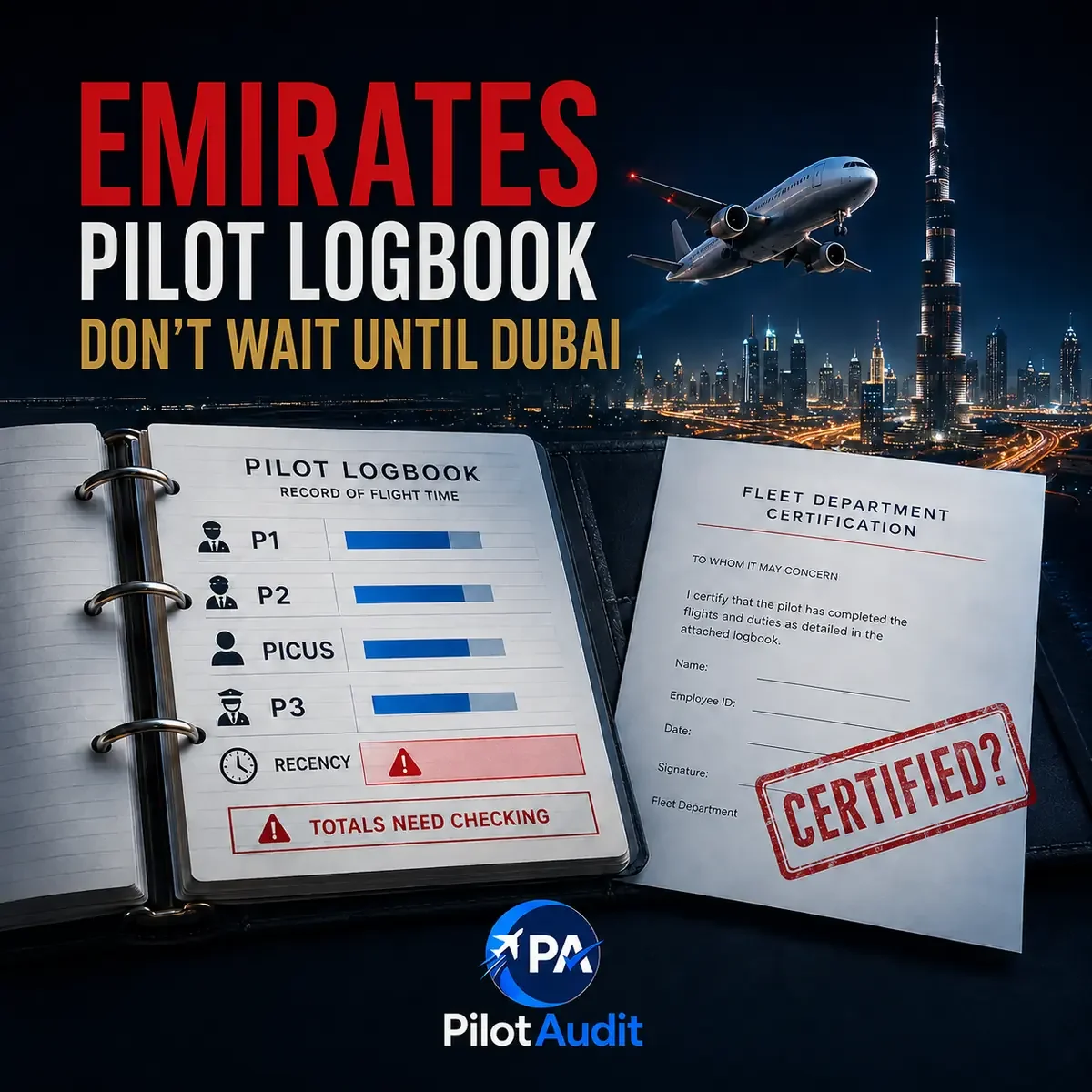
By PilotAudit — a pilot-owned specialist in professional logbook audits and paper-to-digital logbook conversion.
You can practise a simulator profile again. You cannot usually reconstruct a ten-year gap in flight records the night before an assessment.
Preparing for an Emirates pilot assessment normally means concentrating on the HireVue interview, psychometric and abstract-reasoning tests, the live digital panel interview, Advanced Compass and the simulator. There is another requirement that deserves attention well before the flight to Dubai: your logbook.
Emirates has announced substantial pilot recruitment. In May 2025, the airline committed to hiring 1,500 pilots over the following two years as part of its growth programme. Candidates invited to assessment still need to show that the experience behind their applications is properly documented.
The Emirates pilot logbook requirements start with one explicit instruction: pilots invited for assessment must provide complete, certified logbook records. That is more than a request to arrive with a tidy printout. You should be ready to support the flying hours declared in your application with records that are complete, traceable and certified through one of the routes Emirates accepts.
This is not an administrative task to leave until the final week. If your career spans several operators, authorities, paper logbooks or electronic systems, obtaining certification and reconciling the figures can take time.
Emirates logbook requirements at a glance
Certified records are required when you are invited for assessment. Emirates says pilots must provide complete certified logbook records at that stage.
The public FAQ lists two certification routes. These are a logbook stamp from a fleet manager or chief pilot verifying the hours flown, or a stamped original letter from the airline's fleet department or the relevant authority.
Emirates does not publish a universal letter template, discrepancy tolerance or line-by-line review method. Treat claims about those details as unverified unless they appear in your own Emirates correspondence.
The headline total is only part of the calculation. Depending on the pathway, aircraft type, fly-by-wire experience, pilot-in-command capacity, maximum take-off weight, recency and P3 exclusions may matter.
The live vacancy and your invitation control. Use this guide to prepare the record, then follow the current vacancy and every document instruction Emirates sends you.
If any one of those points is unresolved, start before the invitation arrives. Records from former operators and properly stamped letters are rarely the sort of paperwork that can be obtained on demand.
How strict is the Emirates pilot logbook review during assessment?
The documentation requirement is explicit. The current Emirates pilot recruitment information says complete certified logbook records must be provided when a pilot is invited for assessment. Failing to provide them would not meet the published requirement.
One terminology point matters here: Emirates distinguishes the remote interview stage from the two-day Dubai assessment. Its public logbook FAQ ties the certified-record requirement to being invited for assessment; it does not say that certified records must be submitted with the initial application. If your own recruitment correspondence requests them earlier, follow that instruction.
What Emirates does not publish is a universal review procedure. The airline does not publicly describe the check as a line-by-line audit or state a tolerance for discrepancies. It would therefore be inaccurate to claim that every candidate's logbook is examined in precisely the same way.
The requirement itself is clear, however: a candidate should be prepared to support the flying experience declared in the application. A polished CV or a neatly formatted total-time page cannot replace the underlying records and certification.
The sensible approach is simple: assume that any material figure used to establish your eligibility may need to be explained and supported.
What does “complete certified logbook records” mean?
There are two separate parts to the Emirates wording, and both matter.
Complete records
Emirates does not provide a public page-by-page definition of “complete”. In practical terms, your records should cover the flying experience on which your application relies. A pilot whose history is split between early paper logbooks, later electronic entries and operator-issued flight-time statements should be able to show how those records connect.
Look closely at:
missing periods between logbooks or employers;
unexplained differences between paper and electronic totals;
carry-forward figures that cannot be traced to the preceding record;
operator time that appears in the application but not in the personal logbook; and
command, co-pilot, supervised-command and relief time combined into a single figure without a clear breakdown.
The aim is not to make every logbook look identical. Pilots apply from many different licensing systems, and their records will use different layouts and terminology. The aim is to make the history traceable.
Certified records
Emirates gives two accepted certification routes on its recruitment page:
a stamp in the logbook from a fleet manager or chief pilot verifying the hours flown; or
a stamped original letter from the fleet department of the airline or from the relevant authority.
This is an important distinction. A pilot's own signature, an automatically generated “certified” PDF, or an ordinary notarisation is not among the alternatives listed in the public Emirates requirement.
If your employer or authority cannot provide certification in one of the stated forms, do not invent a substitute and hope it will be accepted. Use the contact details in your assessment correspondence and ask Emirates Pilot Recruitment what it will accept for your circumstances.
Why you should start before receiving the Dubai invitation
The current Emirates selection process begins remotely with a HireVue interview, psychometric and abstract-reasoning testing, and a live digital panel interview. Successful candidates then attend a two-day assessment in Dubai involving simulator assessments, Advanced Compass and the Emirates medical assessment.
Emirates says certified logbooks are required when a candidate is invited for assessment. It does not say that a pilot may wait until after selection to resolve missing evidence.
That timing matters. A current fleet department may respond quickly; a former operator, training organisation or national authority may not. Records from an airline that has merged, closed or changed systems can take considerably longer to trace. Starting early gives you time to identify the gap, request the correct document and ask Emirates for guidance if the standard route is not available.
Your logbook can affect more than the headline total
Emirates recruits pilots through different pathways, and the published criteria do not rely on total flying time alone. Aircraft type, aircraft weight, operating capacity, recency and P3 time can all become relevant.
As of 24 August 2026, the public Emirates role pages state the following headline criteria.
First Officer
Headline flying time: 2,000+ hours total
Aircraft or operating experience: Current Boeing or Airbus fly-by-wire experience
Recency: 150 hours on type in the past 12 months
English proficiency: ELP 4+
Accelerated Command
Headline flying time: 5,000+ hours total
Aircraft or operating experience: Pilot in command on Airbus fly-by-wire or Boeing aircraft
Recency: 150 hours on type in the past 12 months
English proficiency: ELP 5+
Direct Entry Captain
Headline flying time: 7,000+ hours total
Aircraft or operating experience: Pilot in command on Airbus aircraft
Recency: 150 hours on type in the past 12 months
English proficiency: ELP 5+
The enhanced First Officer package has additional qualifying-hour conditions discussed below; it should not be reduced to the 2,000-hour headline.
Emirates First Officer
The role page provides headline criteria, not every condition that may appear in a live vacancy. Check the vacancy before deciding that a broad 2,000-hour total establishes eligibility.
The Emirates First Officer overview lists:
at least 2,000 hours total flying time;
current Boeing or Airbus fly-by-wire experience;
at least 150 hours on type during the previous 12 months;
a valid ICAO ATPL with an unrestricted Class 1 medical; and
ICAO English Language Proficiency Level 4 or higher.
Emirates also publishes separate flying-hour criteria for its enhanced First Officer package. At the time of assessment, a pilot must have at least 4,000 hours on jets above 20 tonnes, excluding P3 and rotary time, plus at least 2,000 hours on fixed-wing, multi-crew commercial jets above 50 tonnes. ELP Level 5 or higher is also required.
That exclusion can be material. For example, a pilot may show 4,150 jet hours in a broad personal total, but if 300 hours are P3, only 3,850 remain within the published above-20-tonne threshold—assuming the remaining hours otherwise qualify. The headline total looks sufficient; the qualifying total does not.
Emirates Accelerated Command
The Accelerated Command overview currently lists:
at least 5,000 hours total flying time;
pilot-in-command experience on Airbus fly-by-wire or Boeing aircraft;
at least 150 hours on type during the previous 12 months;
a valid ICAO ATPL with an unrestricted Class 1 medical; and
ELP Level 5 or higher.
For this pathway, a broad “PIC” total is not enough if the underlying records do not show which portion was actual command on the relevant aircraft.
Emirates Direct Entry Captain
The current Direct Entry Captain overview is framed around Airbus command experience and lists:
at least 7,000 hours total flying time;
pilot-in-command experience on Airbus aircraft;
at least 150 hours on type during the previous 12 months;
a valid ICAO ATPL with an unrestricted Class 1 medical; and
ELP Level 5 or higher.
These public role pages are useful starting points, but individual vacancies and assessment invitations may contain more detailed conditions. Always follow the live vacancy and the instructions Emirates sends to you.
P1, P2, PICUS and P3: keep unlike categories separate
A pilot applying with records maintained under EASA, the UK CAA, the UAE GCAA, India's DGCA, CASA, TCCA, SACAA, the FAA or another framework may arrive with different terminology in the logbook. Common descriptions include:
P1 or PIC;
P2 or co-pilot, with SIC used in some systems;
PICUS or P1 under supervision, sometimes shown as P1 U/S;
P3, where used, and operator-specific relief-pilot categories such as cruise-relief co-pilot; and
instruction, examiner and FSTD or simulator time.
Those labels are not interchangeable merely because two columns were accumulated on the same aircraft type. Your licensing authority, operator and Emirates application may each ask a different question. For example, current EASA FCL.050 guidance records PIC, PICUS, co-pilot and FSTD details separately and says a cruise-relief co-pilot may log co-pilot time while occupying a pilot's seat.
Emirates uses the label P3 in the enhanced First Officer exclusion but does not define P3 on the public role page. Do not assume that every operator's P3, cruise-relief or relief-pilot column will be treated identically. Preserve the original category and its operator definition; EASA or another authority's logging rule does not determine how Emirates will apply its own eligibility criteria.
In particular:
Do not merge PICUS into unrestricted command time without a documented basis.
Do not include P3 in a threshold from which Emirates expressly excludes P3.
Do not combine simulator time with aircraft flying time.
Do not assume block time and actual operating-seat time answer the same question.
Do not rename an historic category simply to make it fit an application field.
Emirates does not publicly explain how every possible national or operator-specific category will be treated. Where the application or vacancy wording does not resolve the issue, preserve the original classification, prepare a separate reconciliation and ask Pilot Recruitment for a written answer.
A professional pilot logbook audit can help identify where customer-provided P1, P2, PICUS, P3 and total-time figures stop reconciling. It cannot decide how Emirates will credit a disputed category, but it can help you locate the question before the assessment rather than during it.
The five reconciliations to complete before assessment
1. Application totals against the current logbook
Compare the figures entered in the Emirates application with the exact logbook version used to calculate them. Keep a dated copy of both.
If you continue flying after submitting the application, your current total will naturally be higher. That is not the same as an unexplained discrepancy. Maintain a simple reconciliation showing:
the application total and its effective date;
flying completed since that date;
any documented corrections made after submission; and
the current total and effective date.
Where the application system permits updates, follow its instructions. If it does not, retain a clear explanation rather than trying to force the present total to match an older snapshot.
2. Personal logbook against operator records
Compare the sectors and totals in your personal record with the records available from each operator. Pay particular attention to:
joining and leaving dates;
aircraft types and variants;
operating capacity;
missing or duplicated sectors;
command-course and supervised-command periods;
relief-pilot time on augmented operations; and
the point at which one operator's certified total carries into the next record.
An employer's record and a personal logbook may be organised differently. The important point is to understand the reason for any difference and avoid presenting two unexplained totals as though they are identical.
3. Paper records against the electronic logbook
Paper-to-electronic transitions can introduce discrepancies. A carry-forward may be entered twice, a page may be omitted, or hours-and-minutes may be converted incorrectly into decimals.
Check the total at the end of every paper volume against the opening balance in the electronic system. Then verify a sample around the transition date flight by flight. If the historical entries have never been digitised, PilotAudit's paper-to-digital pilot logbook conversion can transfer the pilot-provided entries into a structured file while flagging handwriting or information that requires confirmation.
Conversion is not certification. It creates a more usable record from the source material; the pilot still needs the supporting employer or authority evidence required by Emirates.
4. Aircraft and recency totals against the role criteria
Build separate totals for the aircraft experience relevant to the vacancy rather than relying only on a lifetime summary.
Depending on the role, this may include:
total flying time;
time on Boeing or Airbus fly-by-wire aircraft;
command time on the relevant type or family;
qualifying jet time above 20 tonnes;
qualifying multi-crew commercial jet time above 50 tonnes;
P3 excluded from a stated threshold; and
hours on type during the preceding 12 months.
Record the as-of date for every recency calculation. “Past 12 months” is a moving window, so a figure prepared months before assessment may no longer be current.
5. Certification against the period it actually covers
A stamp or letter is only useful if it is clear what has been verified. Before relying on it, check that the document identifies the pilot, the organisation, the relevant period and the flying hours or accompanying record being certified.
Emirates does not publish a universal sample certification letter on its public recruitment page. Do not present an unofficial template as an Emirates form. A practical employer letter would normally make the following clear:
the pilot's full name and, where applicable, employee number;
the operator or authority issuing the confirmation;
the employment or record period covered;
the aircraft type or types involved;
the hours verified or the official record to which the letter refers;
the name and position of the authorised signatory; and
the signature, date, official stamp and contact details.
The exact wording remains a matter for the issuing organisation and Emirates. If the proposed letter does not fit the certification routes on the current Emirates page, ask Recruitment before relying on it.
Are electronic pilot logbooks accepted by Emirates?
Emirates' current public FAQ does not give separate instructions for every electronic-logbook format. It says candidates must provide complete certified logbook records.
The safe conclusion is not that electronic records are rejected. It is that using an electronic logbook does not remove the certification requirement.
Prepare a readable, current export and retain the underlying source records used to build it. If part of your history remains on paper, keep that source material available as well. Follow the precise file, print and original-document instructions in your invitation, because those instructions take priority over general online guidance.
Do not assume that a software-generated signature, locked PDF or platform verification badge is equivalent to a fleet manager, chief pilot, fleet department or authority certification. Emirates' public wording does not say that it is.
What if a logbook is missing?
A missing volume does not become more credible because it has been recreated neatly. Do not guess at flights, dates or hours and present them as original records.
Instead:
Identify the exact period and total affected.
Contact the former operator, training organisation or authority for any official flight-time statement, roster record, training record or historic licensing evidence it can provide.
Keep copies of correspondence showing the steps taken to recover the record.
Prepare a factual reconciliation explaining what is original, what is reconstructed from supporting evidence and what remains unresolved.
Contact Emirates Pilot Recruitment before assessment and ask what evidence it will accept.
The same approach applies when a former employer has closed or refuses to certify the records. Supporting material may help explain the history, but only Emirates can confirm whether an alternative satisfies its recruitment requirement.
What if the logbook contains errors or corrections?
An old correction is not automatically a problem. An unexplained change to a material total is more difficult to assess.
Keep corrections transparent and supported. Do not erase the history of a figure, overwrite an entry without a trace or move hours between categories solely to match a vacancy threshold. Where a correction affects an application total, record:
the original figure;
the corrected figure;
the reason for the change;
the source used to verify it; and
the date the correction was made.
PilotAudit's logbook audit service reviews customer-provided records for calculation issues, carry-forward discrepancies, inconsistent categories, missing information and application totals that may require the pilot's attention. We flag the question; we do not manufacture evidence or alter unsupported history.
Common Emirates logbook-preparation mistakes
The following issues can make an otherwise straightforward record difficult to explain:
using an undated total-time figure;
submitting rounded application totals with no reconciliation to the logbook;
including P3 in a threshold that expressly excludes it;
combining P1, PICUS and co-pilot time without separate subtotals;
counting the same carry-forward in both a paper and electronic record;
combining simulator time with aircraft flying time;
relying on aircraft-family totals without checking the type and weight criteria in the vacancy;
presenting a company record and personal logbook with different totals but no explanation;
assuming a neat electronic export is automatically certified; and
waiting until the assessment invitation arrives before contacting former employers.
None of these points proves that Emirates will reject a candidate. Emirates does not publish a list of automatic logbook disqualifiers. They are preparation risks because they make it harder to demonstrate that the application and supporting records describe the same flying history.
Emirates pilot assessment logbook checklist
Before travelling for assessment, work through the current instructions from Emirates and make sure you can account for:
every paper logbook covering time declared in the application;
the current export and backup of any electronic logbook;
operator-issued flight-time records available for each employment period;
the stamps or original letters used to certify the hours;
a dated copy of the totals submitted with the application;
a dated current total and a reconciliation of flying completed since application;
separate P1/PIC, P2/co-pilot, PICUS and P3 figures where applicable;
the aircraft-type, aircraft-weight and command breakdowns relevant to the vacancy;
the rolling 12-month on-type total calculated to the appropriate date;
supporting evidence for corrections, conversions or reconstructed periods; and
a concise written explanation for anything that remains unresolved.
This checklist is a preparation aid, not a replacement for the document list in an Emirates invitation. Requirements and vacancies can change, so the current Emirates instructions always take priority.
How PilotAudit helps Emirates applicants
PilotAudit is a pilot-owned specialist in reviewing, reconciling and converting flight-time records across major civil aviation authority and operator frameworks. That includes logbooks using P1/P2 terminology, PIC/SIC formats, PICUS, supervised command, relief-pilot categories, operator-issued records and mixed paper-and-electronic histories.
The review process is evidence-led: PilotAudit checks customer-provided totals and categories; compares paper, digital and airline application figures when the corresponding records are supplied; and flags missing, duplicate, inconsistent or unclear entries. Unsupported time is not guessed, silently reclassified or altered.
Our Professional Pilot Logbook Audit can compare the records a pilot provides, check totals and carry-forwards, review category splits and identify figures that do not reconcile with an airline application.
For pilots whose earlier flying remains in handwritten books, our Professional Paper to Digital Pilot Logbook Conversion creates a structured electronic record from the submitted pages and flags information that cannot be read or confirmed.
PilotAudit cannot certify hours on behalf of an employer or authority, determine whether Emirates will credit a particular category, or replace instructions from Emirates Pilot Recruitment. Our role is to help the pilot find discrepancies, unanswered questions and weak points in the record while there is still time to address them properly.
Frequently asked questions
Does Emirates require a certified pilot logbook?
Yes. Emirates currently states that candidates invited for pilot assessment must provide complete certified logbook records.
Who can certify a logbook for Emirates?
Emirates lists a fleet manager or chief pilot who stamps the logbook, or a stamped original letter from the airline's fleet department or the relevant authority.
Does Emirates conduct a line-by-line logbook review?
Emirates does not publicly describe the depth or method of every candidate's logbook check. It does, however, expressly require complete certified records, so pilots should be ready to support all material flying-hour figures declared in the application.
Can I use an electronic logbook for an Emirates pilot assessment?
The current public FAQ does not publish format-specific instructions for every electronic system. An electronic export does not remove the requirement for complete, certified records. Follow the document instructions in your invitation and ask Recruitment if your format is unclear.
When does Emirates require certified logbooks: interview or assessment?
Emirates' public FAQ says complete certified records are required when a pilot is invited for assessment. Its process page distinguishes the remote interview stage from the two-day Dubai assessment, but your own invitation controls the timing and exact document format. Prepare the records supporting all material flying hours declared in your application, together with the required certification, before that invitation creates a short deadline.
Does P3 time count towards the Emirates First Officer requirements?
It depends on the requirement being considered. Emirates expressly excludes P3 and rotary time from the published 4,000-hour above-20-tonne threshold for the enhanced First Officer package. Check the exact wording of the vacancy for every other eligibility calculation.
Does Emirates count PICUS as command time?
The public role pages do not explain how Emirates will treat every PICUS or supervised-command arrangement. Keep PICUS separate from unrestricted P1/PIC and obtain clarification from Pilot Recruitment where its treatment affects eligibility.
What should I do if my application and logbook totals differ?
Identify the effective date of the application total, add legitimate flying completed since that date and document any corrections separately. Do not conceal or force the difference. Update the application where permitted and retain a clear reconciliation.
Can PilotAudit certify my flying hours for Emirates?
No. Certification must come from one of the sources accepted by Emirates. PilotAudit can audit and reconcile the records provided by the pilot, flag discrepancies and help organise the supporting information before assessment.
Prepare the record before it becomes the question
The Emirates pilot assessment is not the ideal moment to discover that a former employer's hours were never certified, that P3 was included in the wrong subtotal or that an electronic carry-forward does not match the final paper page.
Start with the official Emirates requirements, preserve the terminology and evidence behind every category, and reconcile the figures before the invitation creates a deadline.
If you want an independent review of your current records, begin with a professional pilot logbook audit. If years of flying remain only in handwritten volumes, a paper-to-digital logbook conversion can make the record easier to search, total and compare while retaining the original source material.
