How to Log PIC, SIC, and Safety Pilot Time Correctly
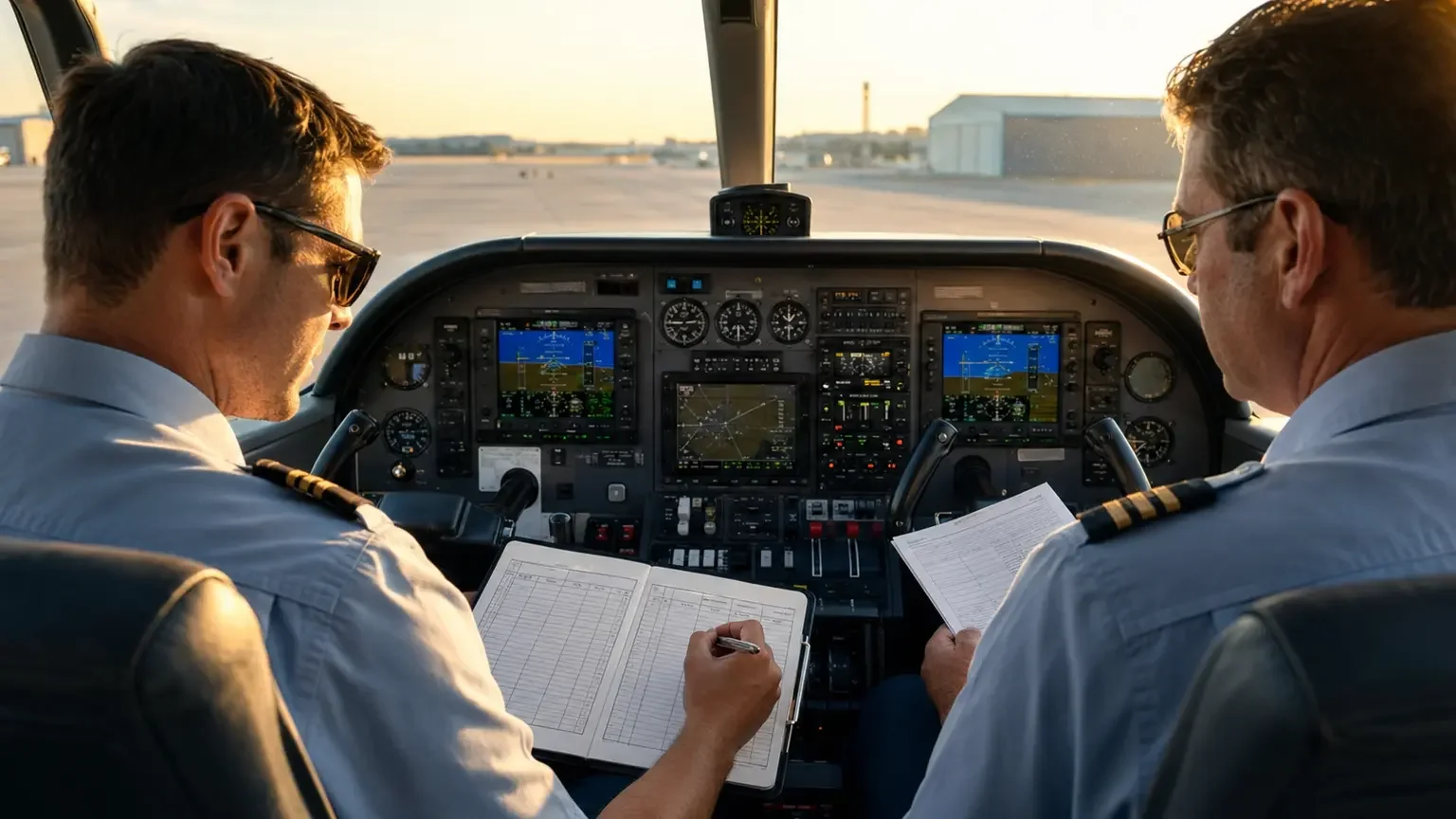
You flew 280 hours in the right seat of a King Air. Part 91, an airplane certificated for single-pilot operation, two pilots up front because the company's insurance required it. You logged all of it as SIC.
None of it is loggable SIC time.
That error doesn't surface until someone checks your application totals against your logbook, and by then the only fix is subtraction — sometimes a few hundred hours of it.
The short version: SIC time requires that a second pilot actually be required, either by the aircraft's type certificate or by the regulations governing that particular flight. An insurance policy or a company two-crew policy isn't a regulation. The full rule is below, and it has more edges than that.
Most logging errors work this way. Not fraud, not carelessness. A pilot applies a reasonable-sounding rule that isn't the actual rule, keeps applying it for years, and builds a career total on top of it. And nearly all of them trace back to a single confusion.
The distinction almost every error traces back to
There are two completely separate concepts in the regulations, and they use the same three letters.
Acting as pilot in command is a role. One person holds it, for the entire flight, and they are directly responsible for and the final authority as to the operation of that aircraft. To act as PIC you need the certificate, the ratings, a current medical, a current flight review, the recency of experience for the conditions, and every endorsement the aircraft requires — high performance, complex, tailwheel, pressurized, type rating, all of it.
Logging pilot-in-command time is a bookkeeping activity governed by 14 CFR 61.51(e). It has its own list of conditions, and that list is much shorter.
The two overlap constantly, but they are not the same thing, and the regulations never claimed they were. Once you internalize that, three quarters of the confusion evaporates.
Two consequences follow immediately, and both surprise people.
More than one pilot can log PIC for the same hour. There's only ever one acting PIC. There is no rule limiting how many pilots may log PIC, as long as each one independently satisfies a provision of 61.51(e).
The acting PIC sometimes logs nothing at all. The FAA worked this exact case in the Speranza (2009) and Walker (2011) interpretations. Two pilots, an airplane certificated for one required pilot, actual instrument conditions. The instrument-rated pilot acts as PIC and carries the responsibility and the certificate risk. The other pilot flies. The pilot flying logs PIC and actual instrument time. The acting PIC logs nothing at all. It reads backwards. It's still the rule.
61.51(c) explains why the FAA is relaxed about this: logged pilot time exists to apply for a certificate or rating, or to satisfy recency requirements. It's a record of experience gained, not a record of who was in charge.
Mistake 1: Misunderstanding what "sole manipulator" lets you log
This is the provision most pilots live under for their first thousand hours. Under 61.51(e)(1)(i), you may log PIC when you are the sole manipulator of the controls of an aircraft for which you are rated.
That phrase does a lot of work, and it's narrower than it sounds.
The FAA has defined "rated" repeatedly — in the legal interpretations to Knight (1999), Herman (2009), and Speranza (2009). It means holding the appropriate aircraft ratings: category, class, and type if a type rating is required. Those are the ratings listed in 61.5 and printed on your certificate. That's the whole test.
What "rated" does not include:
An instrument rating
A current medical certificate
A current flight review
Recency of experience
Endorsements for high performance, complex, tailwheel, or pressurized aircraft
The Herman interpretation addressed this directly. A private pilot without a high-performance or complex endorsement flies a complex airplane while a properly endorsed pilot acts as PIC. Can the unendorsed pilot log the time as sole manipulator? Yes. The endorsements govern acting, not logging.
That's the basis for PIC and dual received appearing on the same line during a checkout or transition training, which most rated pilots already understand. The parts that get missed are further down.
Autopilot counts. Per the Murphy interpretation (2015), the FAA treats a pilot's use and management of the autopilot as the equivalent of manipulating the controls.
Sole means sole. If you and another rated pilot are trading off, you each log only your portion. Splitting a two-hour flight as 2.0 and 2.0 is the single most common inflation error we see, and it's the easiest for a reviewer to spot, because the aircraft's total time doesn't move the way two logbooks say it did.
There's a second, simpler path in the same paragraph: 61.51(e)(1)(ii) lets you log PIC any time you are the sole occupant of the aircraft. No rating analysis required.
Mistake 2: CFIs logging PIC without knowing which rule they're using
Flight instructors have their own provision, and it's generous. Under 61.51(e)(3), a certificated flight instructor may log PIC for all flight time while serving as the authorized instructor — if the instructor is rated to act as pilot in command of that aircraft.
That conditional clause is where instructors get into trouble. It's not enough to hold a CFI certificate and be teaching. You have to be rated to act as PIC of the specific aircraft you're teaching in.
Note what this produces: during a dual lesson with a rated private pilot, the student logs PIC as sole manipulator, and the instructor logs PIC as the authorized instructor. Both, simultaneously, legitimately, under different paragraphs of the same regulation. If a recruiter questions a CFI-era entry, "61.51(e)(3), I was the authorized instructor and rated to act as PIC" is the complete answer.
The related error is on the student side. A student pilot may log PIC under 61.51(e)(4) only when they are the sole occupant of the aircraft, hold a solo endorsement under 61.87, and are undergoing training for a certificate or rating. Every dual lesson before your private checkride is dual received — not PIC. Pre-solo PIC entries in an early logbook are a recurring find, and they're worth correcting before someone else finds them.
Mistake 3: Logging SIC when no second pilot was required
This is the costly one, because SIC time is scrutinized harder than any other column and because the fix is usually subtraction.
Under 61.51(f), you may log second-in-command time only when one of these is true:
You're qualified under the SIC requirements of 61.55 and occupy a crewmember station in an aircraft that requires more than one pilot by its type certificate.
You hold the appropriate category, class, and instrument rating (if required for the flight), and more than one pilot is required either by the aircraft's type certificate or by the regulations under which the flight is conducted.
You serve as SIC under an approved 135.99(c) SIC professional development program.
You're designated as SIC by a government entity under the narrow conditions in 61.51(f)(4).
Read what's missing from that list: there were two of us in the airplane.
Sitting right seat in a Cessna 210 on a Part 91 flight is not SIC time. Flying right seat in a single-pilot-certified turboprop because your company's insurance requires two pilots is not SIC time — a company policy or an insurance requirement isn't "the regulations under which the flight is conducted." Riding along on a Part 91 repositioning leg in an airplane that would require two pilots under Part 135 doesn't make it SIC time either, because the operating rules for that flight didn't require a second pilot.
The regulatory requirement has to actually apply to that specific flight. Nothing else counts.
The safety pilot case, worked all the way through
Simulated instrument flight is where all of this collides, so it's worth doing carefully.
14 CFR 91.109(c) says no one may operate a civil aircraft in simulated instrument flight unless the other control seat is occupied by a safety pilot holding at least a private pilot certificate with category and class ratings appropriate to the aircraft, the safety pilot has adequate vision forward and to each side, and the aircraft has fully functioning dual controls.
In the Hicks interpretation (1993), the FAA read 91.109(c) together with 61.51(e)(1)(iii) and concluded that simulated instrument flight is an operation requiring more than one pilot. That single conclusion drives everything below.
The pilot under the hood logs PIC as sole manipulator under 61.51(e)(1)(i), assuming they're rated in the aircraft. They also log simulated instrument time.
The safety pilot has a choice, made before the flight.
If the safety pilot acts as PIC, they log PIC under 61.51(e)(1)(iii) — acting as PIC of an aircraft for which more than one pilot is required under the regulations under which the flight is conducted. They must be fully qualified to act as PIC: medical, flight review, currency, endorsements.
If the safety pilot is not acting as PIC, they log SIC under 61.51(f)(2), because they hold the appropriate ratings and the flight requires more than one pilot.
Three details that get missed.
Only the hood time counts. The safety pilot logs only the time the other pilot is actually under the hood — not taxi, not the climb out, not the VFR leg home. Logging the full block as safety pilot time is a classic overstatement.
The name goes in the logbook. 61.51(b)(1)(v) requires you to record the name of the safety pilot when one is required by 91.109. Most electronic logbooks have a field for it. Most pilots leave it blank, and it's a required entry.
BasicMed doesn't cover a non-PIC safety pilot. BasicMed applies to exercising private pilot privileges as pilot in command. A safety pilot who is acting as PIC can rely on BasicMed. A safety pilot who is a required crewmember but not acting as PIC needs at least a third-class medical. It's an odd result of how the statute was written, and it catches experienced pilots.
Quick reference
When you can log PIC:
You're the sole manipulator of an aircraft you're rated in, even if someone else is acting as PIC — 61.51(e)(1)(i)
You're the sole occupant of the aircraft — 61.51(e)(1)(ii)
You're acting as PIC where two pilots are required by type certificate or by regulation — 61.51(e)(1)(iii)
You're a CFI instructing, and rated to act as PIC of that aircraft — all of it, under 61.51(e)(3)
You're a student pilot flying solo with the required endorsement — 61.51(e)(4)
You're the safety pilot and acting as PIC — hood time only, under 61.51(e)(1)(iii)
When you can log SIC:
You're qualified under 61.55 and the aircraft requires two pilots by type certificate — 61.51(f)(1)
You hold the required ratings and two pilots are required by type certificate or by the operating rules — 61.51(f)(2)
You're the safety pilot and not acting as PIC — hood time only, under 61.51(f)(2)
You're in an approved 135.99(c) SIC professional development program — 61.51(f)(3)
When you log neither:
You're a student pilot on a dual lesson. That's dual received, not PIC.
You're in the right seat and no regulation required a second pilot on that flight.
You're the acting PIC but someone else is flying and no provision of 61.51(e) applies to you.
You're the safety pilot during the portion of the flight when nobody is under the hood.
Why this matters more than it used to
Airline recruiters don't audit your logbook to catch you cheating. They audit it because the totals on your application have to be defensible, and because a pilot who can explain their own records is telling them something useful about how that pilot handles documentation generally.
What creates problems is rarely dishonesty. It's a pilot who logged something a certain way at 200 hours because that's how the flight school did it, never revisited the decision, and now has 1,400 hours built on an assumption they can't articulate. The entries may be defensible. The pilot just can't defend them under pressure — and when the answer is "I'm not sure, that's just how I've always done it," the reviewer starts checking other things.
The other half of the problem is arithmetic. Column totals that don't carry forward correctly, a page that doesn't sum, a transcription error from a paper book into an electronic one. None of it is misconduct. All of it looks like a red flag when someone is verifying your numbers against your application.
If you're heading into an application cycle and you're not certain your PIC and SIC columns hold up, a professional logbook audit reviews your times, totals, and categories and gives you a clear summary of anything that needs your attention — before a recruiter is the one asking. If your early hours are still in paper books, our paper-to-digital conversion and audit handles both at once, which is usually where the carried-forward errors surface.
And when you do get the call, the Interview Logbook Prep Package formats your records into a clean printed binder that a recruiter can review quickly — organized, tabbed, and easy to follow.
Every service is built on the records you provide. The goal is simple: no surprises on the day it counts.
This article explains the current text of 14 CFR 61.51 and 91.109 along with published FAA Chief Counsel legal interpretations, and is provided for general information. It is not legal advice, and it isn't a substitute for the regulations themselves or guidance from your instructor, chief pilot, or aviation attorney. Regulations and interpretations change — verify against the current eCFR before relying on any of it.
Verified against the eCFR as of July 2026.
