How to Prepare Your Pilot Logbook for an Airline Interview
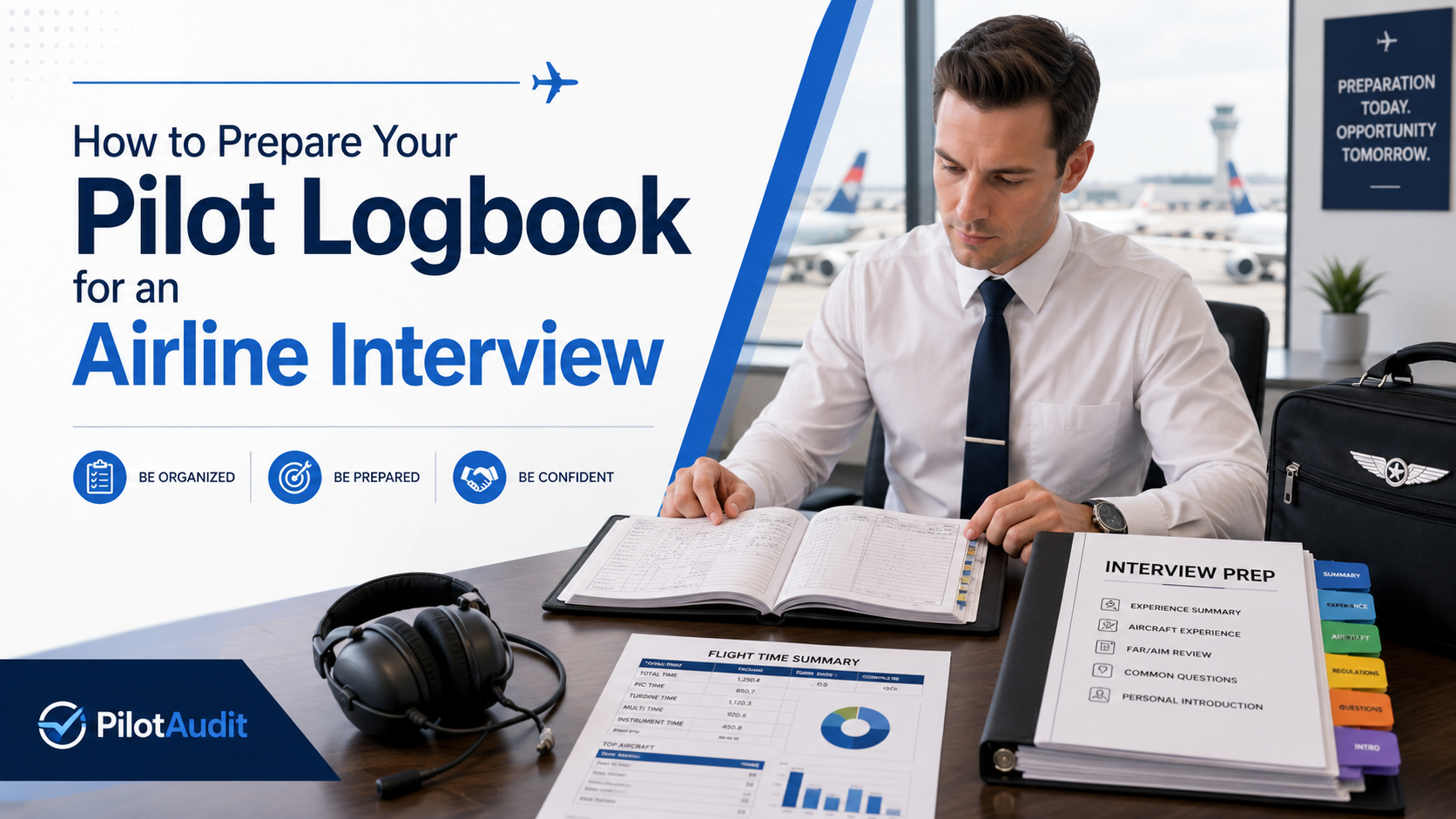
You've built the hours. You've passed the checkrides. Now you have the interview. And somewhere in that interview, a chief pilot or recruiter is going to open your logbook and start reading.
Here's what surprises a lot of pilots: that review has very little to do with how well you fly. Your certificates already prove that. The logbook review is about something else entirely — whether your records are accurate, consistent, and easy to follow. A strong pilot with a messy, contradictory logbook can walk out having created doubt that had nothing to do with stick-and-rudder skill. A well-prepared one hands the book across the table, watches the interviewer flip through it for a few minutes, and moves on without a single question.
This guide walks you through exactly how to get there: what airlines actually check, how to verify your numbers, the mistakes that quietly cost candidates, and how to present a logbook you can hand over with confidence.
Why Your Logbook Matters So Much in the Interview
Your logbook is a legal record of your flight experience, and the airline treats it that way. Recruiters review hundreds of them, and they have a clear mental model of what a professional record looks like before it ever reaches the table. When yours is clean, it signals discipline, attention to detail, and respect for the profession — the same traits that keep an airplane safe. When it's hard to follow, it raises a quieter, more dangerous question: if this pilot is careless with their records, where else are they careless?
That's the real stakes. The logbook review isn't just a numbers check. It's a character check disguised as a numbers check.
What Recruiters Actually Check
Reviewers rarely read your logbook flight by flight. They scan for a defined set of figures, confirm those figures are internally consistent, and verify that your recent flying is current. Knowing what they look for lets you prepare the right things instead of obsessing over the wrong ones.
The numbers most commonly reviewed include:
Total flight time — your headline number, and the one every other figure has to reconcile with.
PIC and SIC time — how your total splits between pilot-in-command and second-in-command. The split often matters more than the grand total, because it tells the airline what kind of experience you actually hold.
Cross-country time — relevant to ATP and many position minimums.
Night time — checked against recency and certificate requirements.
Instrument time — actual and simulated, logged separately.
Turbine, multi-engine, and high-performance time — the "quality" hours that distinguish candidates.
Recency — separate from career totals. A large logbook with no recent activity reads very differently from one showing current, continuous flying.
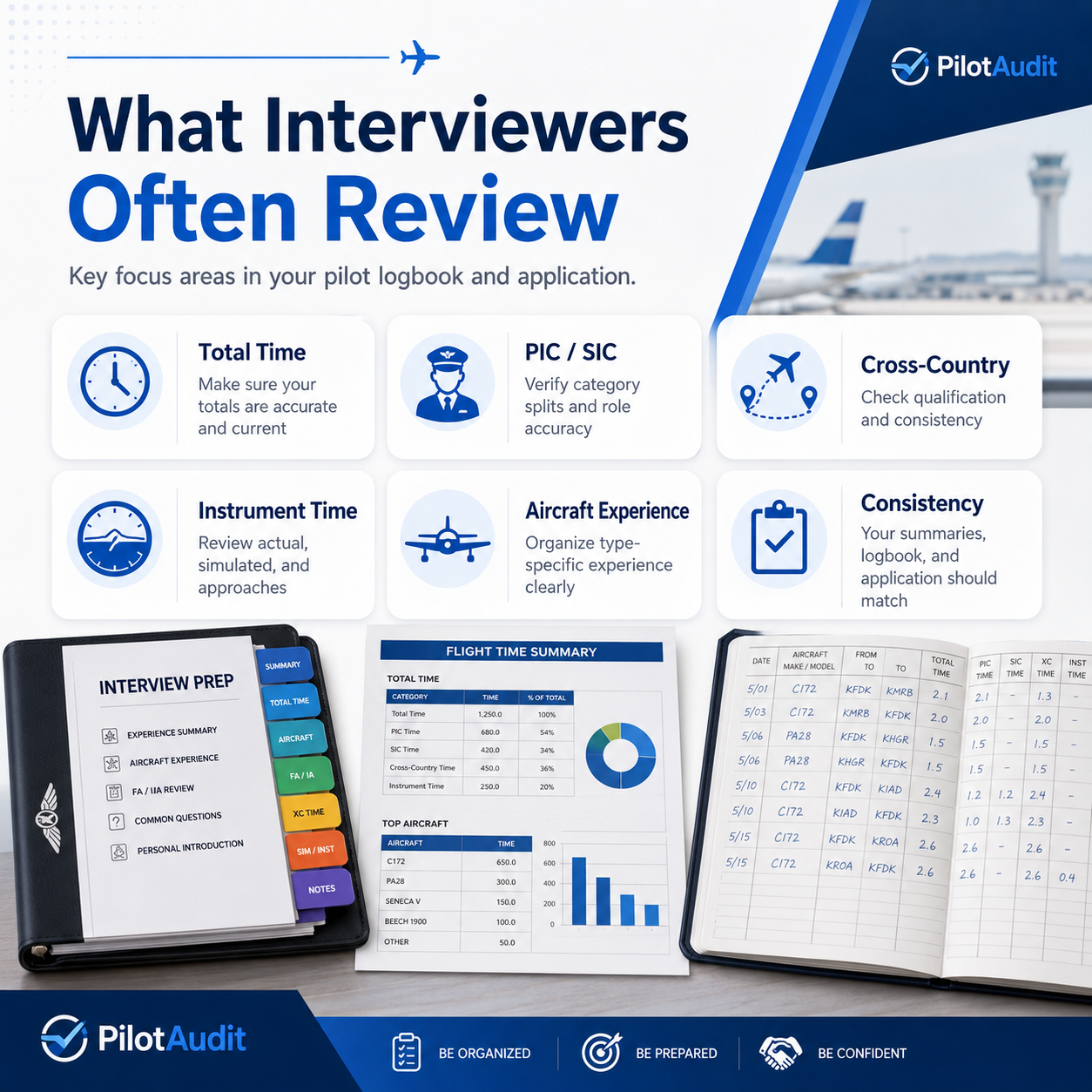
Two things are worth holding onto here. First, the splits matter as much as the total — a clean total time with no clear PIC/SIC breakdown still leaves the most important question unanswered. Second, recency is judged on its own. Build your preparation around making both your totals and your recent activity easy to verify at a glance.
Step 1: Verify Every Total
Before anything else, add it all up again. Yes, all of it.
This is the single highest-value thing you can do, and it's the step pilots most often skip because it's tedious. Reviewers have found career totals off by significant margins — in some documented cases, totals differed by as much as 20 hours between an old logbook and a new one, simply from a carry-forward error that compounded over time. An interviewer who finds that discrepancy before you do has just found a reason to wonder what else is wrong.
Work through it methodically:
Total every column on every page, even pages where you logged no new time in a given category. Use a zero where there's no entry rather than leaving it blank, and carry the running total forward to the next page.
Check your carry-forward totals between logbooks. If you're on your third or fourth book, the most common error is a number that got transposed or mis-added when you started a new one. Trace each book's ending total to the next book's opening total.
Reconcile your splits. Single-engine plus multi-engine should equal your total. Day plus night should reconcile. PIC plus SIC plus dual/student time should make sense against the total. When these don't tie out, an interviewer notices immediately.
Confirm your numbers match your application. The figures in your logbook need to agree with what you submitted through the airline's application system. A mismatch between the two is one of the fastest ways to derail an otherwise strong candidacy.
If you keep a digital logbook, the software totals for you — but that does not mean the entries underneath are correct. Garbage in, garbage out. Spot-check the entries that feed your most important totals.
Step 2: Fix the Common Mistakes Before They're Found
Certain errors come up again and again in recruiter feedback. Hunt for these specifically:
PIC/SIC logged incorrectly. Logging governed by FAR 61.51 is precise about who may log what. Only the person acting as pilot-in-command — responsible for the aircraft and the flight — logs PIC in that capacity. Safety-pilot situations and sole-manipulator time trip up a lot of records. Make sure your designations are defensible.
Missing instructor signatures and endorsements. Endorsements have specific required wording under AC 61-65H, and interviewers do check the endorsement pages. Missing signatures from training are a frequent flag, so identify any gaps early — some can still be fixed.
Incorrect airport identifiers and route entries. Small, but they read as sloppiness when an interviewer spots one.
Military time-conversion errors. A common source of inaccurate totals for pilots converting records.
Illegible entries. If a reviewer can't read it, they can't verify it, and an unverifiable logbook stalls the review. Legibility is non-negotiable.
"Pencil-whipped" or padded-looking time. Estimating or rounding up hours is the cardinal sin. Recruiters have seen everything, and inflated time can end a candidacy on the spot. Accuracy beats impressive numbers every time.
A note on checkride failures and corrections: transparency wins. If you have a disapproval in your record or made a legitimate correction to your hours, don't bury it. Recruiters value honesty far more than a spotless-looking record, and a candidate who can calmly explain a correction reads as professional, not problematic.
Step 3: Organize for Fast Review
Once your numbers are clean, make them easy to find. The goal is a logbook a busy interviewer can navigate in seconds without asking you where anything is.
A few principles:
Group experience logically so categories like PIC, SIC, cross-country, night, and instrument are easy to assess.
Add a one-page summary of total hours, time by category, and aircraft types up front. Many interviewers go to this first, and a clean summary sets the tone for everything that follows.
Tab the milestones. Colored tabs marking your first entry, certificates and ratings, checkride dates, your 1,500-hour ATP milestone, and current flying let an interviewer jump straight to what they're checking. This is the difference between a confident review and an awkward few minutes of flipping pages.
Keep endorsements and certificates together in their own tabbed section with copies of the supporting documents.
This organization is exactly what a professional interview binder is built to do — clean printed pages, a summary up front, and custom tabs so nothing has to be hunted for.
Step 4: Print It Properly
Even if you fly entirely on a digital logbook, bring an organized printout. Airlines expect a hard copy, and a polished one signals professionalism while serving as a backup if a device fails. But not all printouts are equal.
When you export and print:
Use a recognized layout with proper columns and, critically, page totals and carry-forward totals. Some airlines require this explicitly — American Airlines, for example, expects page-total and carry-forward formatting, which means certain "continuous" digital export styles are a poor fit for that interview. Check your target airline's document requirements and format accordingly.
Export to clean, high-resolution PDF in standard Letter or A4 size so text is crisp, not pixelated.
Bring both formats when you have them — your printed records and your digital logbook, plus any original paper books. Bringing everything demonstrates preparation.
Because every airline weighs these details a little differently, formatting your logbook with your specific interview in mind is one of the highest-leverage things you can do. What satisfies one carrier's reviewer can fall short for another's.
Step 5: Know Your Own Logbook Cold
Finally, be ready to talk about it. Some interviewers will ask you to speak to a specific flight, a gap in your record, or a particular milestone. Numbering your flights or keeping brief, professional remarks can help you reference specific entries. (And one piece of timeless advice: keep your remarks professional. Interviewers have a way of noticing the entry that says something you'd rather they didn't.)
If there's anything unusual in your record — a long gap, a category that looks light, a correction — have a calm, one-sentence explanation ready. You don't want to be assembling that answer for the first time across the table.
A Faster, Lower-Stress Path
Doing all of this yourself is absolutely possible. It's also hours of tedious verification, formatting, and second-guessing at exactly the moment you should be focused on interview prep, technical review, and rest.
That's the entire reason the Pilot Interview Logbook Prep Package exists. We review your digital logbook for the issues above — totals, PIC/SIC splits, consistency, unusual entries — and flag anything worth verifying before your interview. Then we format your records into a clean, tabbed binder built around the airline you're interviewing with, printed and shipped to your door.
If you fly on paper and don't need printing, the standalone Professional Pilot Logbook Audit gives you the same detailed review on its own.
Either way, you walk in with records you can hand over without a second thought.
Frequently Asked Questions
Do I need to bring a printed logbook if I use a digital one like ForeFlight or LogTen? Yes. Airlines expect a hard copy at the interview, even from digital users. Bring an organized, professionally formatted printout of your totals and detail pages, and bring your digital logbook as well. Most logbook apps can export an interview-suitable PDF, but the formatting still needs to match what your airline expects.
What's the most common logbook mistake that hurts candidates? Carry-forward and column-total errors. A number that was mis-added or transposed early on compounds over time, leaving your career total inaccurate. Re-totaling your entire logbook before the interview catches these before a recruiter does.
Should I disclose a checkride failure in my logbook? Yes. Transparency is the professional choice, and interviewers value honesty over a record that looks artificially perfect. Mark it clearly and be ready to speak to it calmly in one or two sentences.
How far in advance should I prepare my logbook? Give yourself several weeks. Verifying totals, tracking down missing signatures, and getting records professionally formatted and printed all take time, and you don't want it competing with your technical and interview prep in the final days.
Does every airline want the logbook formatted the same way? No. Document requirements and preferred formats vary by carrier — some require page totals and carry-forward totals, and some specify particular layouts. Always check your target airline's published requirements and format your records accordingly.
Can I just have someone review and format my logbook for me? Yes. A professional logbook audit checks your totals, categories, and consistency and flags anything that needs your attention, and an interview binder service formats and prints your records into a clean, tabbed presentation. It's a common choice for pilots who want an extra layer of review before a high-stakes interview.
PilotAudit reviews, organizes, and formats pilot logbook records based on the documents you provide. You remain responsible for verifying the accuracy, completeness, and legality of all entries. PilotAudit does not provide interview coaching or hiring advice and does not guarantee interview or hiring outcomes.
