Paper vs. Digital Logbook for Airline Interviews
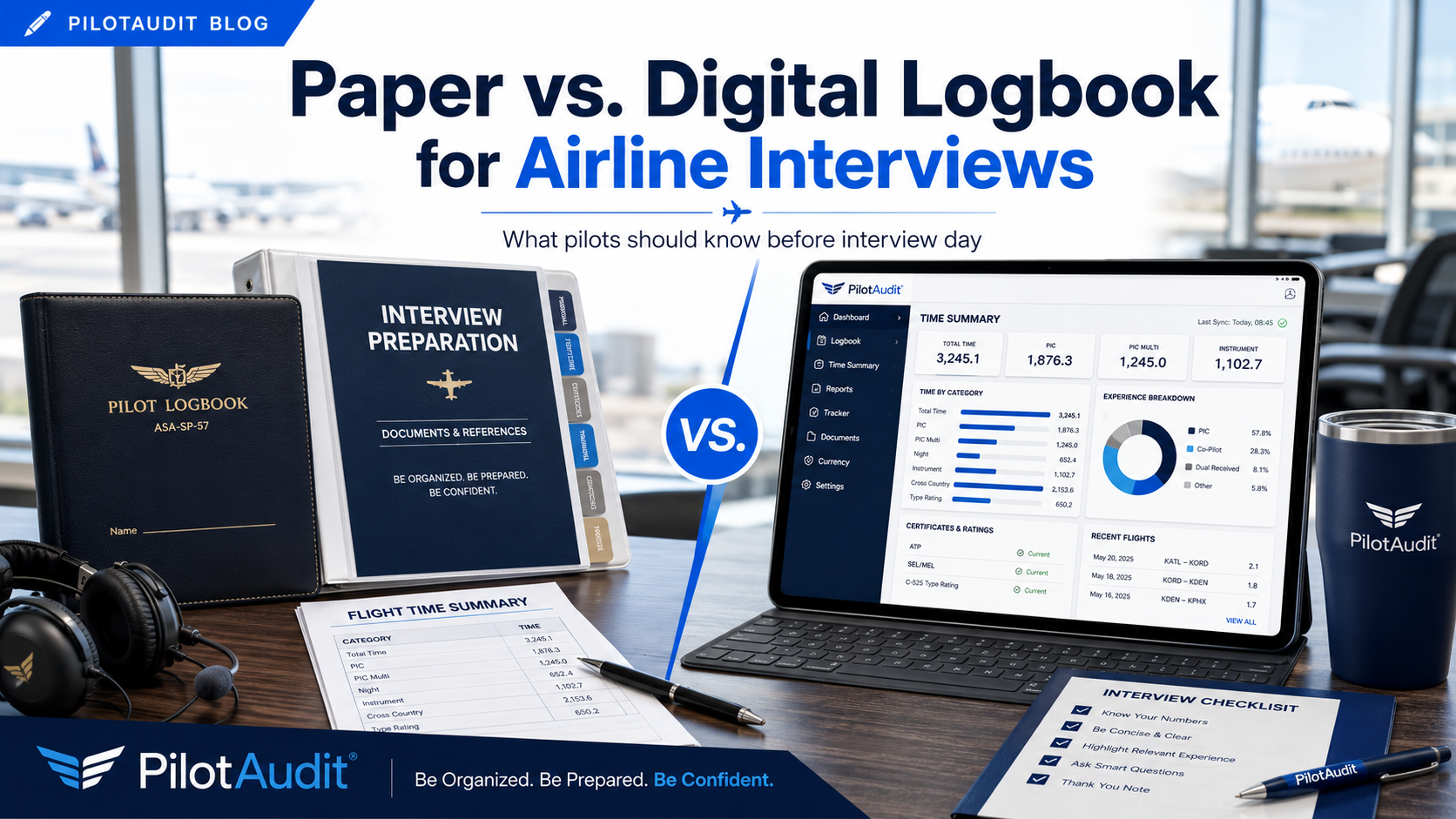
If you're preparing for an airline interview, you've probably wondered which logbook to bring: your handwritten paper books, or a printout from your digital logbook. It feels like a decision that could matter — and pilots argue about it constantly online.
Here's the truth that cuts through the noise: airlines don't care which format you use. They care whether your records are accurate, consistent, and easy to review. A spotless digital export and a clean paper book are both perfectly acceptable. A sloppy version of either is what gets you in trouble.
That said, how you handle each format for an interview makes a real difference, and the strongest candidates almost always do the same thing. This guide breaks down both formats honestly, then shows you the approach that wins.
The Short Answer
Airlines accept both paper and digital logbooks, and neither is "preferred." For an interview, the best approach is to bring both: your original paper logbooks (which hold your original endorsement signatures) and a clean, printed binder generated from your digital logbook (which is easy for a recruiter to scan). What matters most is accuracy, legible presentation, and totals that reconcile — not the format itself.
Now the detail behind that answer.
Does the FAA or the Airline Require a Specific Format?
No. The FAA's logging rules under FAR 61.51 specify what you must record — date, total time, route, aircraft type, and the conditions and categories that apply to each flight — but they don't dictate the medium. Paper, an app, a spreadsheet: all qualify as long as the record is reliable and complete. Electronic logbooks are fully legal and just as valid as paper ones.
Airlines follow the same logic. Their published document requirements tell you what to bring and how they want totals presented, but they don't reject you for choosing pen and paper or an app. What they're really evaluating is whether the person behind the logbook is careful, honest, and organized.
Paper Logbooks at the Interview
Where paper wins:
It holds your original endorsements. Your CFI's signatures for solo privileges, checkride sign-offs, and flight reviews live in your paper book. These originals carry weight, and many pilots keep their paper books specifically because they're the source of truth for endorsements.
It's universally accepted and needs no technology. Nothing to export, no app to load, no battery to die.
It reads as authentic. A well-kept paper logbook spanning years of training and flying tells a story, and some interviewers appreciate that.
Where paper struggles:
Manual math is error-prone. This is the big one. When you add columns and carry totals forward by hand across multiple books, mistakes compound. It's extremely common for pilots to discover their hand-totaled career hours are off — sometimes by a dozen or two dozen hours — from what they entered into the airline's application system. A reviewer who spots that gap before you do has just found a reason to dig deeper.
It's slow to review. A recruiter flipping through hundreds of handwritten pages takes longer to verify your totals, and "hard to follow" works against you.
It can't generate reports. No instant summary, no category breakdown, no export formatted to match an airline application.
Digital Logbooks at the Interview
Where digital wins:
The math is automatic. Totals, splits, and carry-forwards calculate themselves, which removes the single biggest source of paper errors.
It produces clean, professional printouts. A digital logbook can generate a formatted PDF and a one-page summary that a recruiter can scan in seconds.
It generates reports built for hiring. Many apps export totals in formats that line up neatly with airline application systems, and some produce FAA 8710-style reports.
It tracks currency and recency automatically, which helps you confirm you're current before you ever sit down.
Where digital struggles:
It's only as good as the data entered. The software totals flawlessly, but if entries underneath are wrong, the clean output is confidently wrong.
Endorsements need handling. Original signatures still live on paper unless you've captured them digitally (more on this below).
A bad export looks bad. Some "continuous" print layouts omit page totals and carry-forward totals — and certain airlines, American Airlines among them, expect those. The wrong export setting can produce a printout that's technically complete but formatted in a way your target airline doesn't want. Always check your airline's document requirements and format accordingly.
The Real Answer: Bring Both
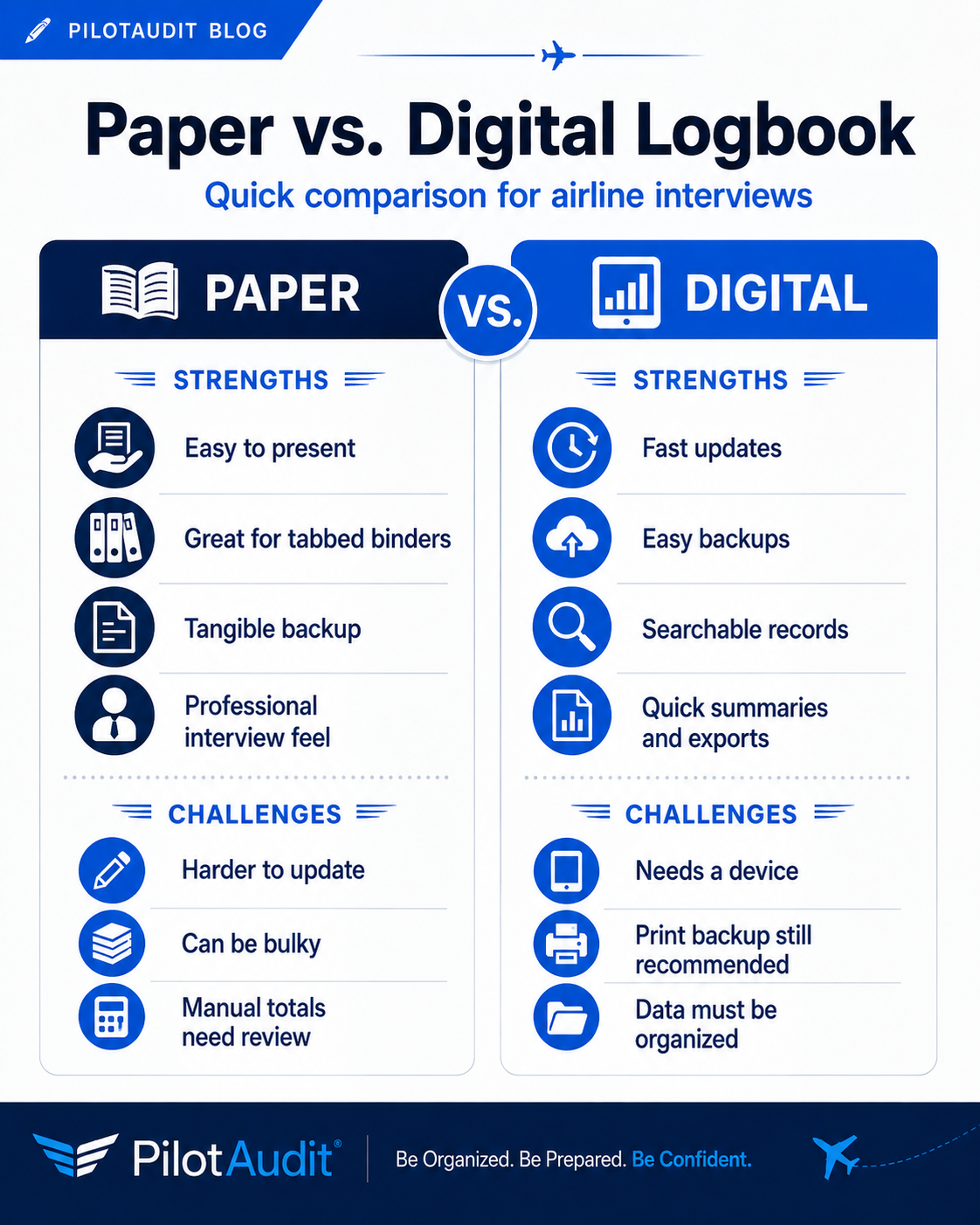
Ask pilots who've recently interviewed, and a clear consensus emerges: bring your original paper logbooks and a professionally printed binder from your digital logbook.
The paper books cover your original endorsements and serve as the source documents. The printed digital binder gives the interviewer the fast, clean, easy-to-verify presentation they actually want to flip through. Bringing both also signals something subtle but powerful — that you're thorough and prepared, which is exactly the impression the logbook review is designed to test.
This is why the format debate is mostly a distraction. The winning move isn't choosing a side. It's presenting accurate records in a clean printed binder while having your originals on hand to back them up. (For a full walkthrough of getting your records interview-ready, see our guide on how to prepare your pilot logbook for an airline interview.)
What About Endorsements?
Endorsements are the one area where paper genuinely matters, because the original signatures live there. A common, smart practice is to photograph or scan each endorsement and attach it to the corresponding entry in your digital logbook, so you're not relying on a single fragile paper book as your only proof. Some digital logbooks also support locked digital signatures, where an instructor signs on a tablet and the entry can't be altered afterward.
For the interview, keep your paper books accessible so you can show original endorsements if asked, and make sure your printed binder includes a clean, tabbed endorsements-and-certificates section.
If Your Records Are Stuck on Paper
Here's the practical problem many experienced pilots face: years of flying recorded entirely by hand, no digital version, and an interview on the calendar. You want the benefits of digital — automatic totals, a clean printout, reports that match the application — but you don't have time to re-enter thousands of entries yourself.
That's exactly what a paper-to-digital conversion solves. Converting your handwritten records into a digital logbook unlocks accurate automatic totals, professional printed reports, and an easy path to the tabbed interview binder recruiters love. PilotAudit's paper-to-digital logbook conversion service handles that transcription for you, so your years of paper records become a clean digital logbook you can verify, print, and present with confidence.
How to Print Your Digital Logbook for an Interview
If you fly on a digital logbook, the printout is what the interviewer actually sees, so get it right:
Export to a clean, high-resolution PDF so text is crisp, not pixelated.
Use Letter or A4 size in a recognizable layout with proper columns.
Make sure page totals and carry-forward totals appear — avoid "continuous" styles that drop them, especially for airlines that require them.
Lead with a one-page summary of total time, category breakdown, and aircraft types.
Tab the milestones — certificates, checkrides, your 1,500-hour ATP milestone, current flying — so a reviewer can jump straight to what they're checking.
Bind it professionally. A clean binder beats a stack of loose pages every time.
Because each airline weighs these details a little differently, formatting your printout with your specific interview in mind is one of the highest-leverage things you can do. PilotAudit's Pilot Interview Logbook Prep Package handles this end to end — reviewing your digital logbook and formatting it into a clean, tabbed binder built around the airline you're interviewing with, printed and shipped to your door.
Best Digital Logbook Apps
There's no single industry-standard app, but the names you'll hear most among career-track pilots include ForeFlight (common, since many pilots already use it for charts and planning), LogTen Pro (popular with airline pilots for its reporting and analysis), APDL (built specifically around Part 117 airline operations and duty tracking), Garmin Pilot, and ZuluLog. Most can import from one another and export interview-ready reports, so if you're starting out, pick one you'll actually keep current — consistency matters more than the brand.
The Accuracy Trap
Whichever format you choose, the most dangerous mistake is the same: totals that don't reconcile. The classic version is a pilot who hand-tallied years of paper, transposed a number somewhere, and walks into the interview with a career total that doesn't match their application. Going digital reduces this risk because the software does the math — but it doesn't eliminate it, because the entries underneath can still be wrong.
This is why a professional review before the interview is worth so much. PilotAudit's Professional Pilot Logbook Audit reviews your totals, PIC/SIC splits, categories, and overall consistency, and flags anything that needs your attention before a recruiter finds it. If you don't need a printed binder — for example, if you keep clean paper books — the audit stands on its own as a focused second set of eyes.
Don't Bring These
One quick warning: the small "trip books" or day logs that working pilots use to jot down legs and times throughout the day are not professional records and shouldn't be presented at an interview. Transcribe them into your official logbook, and bring the official record — not a pile of scratch books.
Walk In Ready
Stop agonizing over paper versus digital. For an airline interview, the answer is to bring accurate records in a clean, professional presentation — ideally your original paper books alongside a tabbed binder generated from a verified digital logbook. Format isn't what gets you hired or rejected. Accuracy, honesty, and presentation are.
If you'd rather not assemble all of that yourself in the weeks you should be spending on technical and interview prep, that's exactly what PilotAudit is built for — converting paper records to digital, auditing your logbook for accuracy, and printing a tabbed interview binder tailored to your airline.
Frequently Asked Questions
Do airlines prefer a paper or digital logbook? Neither. Airlines accept both and don't favor one format. They care about accuracy, consistency, and clean presentation. The strongest approach is to bring your original paper books along with a professionally printed binder from your digital logbook.
Are electronic pilot logbooks legal? Yes. FAR 61.51 specifies what must be recorded, not the format. Electronic logbooks are fully legal and just as valid as paper, as long as all required information is logged.
Do I need to bring my original paper logbooks if I have a digital one? Bring both when you can. Your paper books hold your original endorsement signatures and serve as source documents, while the printed digital binder gives the interviewer a fast, clean record to review.
How do I print a digital logbook for an interview? Export a high-resolution PDF in Letter or A4 size with proper columns, page totals, and carry-forward totals. Add a one-page summary up front, tab your milestones, and bind it professionally. Check your target airline's specific formatting requirements before printing.
What's the best logbook app for airline pilots? There's no single standard. ForeFlight, LogTen Pro, APDL, Garmin Pilot, and ZuluLog are all popular. Choose one you'll keep current and that exports interview-ready reports — consistency matters more than the specific app.
I only have paper logbooks. Should I convert them to digital before my interview? It's worth considering. Converting to digital gives you accurate automatic totals, professional printed reports, and an easy path to a tabbed interview binder. A paper-to-digital conversion service can transcribe your records for you if you don't have time to do it yourself.
PilotAudit reviews, organizes, formats, and converts pilot logbook records based on the documents you provide. You remain responsible for verifying the accuracy, completeness, and legality of all entries and totals. PilotAudit does not provide interview coaching or hiring advice and does not guarantee interview or hiring outcomes.
