UK CAA Pilot Logbook Rules: What Pilots Must Record
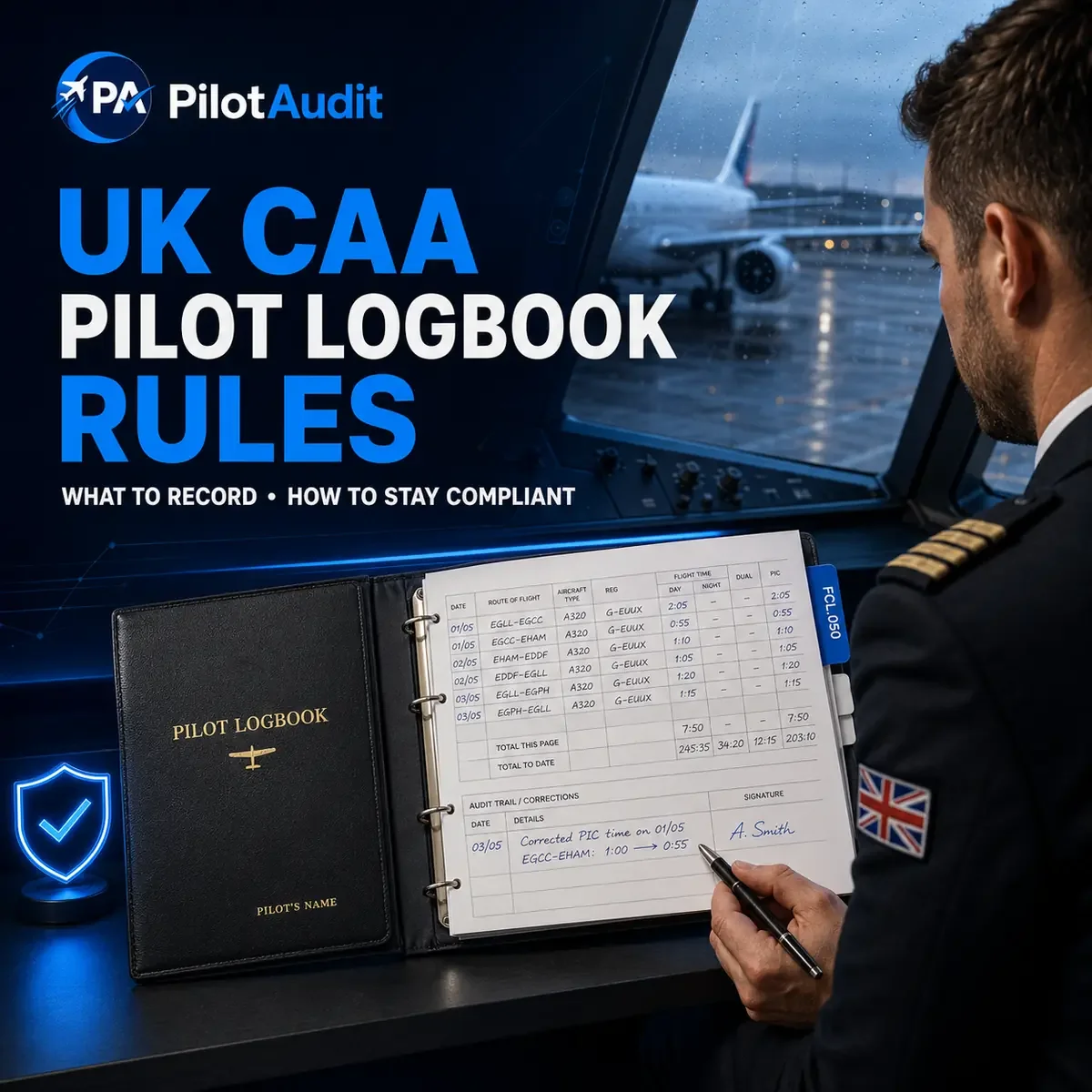
A pilot's logbook should do more than produce a grand total. It should allow an instructor, examiner, operator or CAA licensing officer to follow the experience behind that total without having to guess what happened.
For pilots operating under UK Part-FCL, the legal starting point is straightforward: these UK CAA pilot logbook rules require a reliable record that can support the experience you claim. FCL.050 requires the details of all flights flown to be kept in the form and manner established by the Civil Aviation Authority. Under FCL.045(c), a pilot or student pilot must also present the flight-time record without undue delay when an authorised representative requests it.
The short answer: A UK CAA pilot logbook needs to identify the pilot, the aircraft, the route, the times, the flight-time category, the pilot's function, the operating conditions and any required training, test or supervision certification. Paper and electronic logbooks can both work, but the record must be complete, traceable and capable of being produced in an acceptable format.
Scope. This guide is written principally for aeroplane and helicopter pilots operating under UK Part-FCL. Sailplane pilots fall under Part-SFCL, balloon pilots under Part-BFCL, and holders of national licences may have additional or different requirements. An ATO, DTO, AOC holder or prospective employer may also require more detail than the regulatory minimum.
The UK legal starting point: FCL.050
The UK left the EASA system at the end of 2020, but it did not discard the Part-FCL framework. The Aircrew Regulation was retained and amended in UK law. The CAA's UK-EU Transition Decision No. 1 preserved the EASA Acceptable Means of Compliance and Guidance Material published by exit day unless the CAA later amended or withdrew it. The CAA Aviation Regulation Library is now the practical place to check the consolidated UK regulation, AMC and guidance.
That distinction matters. A UK CAA licence and an EASA licence are no longer the same regulatory product. The familiar FCL.050 structure remains, but a UK pilot should follow current UK CAA application and certification instructions rather than assume that guidance issued by an EASA Member State automatically applies in the UK.
In practical terms, FCL.050 creates two responsibilities: record every flight reliably, and keep the record in a form that allows the required experience to be checked. A perfectly calculated total built from missing or misclassified flights is not a reliable record. Equally, a complete set of flights with broken page totals and unsupported role classifications is difficult to use when a licence, rating or airline application depends on it.
What a UK CAA pilot logbook should contain
The adopted AMC to FCL.050 sets out the information expected in the record. The screen layout of an electronic logbook does not need to look exactly like the CAA's paper book, but the underlying data and the export need to preserve the relevant fields.
Personal details: Your full name and address should identify the owner of the record. Include your licence number or CAA reference number in the logbook or its personal-details page where the format provides for it.
Date of flight: Use an unambiguous day-month-year format and keep it consistent.
Departure and arrival: Record the place and time of departure and arrival. The AMC instructions use UTC and permit recognised three- or four-letter aerodrome designators.
Aircraft details: Record the make, model and variant, together with the aircraft registration.
Single-pilot or multi-pilot operation: Where applicable, identify SP or MP and, for single-pilot time, whether it was single-engine or multi-engine.
Total flight time: Record the duration of the flight using one consistent time convention.
Name of the PIC: Enter the pilot-in-command's name, or SELF where the logbook format and circumstances make that appropriate.
Landings: Record day and night landings made as pilot flying where the format calls for them.
Operational conditions: Record night and IFR time when applicable.
Pilot function: Distinguish PIC, solo, SPIC, PICUS, co-pilot, dual, instructor and examiner time as applicable.
FSTD sessions: Keep simulator or training-device sessions separate, including the date, device type and qualification number, session time and the exercise or check performed.
Remarks and endorsements: Use this area for required signatures, skill tests, proficiency checks, training details, revalidation entries and anything needed to explain the flight.
Accumulated totals: Carry totals forward accurately and certify completed pages or exported records as required.
A useful test: Could a competent reviewer work out who flew, when and where the flight took place, which aircraft was used, how long it lasted, what your legal or training function was, and which operating conditions applied? If not, the entry probably needs attention.
How flight time is measured
For aeroplanes and touring motor gliders, flight time runs from the moment the aircraft first moves for the purpose of taking off until it finally comes to rest at the end of the flight. For helicopters, it runs from the moment the rotor blades start turning until the helicopter finally comes to rest and the rotor blades are stopped. These definitions are contained in the UK Aircrew Regulation and reflected in the FCL.050 logbook instructions.
This is why an airline's rostered sector time, duty time or airborne time should not be copied into a personal logbook without checking what the source field actually represents. In an aeroplane operation, the applicable flight-time value will often resemble block time, but the source still needs to match the regulatory definition.
Hours and minutes are not decimal hours. The AMC allows flight time to be recorded in hours and minutes or decimal notation. Either can work, but they must not be mixed carelessly. One hour 30 minutes is 1:30 in hours and minutes and 1.5 in decimal hours. A value of 1.30 decimal hours is only 1 hour 18 minutes. This conversion error can spread through hundreds of imported flights while leaving the software's arithmetic technically correct.
Paper and electronic logbooks are both acceptable
A UK pilot is not required to use one particular brand of paper logbook. The CAA still publishes the CAP 407 Personal Flying Log Book, but the controlling question is whether the record meets FCL.050 and the adopted AMC.
Paper logbooks
The AMC says entries should be made as soon as practicable after the flight. Paper entries should be made in ink or indelible pencil. Complete the personal-details page, keep handwriting legible, use one time convention throughout and certify page totals in the manner required by the format.
Electronic logbooks
Electronic records are expressly contemplated by the FCL.050 AMC. The record should remain readily available to the CAA, contain the relevant data, be certified by the pilot and be capable of being produced in an acceptable format. Commercial air transport flights may also be held in an electronic system maintained by the operator, which should make the pilot's flight records available on request.
For a CAA application, the current logbook submission guidance says an electronic logbook should be downloaded and electronically signed to show who it belongs to. If it is printed instead, one page may be hand signed, but it must include the date, the owner's full name, signature and CAA reference number. Include the cover or personal-details page if the export has one.
Do not rely on a single live copy inside an app. Keep a regular PDF export that can be read without the app, a structured data export where available, and a separate backup. If earlier flying was transcribed from paper, keep the original books and the source scans. The digital record improves access; it does not make the source evidence disposable.
Important: FCL.050 and the CAA's public submission guidance do not give UK Part-FCL pilots a general date after which old personal logbooks may safely be discarded. Because the CAA can request an original and the lost-logbook process may not recover every hour, the sensible career-long practice is to retain the originals.
How different types of flight time should be logged
Pilot-in-command time
A licence holder may log PIC time for the period during which they are the designated pilot-in-command. An instructor may log PIC while acting as an instructor in an aircraft. An examiner may log PIC when occupying a pilot seat and acting as an examiner.
Do not treat pilot flying and pilot-in-command as interchangeable. Pilot flying describes who manipulated or managed the flight on a particular sector. PIC identifies the pilot designated as being in command and responsible for the safe conduct of the flight. On a multi-pilot sector, a co-pilot may be pilot flying without becoming PIC or PICUS.
Co-pilot time
A licence holder occupying a pilot seat as co-pilot may log co-pilot time when more than one pilot is required by the aircraft's type certification, the applicable regulations or the operator's operations manual. Merely placing a second pilot in a single-pilot aircraft does not, by itself, create loggable co-pilot time. The operational and regulatory basis for the second pilot must be clear.
SPIC and PICUS
Student pilot-in-command and pilot-in-command under supervision are not informal labels for a flight that went well. They are defined forms of credited experience and require the prescribed supervision and certification. SPIC and flight time under supervision must be countersigned by the instructor. PICUS applies to a co-pilot performing the duties and functions of PIC under supervision, with the method of supervision acceptable to the authority and the PIC not needing to intervene in the interests of safety.
The AMC logbook instructions place SPIC and PICUS in the PIC column but require the applicable PIC or instructor certification in the remarks. For a UK ATPL(A) application, current CAA ATPL guidance may also require an operator PICUS letter and a flying-hours confirmation, depending on the application route. Build that evidence while the records and signatories are still accessible, rather than attempting to reconstruct it years later.
Night and IFR
Night and IFR are operating conditions, not rough descriptions. Under the UK definition of night, night runs from half an hour after sunset until half an hour before sunrise, using sunset and sunrise at surface level. IFR time is time during which the aircraft is operated under the Instrument Flight Rules; it is not simply any period in cloud or poor visibility. If a logbook app calculates night automatically, make sure its location, date, time zone and UK definition are configured correctly.
FSTD and simulator time
Record FSTD sessions separately from aircraft flight time. Include the device type and qualification number, the date, the total session time and the exercise performed, such as an LPC, OPC, rating renewal or training detail. A particular licensing rule may permit a limited amount of FSTD or instrument ground time to count towards an experience requirement, but that does not turn the session into aircraft flight time or justify merging it into the aircraft total.
Signatures and endorsements that deserve special attention
A logbook can contain all the right figures and still fail to prove the experience if the certification behind those figures is missing. Check the following before an application or assessment:
SPIC and PICUS entries carry the required name and signature or other accepted certification from the PIC or instructor.
Skill tests and proficiency checks are clearly identified in the remarks and supported by the examiner's documentation.
Instrument flight time completed as part of training for a licence or rating is identifiable.
Any flight used as part of SEP or TMG revalidation carries the required instructor details and signature.
Differences training is recorded with the features and type or class covered and is signed by the instructor. The CAA's current SEP differences-training guidance specifically requires a logbook or equivalent annotation.
Completed paper pages and electronic exports are certified in the required manner.
When several short flights may be combined
The FCL.050 AMC permits a series of flights to be entered as one line when they take place on the same day, return to the same place of departure on each occasion and the interval between successive flights does not exceed 30 minutes. This can be useful for repeated local sectors or circuit work.
Use that permission carefully. Do not combine flights if doing so hides a change of aircraft, PIC, instructor, student status, operating condition or training exercise. If an ATO's training record, an examiner's certification or an operator's source data identifies individual sectors that matter to the experience claimed, keeping those sectors separate usually produces the clearer record.
What the CAA expects when a logbook is submitted
The CAA does not publish one fixed page count for every licence or rating application. Its current guidance requires enough logbook evidence to cover the experience relevant to the application. The personal-details page must identify the owner, the copies must be legible, and the CAA retains the right to request the original logbook.
Read the page for the exact licence, rating or service before preparing the file. The evidence list can differ between an initial licence, rating issue, conversion and ATPL application.
Reconcile the logbook totals to the application form, operator hours confirmation and any PICUS letter before submission.
Include the personal-details or cover page and every relevant page needed to demonstrate the claimed experience.
For an electronic logbook, export a clear PDF and apply the signature information required by the CAA's current guidance.
Combine pages into the required file structure and keep within the portal's current upload instructions. The CAA's e-Licensing guidance says documents must be clearly legible and that pages for one document category may need to be combined into one PDF.
Keep the original paper books, source exports, training records and operator records available in case further evidence is requested.
Airline selection adds another layer. The application total, licence evidence, operator record and logbook should tell the same story even where an airline uses a different label such as commander, captain, first officer or SIC. For a UK-specific example, see our guide to British Airways pilot logbook requirements.
What to do if a logbook is lost, damaged or corrupted
This is one of the strongest reasons to keep independent backups. The CAA no longer accepts a sworn affidavit as the primary means of proving the hours required for a licensing service when a logbook has been lost, stolen, damaged or corrupted.
The published process begins by contacting the CAA in writing with the subject LOST LOGBOOK and providing the pilot's identifying details and a brief account of what happened. Loss, theft or malicious damage is expected to be reported to the police, with evidence of the incident reference. The pilot may then need a paid appointment at which the CAA determines what experience can be verified from historic applications and legitimate supporting evidence. See the CAA's current lost-logbook procedure before taking action.
Useful supporting evidence can include ATO training records, operator-issued flight records, aircraft records, previous CAA application material, contemporaneous scans and reliable electronic exports. A reconstruction should reproduce what the evidence supports. It is not an opportunity to estimate missing flights or make a balance agree by assumption.
How to correct a UK pilot logbook without weakening the record
FCL.050 does not prescribe one universal correction symbol for every paper book and electronic system. The principle to protect is reliability. A correction should make the record more transparent, not make the original value disappear without explanation.
For a paper logbook
Verify the correct value against the strongest available source before changing anything.
Put a single line through the incorrect value so that it remains readable. Avoid correction fluid, erasure or overwriting that obscures the history.
Enter the corrected information beside the entry or on the next available line, with a short note where the reason is not obvious.
Initial and date the correction. If the original item required an instructor, examiner, PIC or operator certification, obtain the appropriate correction from that person or organisation rather than self-certifying on their behalf.
Recalculate the affected page, carry-forward and subsequent total. Do not change only the final total to make the book match another record.
For an electronic logbook
Export a dated backup before making a material batch correction.
Edit the underlying flight only after checking the source record; do not force a summary total.
Use the application's notes, audit trail or version history to preserve the reason for the change where possible.
After an import or synchronisation, check for duplicates, missing sectors, changed aircraft mappings and time-format conversions before accepting the new totals.
Generate a fresh signed export and retain the prior export when the correction affects an application already submitted or a previously certified period.
Do not confuse correction with falsification: UK Part-ARA specifically identifies falsification of logbook and licence or certificate records as a basis for regulatory action. Honest, traceable corrections supported by evidence protect the record. Concealing, inventing or knowingly misclassifying time does the opposite.
Common UK pilot logbook problems
Blank personal-details page: The CAA may return a paper logbook that does not clearly identify its owner.
Local time mixed with UTC: Routes can appear impossible and night calculations can move into the wrong date.
Aircraft type or registration missing: The entry cannot be tied cleanly to the aircraft or category claimed.
Pilot flying treated as PICUS: Handling the sector is not enough; PICUS requires the defined duties, supervision and certification.
Co-pilot time in a single-pilot operation: A second person in the cockpit does not automatically establish required co-pilot time.
Unsigned SPIC or PICUS: The hours may be arithmetically present but the supporting certification is incomplete.
FSTD time included in aircraft total: Training-device credit and aircraft flight time must remain distinguishable.
HH imported as decimal: Every individual value may look plausible while the total drifts.
Carry-forward or opening-balance error: The first wrong total can contaminate every page or report after it.
Duplicate operator imports: The electronic logbook calculates accurately from the same flights entered twice.
UK CAA logbook audit checklist
The owner, address and CAA reference or licence number are identifiable.
Dates, departure and arrival places, and UTC times are complete and consistent.
Aircraft make, model, variant and registration are present.
SP/MP and SE/ME classifications match the aircraft and operation.
Total flight time follows the applicable aeroplane or helicopter definition.
PIC, co-pilot, dual, instructor, SPIC and PICUS time are classified on a defensible basis.
Night and IFR time use the correct definitions and settings.
FSTD sessions are separate and include the device and exercise details.
Required instructor, examiner, PIC and operator signatures or certifications are present.
Page totals, carry-forwards, opening balances and electronic reports reconcile.
The totals match the figures intended for the CAA, ATO, operator or airline application.
Original books, scans, PDFs and structured exports are backed up separately.
How PilotAudit helps UK pilots
For UK-based pilots, the two most relevant PilotAudit services are a professional pilot logbook audit and a paper-to-digital pilot logbook conversion.
Our audit reviews the records and supporting information a pilot provides, traces totals and carry-forwards, checks category consistency, and flags entries that may need clarification. We do not invent missing information or make legal credit decisions on the CAA's behalf. Where a point depends on an instructor, examiner, operator or the Authority, we identify it for the pilot to verify with the appropriate party.
Our conversion service transfers readable paper entries into a structured digital record using fields appropriate to the source logbook. Unclear handwriting or unsupported information is flagged rather than guessed. The pilot keeps the original paper books as source evidence while gaining a digital record that is easier to search, total, back up and use for future applications.
Pilots who also hold or are pursuing an EASA licence can read our separate EASA pilot logbook guide. The logbook structures remain familiar, but the UK CAA and EASA are separate authorities and the current submission requirements should be checked for each.
Frequently asked questions
Does the UK CAA accept electronic pilot logbooks?
Yes. Electronic records are contemplated by the FCL.050 AMC, and the CAA publishes a process for submitting electronic logbooks. The export must contain the relevant fields, identify the pilot, be signed or certified as required and be capable of being produced in an acceptable format.
Must I use a CAA CAP 407 logbook?
No specific commercial product is the whole test. CAP 407 is the CAA's personal flying logbook, but another paper or electronic format can be suitable if it preserves the information and certification required by FCL.050 and the applicable CAA process.
Can I log co-pilot time in a single-pilot aeroplane?
Not merely because two pilots were on board. Co-pilot time needs a basis in the type certification, applicable regulation or operator's operations manual. If the aircraft and operation require only one pilot, the second pilot's presence alone does not create co-pilot time.
Is pilot flying the same as PICUS?
No. Pilot flying describes the crew member operating the sector. PICUS is a defined form of supervised command experience with specific duties, supervision and certification.
Can simulator time be included in total flight time?
Keep FSTD time separate from aircraft flight time. A particular licence rule may allow a limited amount of FSTD or instrument ground time to be credited towards an experience requirement, but the session remains FSTD time and should be recorded as such.
How long should a UK pilot keep old logbooks?
FCL.050 does not set a general disposal date for a pilot's personal career record. The CAA can request original logbooks and the lost-logbook process may not verify every unsupported hour. Retaining original books and independent electronic backups for the duration of a flying career is the safer practice.
Does PICUS need to be signed?
The FCL.050 AMC requires PICUS time to be countersigned by the PIC, and the remarks instructions call for the PIC's name and signature. Current CAA ATPL processes may also require an operator PICUS letter and hours confirmation. Follow the evidence list for the exact application route.
Can I use one record for both UK CAA and EASA purposes?
A well-designed record can capture the common flight details needed by both systems. However, the UK CAA and EASA are now separate authorities, so check each authority's current rules for certification, licence credit and submission format rather than assuming one authority's guidance controls the other.
A reliable logbook is easier to defend
The best UK pilot logbooks are not the ones with the most columns or the most polished cover. They are the ones that connect every claimed total to a complete, correctly classified and properly supported set of entries.
Keep the record current, preserve the original evidence, obtain signatures while the relevant people are available, and reconcile totals before an application creates a deadline. If something is wrong, correct it transparently and from the source rather than forcing one number to agree with another. That is what turns a logbook from a private diary into a credible professional record.
Regulatory note: This article provides general records guidance and is not legal advice. The UK CAA, an authorised examiner, an ATO/DTO and the relevant operator remain the sources for decisions about a specific licence, rating, flight-time credit or application.
