Missing CFI Signatures or Endorsements in a Pilot Logbook: What to Do
You are reviewing your pilot logbook before a checkride, airline application, or interview when you find a problem: a flight marked as Dual Received has no instructor signature. A solo endorsement is missing. A flight review was completed, but the endorsement is nowhere to be found. Or an endorsement that existed in your paper logbook never made it into your digital record.
A missing CFI signature or flight instructor endorsement should not be ignored—but it also should not be “fixed” by guessing, copying an old signature, or asking a different instructor to sign for training they did not provide.
The correct response depends on exactly what is missing and what the record is being used to prove.
Quick Answer: What Should You Do About a Missing CFI Signature?
First, determine whether you are dealing with:
An unsigned training entry
A missing endorsement required for a specific privilege
A missing practical-test recommendation
A missing flight review or instrument proficiency check endorsement
A signature that exists in an original paper logbook but is missing from a digital transcription
A missing record from an old flight school or instructor
Locate the best original records available, contact the instructor who provided the training, and give that instructor enough information to verify what occurred. If the original instructor cannot be reached or cannot support the record, another instructor generally should not certify training that instructor did not provide. New training or a new evaluation may be necessary before a new endorsement can be issued.
If the missing item affects an upcoming practical test, current operating privilege, previously issued certificate, or other FAA eligibility determination, contact the appropriate designated pilot examiner or Flight Standards District Office before relying on a reconstructed record.
Most importantly, do not sign for the instructor, copy a signature from another entry, invent certificate information, or make a newly created document appear as though it was signed earlier.
A CFI Signature and an Endorsement Are Not Always the Same Thing
Pilots often use “signature” and “endorsement” interchangeably, but the distinction matters.
A signature on a training entry documents training received
Under 14 CFR §61.51(h), logged training time must be endorsed legibly by the authorized instructor. The entry must include:
A description of the training given
The length of the training lesson
The instructor’s signature
The instructor’s certificate number
The instructor’s certificate expiration date or recent-experience end date, as applicable
Section 61.189(a) separately requires a flight instructor to sign the logbook of each person to whom that instructor has provided flight or ground training.
If an entry shows Dual Received but does not include the required instructor information, it is not fully documented as training under those requirements.
That does not necessarily answer whether another flight-time category associated with the flight might independently be loggable. For example, a certificated pilot receiving instruction may sometimes qualify to log PIC under a separate provision of §61.51. Whether a flight qualifies as PIC, training received, cross-country, instrument, or another category must be evaluated independently. A missing training signature should not automatically be treated as proof that every category associated with the flight is valid—or invalid.
A separate endorsement certifies completion or grants a privilege
Other endorsements serve a different purpose. They may certify that a pilot completed a flight review, is prepared for a practical test, is proficient to operate a complex airplane, or is authorized to conduct solo flight.
The FAA’s current endorsement guidance is contained in Advisory Circular 61-65K. The FAA explains that endorsements formalize completed training, operating privileges, authorizations, and limitations.
A missing required endorsement may therefore affect more than the appearance of the logbook. It may affect whether the pilot can exercise a privilege, take a practical test, or use the record to establish compliance.
Why the Type of Missing Endorsement Matters
There is no single repair that applies to every missing instructor signature. These common situations have different consequences.
Unsigned Dual-Received Training
When flight or ground training is logged, the instructor who provided it is required to sign the pilot’s logbook. For training time logged under §61.51(h), the entry must also contain the required lesson description, duration, certificate information, and applicable expiration or recent-experience date.
If you find unsigned training:
Identify the exact flight or lesson.
Confirm the date, aircraft identification, route, lesson time, and training provided.
Locate receipts, scheduling records, training notes, syllabus records, or other contemporaneous documentation.
Contact the instructor who provided the training.
Ask the instructor to review the available records and determine what the instructor can truthfully verify.
Supporting documents may help the instructor confirm what occurred, but they do not become an instructor signature by themselves.
Missing Student Solo Endorsement
A student pilot may not conduct solo flight simply because the training entries appear complete.
Under 14 CFR §61.87, the student must receive the required training and a logbook endorsement for the specific make and model. The instructor providing the authorization must have given the required training, found the student proficient, and endorsed the student’s logbook.
The solo endorsement must also remain current. Section 61.87 requires the student’s logbook to be updated every 90 days for continued solo privileges.
If a current solo endorsement is missing or expired, do not conduct the solo flight until an authorized instructor has completed the necessary review or training and issued a valid endorsement.
Missing Practical-Test Endorsement
A practical-test recommendation is more than a general statement that a pilot trained recently.
Under 14 CFR §61.39(a)(6), an applicant must have a signed endorsement from an authorized instructor, when required, certifying that the applicant:
Received and logged the required training within the applicable two-calendar-month period
Is prepared for the practical test
Demonstrated satisfactory knowledge in any deficient areas identified on the knowledge test
The current sample wording appears in AC 61-65K.
If this endorsement is missing, incomplete, outside the applicable period, or signed by someone who was not authorized to make the certification, resolve it before arriving for the practical test. The applicant has not satisfied the endorsement requirement merely because a test has already been scheduled.
Missing Flight Review Endorsement
A flight review includes at least one hour of flight training and one hour of ground training unless an exception applies. But completing the flight and ground portions is not the entire requirement.
Under 14 CFR §61.56(c), the pilot must also have a logbook endorsement from the authorized instructor who gave the review, certifying satisfactory completion.
If the instructor provided the review but forgot the endorsement, contact that instructor immediately. If the instructor cannot verify the review or the missing documentation cannot be resolved, completing a new flight review with an authorized instructor may be the cleanest way to establish current compliance.
Do not continue acting as PIC based solely on an undocumented claim that a flight review occurred.
Missing Instrument Proficiency Check Endorsement
An instrument proficiency check must be completed with a person authorized under §61.57(d). AC 61-65K provides the FAA’s current sample endorsement for satisfactory completion of an IPC.
If the endorsement is missing, first contact the person who conducted the check and locate any associated training or checking record. If satisfactory completion cannot be documented, do not rely on the claimed IPC to establish instrument currency. Repeating the IPC may be necessary.
Missing Complex, High-Performance, or Tailwheel Endorsement
Section 61.31 requires specific training and endorsements for several operating privileges.
Except where a regulatory exception applies:
A complex-airplane endorsement requires logged ground and flight training and a one-time endorsement certifying proficiency.
A high-performance-airplane endorsement requires logged ground and flight training and a one-time endorsement certifying proficiency.
A tailwheel endorsement requires logged flight training and an endorsement from an instructor who found the pilot proficient.
If the endorsement cannot be located, do not assume previous flights or informal instructor confirmation replace the required record. Contact the original instructor. If the original endorsement cannot be recovered or supported, receive the necessary training and proficiency evaluation from a currently authorized instructor who can issue a new endorsement.
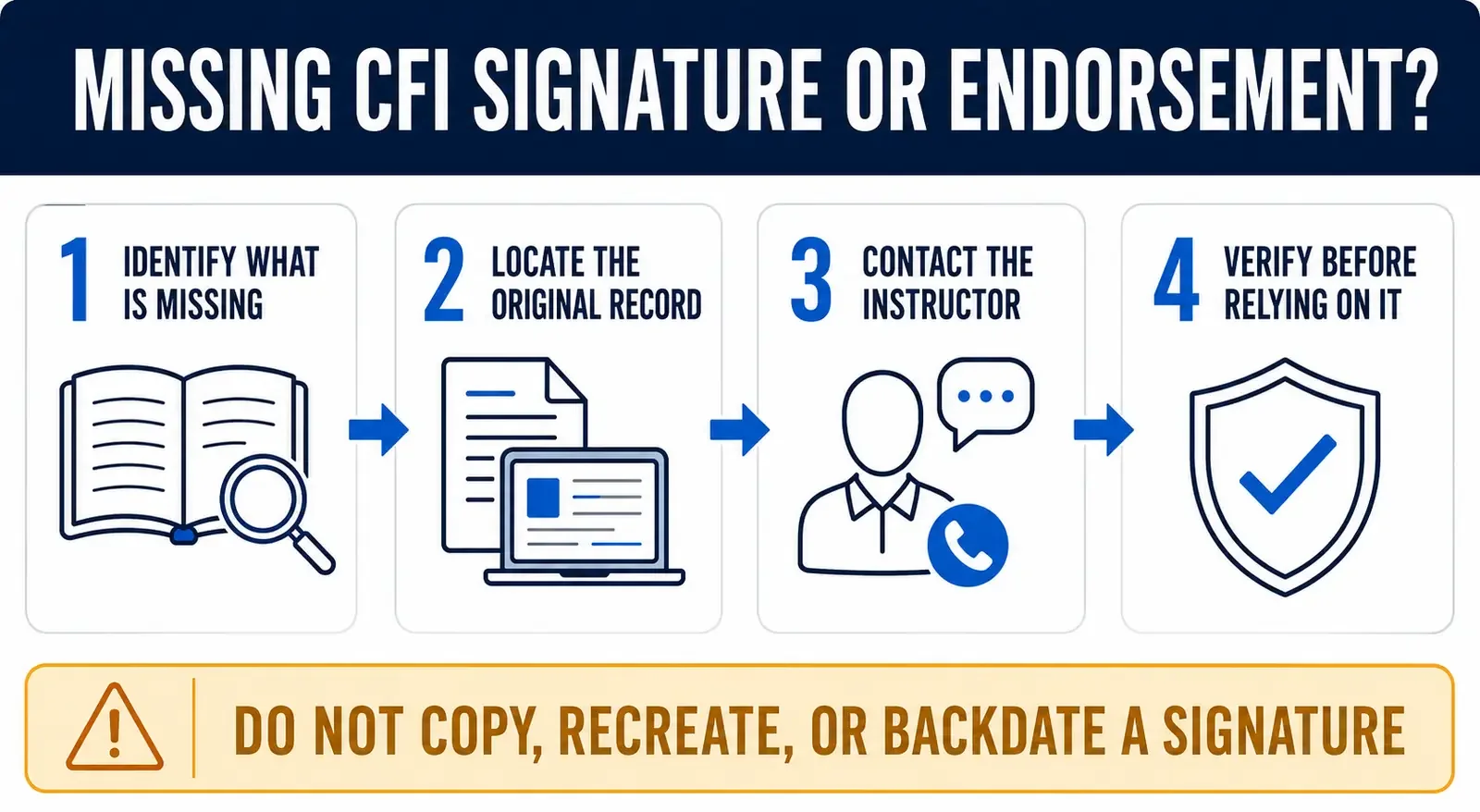
Step 1: Confirm That the Signature Is Actually Missing
Before treating the record as lost, check every version.
Review:
The original paper logbook
Endorsement pages in older logbooks
Scans or photographs of the original pages
Earlier digital-logbook exports
Training folders and graduation records
Separate endorsement sheets
Flight-school records
FAA certification records, when the issue concerns a past certificate or rating
A signature may exist in the original paper logbook even though it was omitted from a spreadsheet or digital conversion. In that situation, preserve the signed original and keep it associated with the digital record. Do not represent the digital entry itself as signed if it is merely a transcription of a separate signed source.
When converting paper records, the original pages containing instructor signatures and endorsements should be preserved. PilotAudit’s paper-to-digital pilot logbook conversion service works from the records provided and flags unclear or unreadable information instead of inventing missing entry details.
Step 2: Gather Records Before Contacting the Instructor
Make the instructor’s review as straightforward as possible.
Prepare:
The lesson date
Aircraft make, model, and registration number
Departure and arrival locations
Total lesson or flight time
Training subjects and maneuvers
Copies of surrounding logbook entries
Scheduling or dispatch records
Receipts or invoices
Training notes or syllabus records
Any previous scan showing the original entry
Do not fill in the instructor’s certificate number or signature yourself. Send the information to the instructor and let that instructor determine what can be verified and signed.
The instructor may not have a copy of every lesson
Section 61.189 requires CFIs to retain certain records for at least three years, including records of people endorsed for solo privileges and for knowledge or practical tests.
The regulation does not require the instructor to retain a separate duplicate of every ordinary training entry. Therefore, an instructor may have useful records of a solo or practical-test endorsement but no retained copy of every flight lesson.
That is why contemporaneous school, scheduling, aircraft, and training records can be valuable when trying to establish what occurred.
Step 3: Contact the Instructor Who Actually Provided the Training
The original instructor is generally the correct person to address an unsigned training entry because §61.189 requires the instructor who provided the training to sign the pilot’s logbook.
Send a concise request identifying:
What appears to be missing
The specific date and flight involved
What documentation is available
Why the record is now being reviewed
Whether a practical test, FAA review, or airline interview is approaching
Ask the instructor to verify the facts before signing anything.
AC 61-65K states that an endorsement must be legible and contain the instructor’s:
Signature
Date of signature
CFI or ground-instructor certificate number
Flight-instructor recent-experience end date or certificate expiration date, as applicable
Since December 2024, newly issued flight instructor certificates generally do not display an expiration date. Current records may instead show the instructor’s recent-experience end date consistent with §61.197. Older endorsements may properly show the expiration date that applied when an older certificate was used.
Can a Different CFI Sign the Missing Entry?
A different instructor should not certify that they personally provided training they did not give.
Section 61.189 connects the signature requirement to the instructor who gave the training. Several privilege-specific regulations also require an endorsement from the instructor who provided the applicable training or evaluation.
A new instructor may be able to:
Review the pilot’s current knowledge or proficiency
Provide any necessary additional training
Conduct a new flight review or IPC
Issue a new endorsement after personally satisfying the applicable requirements
That is different from signing an old lesson as though the new instructor had provided it.
When the original instructor is unavailable, determine what the missing record was intended to prove. If the issue can be resolved through a new training event or proficiency evaluation, that may be the most supportable path.
What If the Training Was Conducted Under Part 141?
A certificated Part 141 school must maintain a current training record for each enrolled student. Under 14 CFR §141.101, the school must retain the record for at least one year after the student graduates, terminates enrollment, or transfers, and must make a copy available upon the student’s request.
Contact the school and request:
The complete student training record
Course enrollment and completion dates
Chronological lesson records
Stage-check and final-check records
Graduation certificates
Any retained copies of endorsements
A school training record may help identify the instructor and verify completed course activity. Whether it resolves a particular Part 61 signature or endorsement requirement depends on the record, the regulation involved, and how the documentation will be used.
What If the Instructor Cannot Be Found?
If the original instructor is deceased, unreachable, no longer instructing, or unable to verify the training:
Preserve the incomplete original entry.
Gather every supporting record available.
Contact the former flight school or training provider.
Determine whether the issue can be resolved through new training or a new evaluation.
Speak with the DPE if a practical test is approaching.
Contact the appropriate FAA Flight Standards District Office when the issue affects FAA certification, operating privileges, or acceptance of reconstructed documentation.
The FAA maintains a directory of Flight Standards District Offices for airman-certification and regulatory questions.
If the issue concerns a previously issued certificate or rating, pilots can also request a copy of their complete FAA airman certification file. That file may contain applications and certification records relevant to the event. It should not be assumed to contain a duplicate of every logbook endorsement or training signature.
Do Not Recreate or Backdate a CFI Signature
Never:
Sign the instructor’s name
Copy a signature from another entry
Insert a certificate number without the instructor’s authorization
Change the date to make a new signature appear older
Create training details from memory and present them as verified
Remove or conceal the incomplete original entry
Ask another instructor to certify training they did not provide
Current 14 CFR Part 3, Subpart D prohibits fraudulent or intentionally false statements, fraudulent alterations, and knowing omissions of material facts in documents used to show regulatory compliance. Section 3.405 also addresses materially incorrect statements or omissions.
The objective is not to make the logbook appear flawless. It is to create a transparent record that accurately distinguishes documented facts from information that remains unverified.
If an entry has already been physically altered or covered with correction fluid, see PilotAudit’s guide on what to do after finding white-out in a pilot logbook.
How to Document the Resolution
There is no single FAA-published correction format that resolves every missing signature or endorsement situation.
The appropriate documentation depends on:
Whether the original instructor is available
Whether the instructor can verify the training
Whether the record involves training time, solo authority, a flight review, an IPC, a practical test, or an operating privilege
Whether the record is being used for a current FAA requirement
Whether a DPE or FSDO will need to evaluate it
Any corrective documentation should preserve the original record and make the timeline understandable. A newly signed document should not be made to appear as though it was signed on an earlier date. When AC 61-65K provides a sample endorsement for the event, the instructor should use wording that accurately reflects the applicable regulation and facts.
When a practical test or FAA determination is approaching, confirm the proposed documentation with the DPE or FSDO before relying on it.
Reviewing Missing Signatures Before an Airline Interview
An airline interview does not give a pilot permission to alter or reconstruct an unsupported record. Airline document requirements also vary, so there is no single rule governing how every airline will view an old missing signature.
Before the interview:
Review every entry showing Dual Received
Separate unsigned training entries from standalone endorsements
Confirm flight reviews and IPCs
Locate complex, high-performance, and tailwheel endorsements
Preserve original signed paper pages
Compare paper records with digital transcriptions
Organize any legitimate supporting documentation
Be prepared to explain unresolved items factually
Do not claim that an issue was “approved by the FAA” unless applicable FAA guidance was actually received.
A Professional Pilot Logbook Audit can identify entries with missing instructor information, locate gaps between paper and digital records, and organize the items that require the pilot’s attention. PilotAudit cannot sign an entry, replace an instructor endorsement, determine legal credit, or invent missing information. Unclear items are flagged for the pilot to verify with the appropriate instructor, examiner, or FAA office.
Once the underlying records have been reviewed, the Pilot Interview Logbook Prep Package combines a logbook audit with a professionally formatted and organized printed binder for the pilot’s interview.
Frequently Asked Questions
Does an unsigned Dual Received entry count as training?
Section 61.51(h) requires logged training time to be legibly endorsed by the authorized instructor and include the required training description, lesson length, signature, certificate number, and applicable expiration or recent-experience date. Without that information, the entry is not fully documented as training.
Whether another flight-time category associated with the flight independently qualifies must be evaluated separately.
Can my current CFI sign an old entry from another instructor?
A CFI should not certify training they did not provide. Your current instructor may provide new training or conduct a new evaluation and then issue an endorsement the instructor is authorized to make.
Can the original CFI sign the entry later?
Contact the original instructor and provide the available records. The instructor must determine what can be truthfully verified and how it should be documented. When the entry affects an upcoming practical test or FAA eligibility determination, confirm the proposed documentation with the DPE or FSDO.
What if my CFI certificate number is present but the signature is missing?
A certificate number by itself does not satisfy the signature requirement. Section 61.51(h) and AC 61-65K identify the instructor’s signature as a required element.
What if the signature exists in my paper logbook but not my digital logbook?
Preserve the signed paper record and keep it associated with the digital transcription. Do not destroy the original endorsement page or represent an unsigned digital entry as independently signed.
What if my flight review endorsement is missing?
Contact the instructor who conducted the review. Section 61.56(c) requires an endorsement from the authorized instructor who gave the review. If satisfactory completion cannot be properly documented, completing a new flight review may be necessary before acting as PIC.
Does passing a checkride prove that every earlier endorsement was correct?
A completed practical test does not give a pilot authority to recreate missing documents or assume every underlying record is complete. If an old omission materially affects certification records or current compliance, request the relevant FAA records and obtain case-specific guidance.
Should I correct a missing signature before an airline interview?
Review it well before the interview. Locate the original record, contact the instructor, and organize any legitimate supporting documentation. Do not wait until the final days before the interview, since instructors, schools, and FAA records may take time to locate.
The Bottom Line
A missing CFI signature or endorsement is not something to cover up or casually recreate. Begin by identifying what the record was intended to prove.
An unsigned training entry, an expired solo endorsement, a missing practical-test recommendation, and an undocumented flight review are different problems governed by different requirements.
Preserve the original record. Locate the best supporting documentation. Contact the instructor who provided the training. If that instructor cannot verify or complete the record, determine whether new training or a new evaluation can establish the required qualification. In cases involving FAA certification or operating privileges, obtain guidance from the appropriate DPE or FSDO before relying on reconstructed documentation.
A professional logbook review can help identify and organize the affected records, but only an appropriately authorized instructor or FAA representative can make the certifications within their authority.
Official FAA Sources
This article provides general educational information and does not constitute legal advice or an FAA determination regarding any individual record. PilotAudit reviews, organizes, formats, and converts records based on the documents provided. PilotAudit does not issue or replace instructor signatures or endorsements, determine whether time is legally creditable, or guarantee acceptance by the FAA, an examiner, an airline, or another reviewing organization. The pilot remains responsible for the accuracy, completeness, legality, and use of all logbook entries and supporting records.
