Used White-Out in Your Pilot Logbook? Here’s What to Do Next

You open an old pilot logbook and find white-out covering part of an entry. Maybe you used it during training because you thought you were cleaning up a simple mistake. Now a checkride, airline application, or interview is approaching, and the entry suddenly looks much more serious.
First, do not assume your entire logbook is invalid. The current federal regulations do not contain a rule stating that white-out, by itself, voids a pilot logbook. They also do not prescribe one universal method for repairing every logbook mistake.
What matters is whether the record contains the information required by the FAA, whether that information is accurate and supportable, and whether anything was intentionally falsified, fraudulently altered, or materially omitted.
That distinction is important. An honest but poorly documented correction is not automatically the same thing as falsification. At the same time, covering an original value can make the entry harder to verify. The right response depends on what the white-out covers and whether the accurate information can still be established from reliable records.
This guide explains what the current FAA rules actually say, what they do not say, and how to approach the affected entry without guessing or making the record less transparent.
Quick Answer: Is White-Out Illegal in a Pilot Logbook?
No current FAA regulation expressly says that using white-out in a personal pilot logbook is automatically illegal or that it invalidates the entire logbook.
14 CFR §61.51 identifies the flight and training information that must be recorded. It does not specify an ink color, require a particular brand or format of logbook, or establish a specific white-out procedure.
However, that does not mean the substance of a correction is unimportant. Current 14 CFR §3.403 prohibits fraudulent or intentionally false statements, alterations made for a fraudulent purpose, and knowing omissions of material facts in records used to show regulatory compliance. Section 3.405 also addresses materially incorrect statements or omissions connected to the issuance or validity of an FAA approval, certificate, rating, qualification, or similar authorization.
The practical answer is therefore:
White-out is not automatically disqualifying, but the information underneath it and the reason for the alteration matter.
If the entry remains accurate, complete, legible, and supportable, the presence of white-out does not trigger a regulation that automatically invalidates the logbook. If required information was covered, changed inaccurately, or can no longer be verified, the record needs careful review.
Why Many Online Answers Still Cite the Wrong Regulation
Older articles, forum posts, and legal discussions often refer to 14 CFR §61.59 as the FAA’s falsification rule. That was historically correct, but it is no longer the current citation.
The FAA issued a final rule in September 2025 that consolidated falsification provisions from multiple parts of Title 14 into Part 3. The change became effective November 3, 2025. Section 61.59 is now reserved, and the applicable current provisions are found in 14 CFR Part 3, Subpart D.
This change did not create an FAA-approved white-out repair procedure. It changed where the falsification, alteration, omission, and incorrect-statement rules are located. That is why a current article should cite §§3.401–3.405 rather than presenting §61.59 as the active rule.
What the FAA Requires a Pilot Logbook to Show
Under §61.51, the required information depends on the time or training being recorded. For a flight or lesson, the rule generally calls for information including:
The date
Total flight or lesson time
Departure and arrival locations, or the training-device location when applicable
Aircraft or training-device type and identification
The name of a required safety pilot, when applicable
The applicable category of experience, such as solo, PIC, SIC, or training received
Applicable flight conditions, such as day, night, actual instrument, or simulated instrument
Training entries have additional requirements. Under §61.51(h), training time must be entered in a legible manner by the authorized instructor and include a description of the training, the length of the lesson, the instructor’s signature, certificate number, and the certificate-expiration or recent-experience information required by the current rule.
This is where white-out can become more than a cosmetic issue. If it covers required flight information, a flight-time value, an instructor signature, or part of an endorsement, the affected record may no longer show what §61.51 requires.
What to Do After Finding White-Out in Your Logbook
There is no single FAA-mandated repair format for every situation. The following process is designed to preserve the record, identify what can be established, and avoid unsupported changes. It should not be described as an “FAA-approved correction method.”
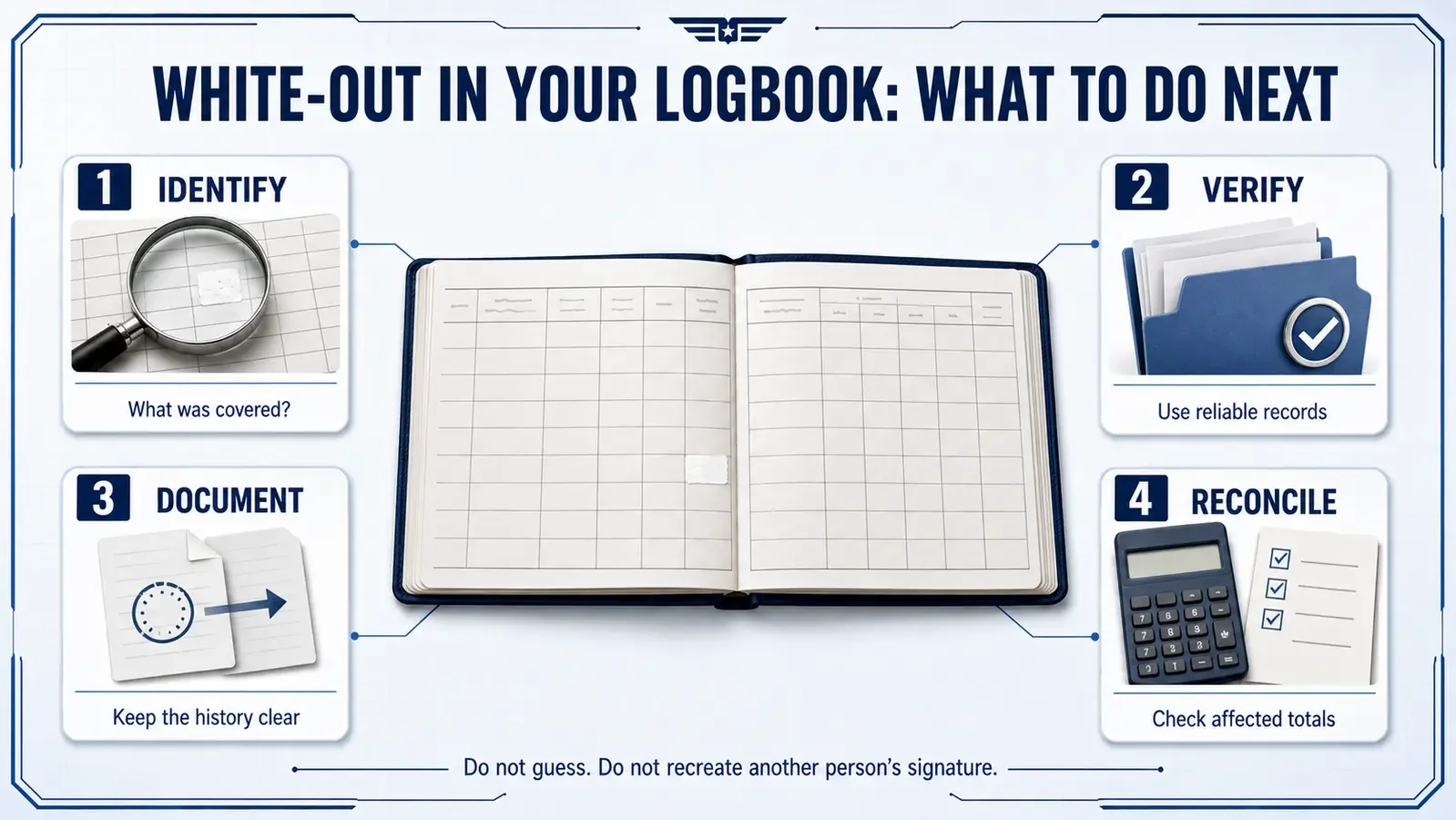
1. Stop Before Making Any Additional Changes
Do not add more white-out, scrape the page, overwrite the area repeatedly, or remove the page in an attempt to make the book look cleaner.
Those actions can destroy information that may still be visible and make it more difficult to understand what happened. Before doing anything else, make a clear color scan or photograph of the affected page as it currently exists. Preserve the full page, including its page number, running totals, adjacent entries, signatures, and remarks.
This preservation step is a prudent recordkeeping practice, not a separate regulatory requirement. Its purpose is to retain an accurate image of the record before any further clarification is added.
2. Identify Exactly What the White-Out Covers
The appropriate response depends on the affected information. Determine whether the white-out covers:
A spelling error or nonessential remark
A date, route, aircraft type, or registration number
Total time or a flight-time category such as PIC, SIC, cross-country, night, or instrument
A page total or carry-forward total
An instructor’s signature or certificate information
A required endorsement
An entry connected to a certificate, rating, currency requirement, checkride, or airline application total
A misspelled remark and an obscured instructor endorsement are not the same problem. Do not treat them as if one universal correction can resolve both.
3. Determine Whether the Current Entry Is Accurate and Complete
Compare the visible entry against §61.51. Ask two separate questions:
Does the entry still contain the information the regulation requires for that flight or lesson?
Is the information currently shown accurate?
If the required information remains visible and accurate, the issue may primarily be one of clarity and presentation. No current regulation states that the entire book becomes invalid merely because white-out appears on the page.
If required information is missing, illegible, or inaccurate, the record needs to be addressed. A 2010 FAA Chief Counsel interpretation, commonly known as the Benninger interpretation, states that a certificate holder should take action to correct an inaccurate record once the inaccuracy becomes apparent. The interpretation does not prescribe a specific correction format.
4. Locate Reliable Supporting Records
Do not guess what was underneath the white-out. Look for contemporaneous records that can help establish the accurate information, such as:
A parallel digital logbook or backup
Flight-school scheduling or training records
Aircraft rental records or receipts
Dispatch, trip, or company flight records
Instructor records
Aircraft records that genuinely document the relevant operation
Prior FAA Form 8710-1 applications showing totals as of known dates
Other records created at or near the time of the flight
Supporting documents do not automatically prove that a particular category of time was legally loggable. They help establish facts such as when the flight occurred, which aircraft was used, or how much time was recorded. The underlying time must still satisfy the applicable logging rule.
If the available records conflict, do not choose the number that produces the most favorable total. Resolve the conflict before changing or relying on the entry.
5. Correct or Clarify the Record Transparently
The FAA requires accurate records but does not publish a universal white-out correction template. Any clarification should preserve an understandable trail between the affected entry, the verified information, and the source supporting it.
One possible recordkeeping approach is a new, clearly labeled correction or clarification entry that identifies the original flight by date and page and states only the verified adjustment. That is a transparency practice—not a correction format expressly mandated or formally approved by the FAA for every situation.
The facts determine whether that approach is sufficient. A simple arithmetic correction is different from an obscured endorsement or a disputed flight-time category. If the entry supports a certificate, rating, currency requirement, or other FAA authorization and the proper treatment is uncertain, obtain case-specific guidance from an authorized instructor, the responsible Flight Standards District Office, or qualified aviation counsel before relying on a correction.
Whatever approach is used:
Do not invent missing information.
Do not recreate another person’s signature.
Do not state that a source verifies more than it actually does.
Do not conceal the fact that a clarification or adjustment was made.
Keep the source records used to support the corrected information.
6. Handle Instructor Signatures and Endorsements Separately
If white-out covers an instructor’s signature, certificate information, training description, or required endorsement, do not attempt to copy, trace, or reproduce it yourself.
Contact the instructor who made the original entry. That instructor can determine, using their own records and knowledge, whether they can properly issue a replacement or corrective entry. If the original instructor is unavailable, speak with a current authorized instructor or the responsible FSDO about what additional training, evaluation, documentation, or endorsement may be needed.
FAA Advisory Circular 61-65J contains the FAA’s current recommended endorsement language for many Part 61 situations. The correct endorsement depends on the specific privilege, training, or practical-test requirement involved; a generic replacement sentence should not be invented.
7. Recalculate Every Total Affected by the Entry
If the obscured information involves flight time, the effect may extend beyond one line. Review:
The page total
Running totals carried onto later pages
Totals carried into the next logbook
Parallel digital-logbook totals
FAA Form 8710-1 totals
Résumés and airline applications
Aircraft-type and category summaries
Recalculate from verified entries rather than changing a later total merely to make the numbers agree. If the paper and digital records differ, locate and document the source of the difference instead of assuming one version is automatically correct.
For a wider review of the issues that commonly affect applications and interviews, see Common Pilot Logbook Mistakes That Raise Red Flags.
8. Preserve the Supporting File
Keep the scan of the affected page, the records used to verify the information, and a copy of any clarification or replacement endorsement. The goal is to make the history understandable without relying on memory years later.
If you decide to create a digital working record, keep the original paper logbook and its endorsements. A digital transcription can make totals easier to review, but it should be based on the source records rather than guesses. PilotAudit’s paper-to-digital pilot logbook conversion flags unreadable information instead of inventing an entry.
Four Common White-Out Scenarios
White-Out Covered a Typo or Nonessential Remark
Confirm that every item required by §61.51 remains present, legible, and accurate. Preserve the page as it exists. If the white-out does not affect required information or the accuracy of the entry, no regulation cited in this guide states that the entire logbook is invalid because of that cosmetic correction alone.
White-Out Covered Flight Time or a Time Category
Do not estimate the original or corrected value. Verify the flight using contemporaneous records and confirm that the time qualifies for the category claimed. Recalculate the affected totals and preserve the supporting documentation. Obtain case-specific guidance if the time is being used for a certificate, rating, currency requirement, or other FAA authorization and the proper treatment remains uncertain.
White-Out Covered a CFI Signature or Endorsement
Contact the instructor who issued it. Do not recreate the signature or write replacement endorsement language on the instructor’s behalf. If that instructor is unavailable, consult an authorized instructor or the responsible FSDO about the appropriate path for the specific endorsement.
White-Out Appears Throughout the Logbook
Review the entire record before an application, checkride, or interview. Repeated white-out does not create a single automatic legal conclusion, but it can make multiple entries and totals difficult to verify. A systematic review should separate entries that remain complete and supportable from those requiring clarification.
A Professional Pilot Logbook Audit can identify affected totals, missing information, category discrepancies, and entries that need the pilot’s confirmation. PilotAudit does not guess at covered information or alter unsupported entries; unclear items are flagged for the pilot to verify.
What If an Airline Interview Is Approaching?
Airline document instructions vary, and the airline’s current candidate instructions control. There is no universal published rule stating that every airline handles white-out the same way.
Before the interview:
Confirm that your logbook totals match the figures you submitted.
Keep your source records and any correction documentation organized.
Follow the airline’s instructions for original logbooks, printed digital records, tabs, summaries, and supporting documents.
Be prepared to explain the affected entry accurately if asked.
Do not characterize the correction as “FAA approved” unless you actually received applicable written FAA guidance.
The best explanation is factual and limited to what you can support. For example: the original entry contained an error; white-out was used; the accurate information was later verified against identified records; and the totals were reconciled accordingly. Do not claim facts that are not documented.
Our guide on how to prepare your pilot logbook for an airline interview covers the larger review process. Pilots who want both a records review and an organized printed binder can use the Pilot Interview Logbook Prep Package.
What Not to Do
Avoid actions that make the underlying history harder to establish:
Do not apply additional white-out simply to improve the page’s appearance.
Do not remove or replace an original page to hide the correction.
Do not guess at an obscured time, aircraft, route, or category.
Do not recreate an instructor’s signature or endorsement.
Do not change totals solely to match an application.
Do not describe a common practice as an FAA requirement.
Do not rely on an old article that still presents §61.59 as the current rule.
The objective is not to make the logbook appear untouched. It is to maintain a record that is accurate, supportable, and understandable.
Frequently Asked Questions
Does white-out invalidate a pilot logbook?
No current FAA regulation states that white-out automatically invalidates an entire personal pilot logbook. The important questions are whether the required information remains present and accurate and whether the alteration involved fraud, intentional falsification, a fraudulent purpose, or a material omission.
Is using white-out the same as falsifying a logbook?
Not automatically. Section 3.403 addresses fraudulent or intentionally false statements, alterations for a fraudulent purpose, and knowing material omissions. The use of white-out alone does not establish those elements. The facts, purpose, information affected, and surrounding circumstances matter.
Does the FAA require logbook corrections to use a single-line strikeout?
The current personal pilot-logbook rule in §61.51 does not establish a universal single-line-strikeout procedure. A visible strikeout with a clear correction is often recommended as a transparent recordkeeping practice, but it should not be represented as wording contained in §61.51.
Should I rewrite my entire logbook?
Do not discard or conceal the source record. A digital transcription may be useful as a working record when it is based on verifiable entries, but retain the original paper logbook, especially where it contains original signatures or endorsements. If extensive information is unreadable or unsupported, obtain case-specific guidance rather than filling gaps from memory.
Can I rewrite a CFI endorsement that was covered by white-out?
Do not recreate an instructor’s signature or issue an endorsement on that instructor’s behalf. Contact the instructor who made the original entry. If they are unavailable, ask an authorized instructor or the responsible FSDO what is required for that particular privilege, training event, or application.
What if the white-out was used years ago?
The age of the correction does not determine whether the information is accurate. Review what was covered, locate the best available supporting records, and verify any totals affected. Do not reconstruct a value from memory when reliable support is unavailable.
Should I have the logbook reviewed before an airline interview?
A review can be valuable when white-out affects flight time, totals, signatures, endorsements, or multiple pages. The purpose is to identify what remains supportable and what needs the pilot’s attention before the logbook is used for an application or interview.
The Bottom Line
White-out in a pilot logbook is not, by itself, a regulation that automatically ends a checkride or airline application. The real issue is the integrity of the information.
Start with the current rules. Preserve the record. Identify exactly what was covered. Verify the accurate information without guessing. Address instructor-signed material through the appropriate instructor or FAA channel. Reconcile every affected total, and retain the documents that support the result.
If the problem extends beyond one obvious entry, PilotAudit can review the records you provide and flag totals, categories, missing information, and unclear entries through a Professional Pilot Logbook Audit. The pilot remains responsible for verifying the accuracy, completeness, legality, and use of every entry.
Regulatory Sources and Verification
This article was verified against the following sources on August 1, 2026:
14 CFR §3.403 — Falsification, reproduction, alteration, or omission
FAA Advisory Circular 61-65J — Certification: Pilots and Flight and Ground Instructors
This article provides general educational information and does not constitute legal advice or an FAA determination regarding any individual logbook. PilotAudit reviews, organizes, formats, and converts records based on the documents provided. PilotAudit does not decide whether time is legally loggable, issue FAA approvals, or guarantee an interview, checkride, or hiring outcome. The pilot remains responsible for the accuracy, completeness, legality, and use of all entries, totals, endorsements, applications, and supporting records.
