Common Pilot Logbook Mistakes That Raise Red Flags in an Airline Interview
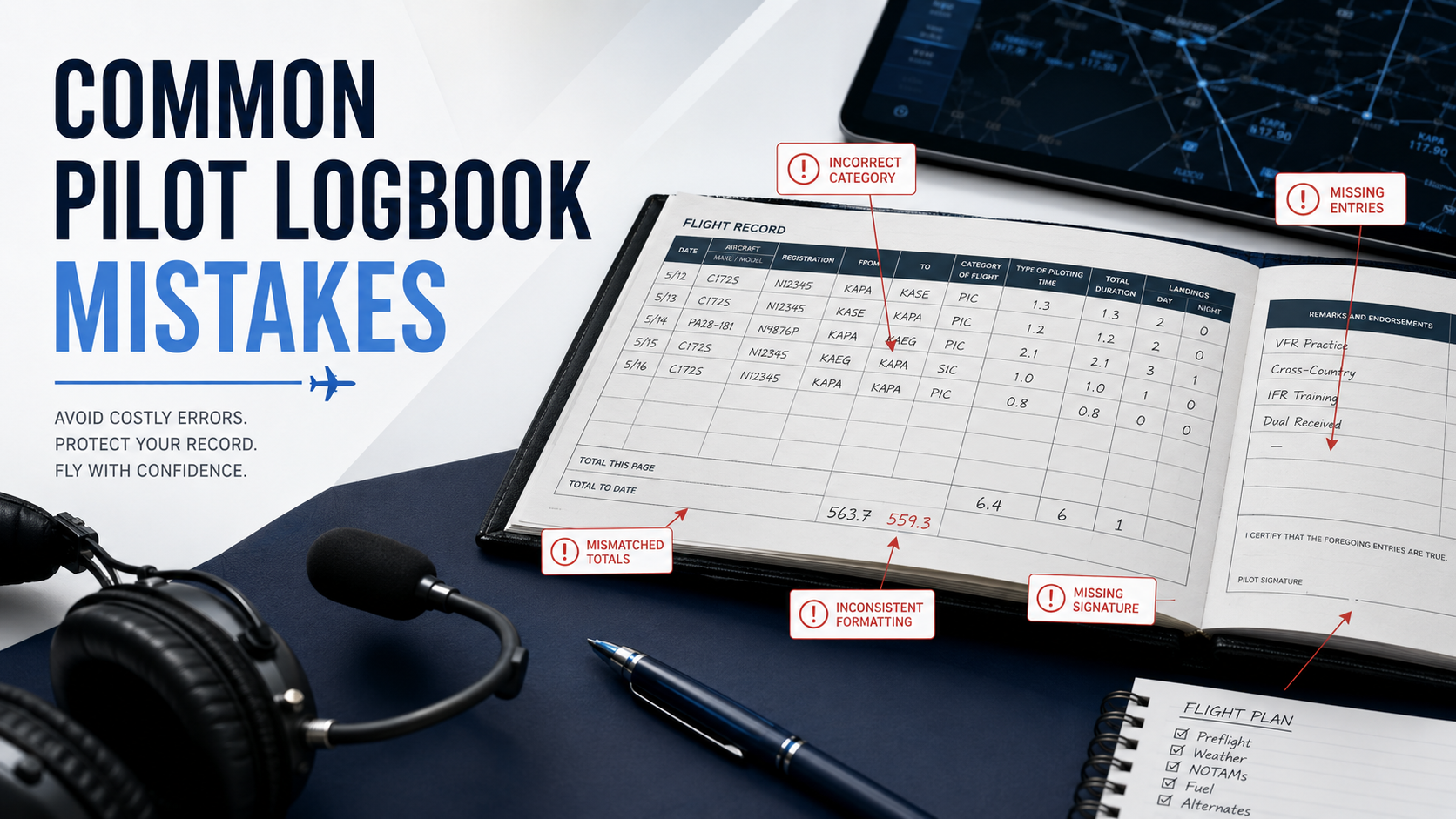
When an airline calls you for an interview, they already believe you can fly. Your certificates and hours got you in the door. What happens next — the logbook review — is testing something different: whether your records are accurate, honest, and professional. Recruiters who have reviewed thousands of logbooks know exactly what a careless record looks like, and they spot the warning signs fast.
The good news is that nearly every red flag they look for is preventable. Below are the logbook mistakes that come up again and again in recruiter feedback, why each one matters, and how to fix it before anyone else sees it.
Why Recruiters Scrutinize Your Logbook
Your logbook is a legal document, and the airline treats it that way. The review isn't really about the numbers themselves — it's a window into your character. A record that's accurate, legible, and well-organized signals discipline and integrity, the same traits that keep an airplane safe. A messy or inconsistent one raises a quieter, more damaging question: if this pilot is careless here, where else are they careless?
That's why small errors carry outsized weight. An interviewer who finds a problem you missed has found a reason to wonder what else is wrong. Here's what to hunt for.
1. Totals That Don't Reconcile
This is the single most common problem recruiters report. Your category totals have to add up against each other: single-engine plus multi-engine should equal your total time, day plus night should reconcile, and your splits should make sense against the grand total. When single- and multi-engine time doesn't sum to your total, an interviewer notices immediately — and starts looking harder at everything else.
The fix: Re-add every category and confirm the relationships tie out before you walk in. If they don't, find the entry where the math breaks.
2. Totals That Don't Match Between Logbooks
When you start a new logbook, you carry your previous totals forward. A single transposed or mis-added number at that handoff compounds through every page that follows. Recruiters have found career totals off by more than twenty hours from this exact error — a gap large enough to look like padding even when it was an honest mistake.
The fix: Trace the ending total of each logbook to the opening total of the next. Verify the carry-forward at every book transition.
3. Logbook Totals That Don't Match Your Application
Airlines use verification systems, and a mismatch between your logbook and the hours you reported on your application is one of the fastest ways to raise doubt — even a discrepancy of a few hours reads as a problem with attention to detail or honesty.
The fix: Reconcile your logbook against your application line by line before submitting and again before the interview. The two must agree.
4. Untotaled or Skipped Columns
Some pilots total only the columns where they logged new time on a given page, leaving others blank. That inconsistency makes a logbook hard to follow and easy to misread.
The fix: Total every column on every page, even ones with no new entries. Use a zero where there's nothing to add, and carry the running total forward. Consistency keeps the whole record clear.
5. Mislogged PIC and SIC Time
Logging governed by FAR 61.51 is precise about who may log what, and this is where a lot of records go wrong. Common errors include logging PIC when you weren't rated in the aircraft or weren't the sole manipulator acting as pilot-in-command, and logging SIC in a single-pilot aircraft on a Part 91 flight where a second-in-command wasn't required. Because the PIC/SIC split often matters more to an airline than your raw total, errors here are especially damaging.
The fix: Review your PIC and SIC entries against the actual conditions of each flight. Make sure every designation is defensible under 61.51.
6. Simulator Time Mixed Into Flight Time
Simulator and flight training device time has its own rules and belongs in its own column or section — never blended into your total flight time. Mixing it in inflates your total and gets flagged instantly.
The fix: Keep sim time clearly separated. Most digital logbooks do this automatically; on paper, give it its own column and never roll it into your aircraft totals.
7. Rounded or Padded Hours
Consistently rounding 1.3 up to 1.5 across hundreds of flights quietly inflates your total, and to a recruiter that pattern reads as falsification — the cardinal sin of logbooks. Estimating or "pencil-whipping" time can end a candidacy on the spot.
The fix: Log actual block or Hobbs time, not convenient round numbers. Accurate hours always beat impressive-looking ones.
8. Missing Signatures and Endorsements
Unsigned training pages and missing endorsements are a frequent flag. Endorsements also have specific required wording under Advisory Circular AC 61-65, and incorrect or missing wording can invalidate them. Interviewers do check the endorsement pages.
The fix: Audit your endorsements and instructor signatures early — some gaps can still be corrected if you catch them in time. Keep certificates and endorsements together in a clearly marked section.
9. Illegible Entries
If a recruiter can't read it, they can't verify it — and an unverifiable logbook stalls the entire review, which can delay your application. Legibility isn't a cosmetic concern; it's functional.
The fix: Write clearly in blue or black ink, never pencil. If your handwriting makes pages hard to follow, a clean printed version solves the problem entirely.
10. Improper Corrections (White-Out)
How you fix an error matters as much as the error itself. Correction fluid over a logbook entry is widely seen as a red flag, because it looks like you're hiding something.
The fix: Draw a single line through the mistake, write the correct entry on the next line, and initial it. Leave the original visible. Transparency reads as professional; concealment does the opposite.
11. Missing Required Entry Details
FAR 61.51(b) requires each entry to include specifics like date, aircraft type and registration, departure and arrival points or route, total time, and the conditions and categories of flight. Entries missing these read as incomplete and sloppy.
The fix: Confirm your entries carry the required details. Digital logbooks help by prompting for or auto-filling these fields.
12. Unexplained Gaps and Risky Comments
A large gap between entries — say, fifty hours with no logged activity — invites a question you'd rather not field across the table. So do offhand or "incriminating" remarks jotted next to entries, which interviewers have a way of noticing.
The fix: Keep your record continuous and your comments strictly professional. If there's a legitimate gap, have a calm one-sentence explanation ready.
A Word on Checkride Failures
A disapproval in your record is not the dealbreaker many pilots fear. Airlines have hired pilots with multiple failures — what matters is how you present it. Own it, explain what you learned, and show improvement. Blaming the instructor or the examiner is the actual red flag. And never omit a failure hoping it won't surface; background checks are thorough, and getting caught in an omission is far worse than the failure itself. Honesty is a conversation; concealment is a termination.
Don't Present Trip Books
The small "trip books" working pilots use to jot legs and times throughout the day are not professional records and shouldn't be presented at an interview. Transcribe them into your official logbook and bring the real record — not a stack of scratch books.
Catch These Before a Recruiter Does
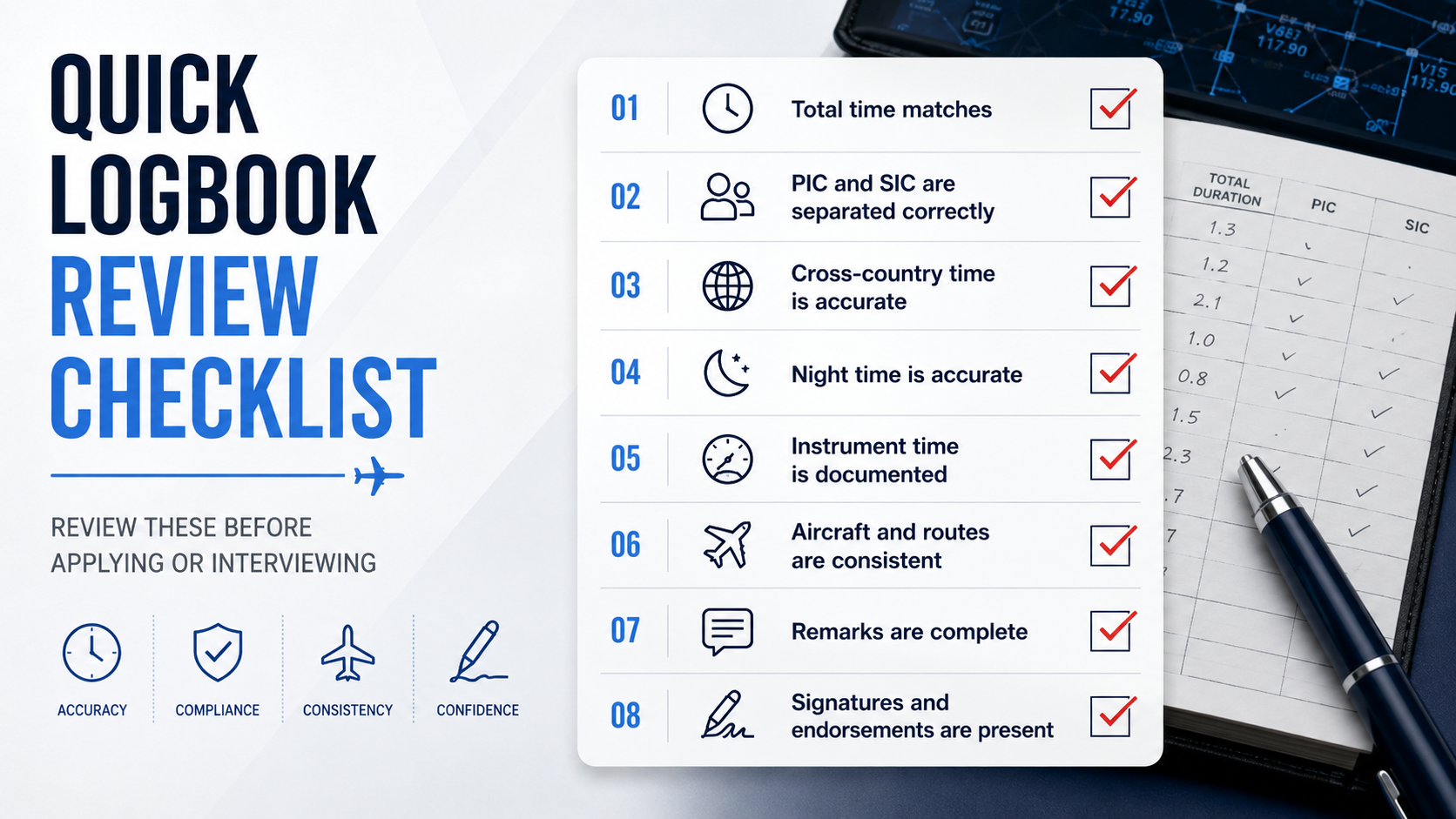
Reading this list is the easy part. Methodically working through your own logbook to find these issues — re-totaling every column, reconciling every carry-forward, verifying every PIC entry — is hours of tedious work, and it's hard to catch your own mistakes when you're the one who made them.
That's exactly what a professional review is for. PilotAudit's Professional Pilot Logbook Audit reviews your totals, PIC/SIC splits, categories, consistency, and entries, and flags anything that needs your attention before your interview — a focused second set of eyes on the document that matters most. If you also want a clean, tabbed binder for the interview itself, the Pilot Interview Logbook Prep Package combines that review with professional printing tailored to your airline.
And if your records live entirely on paper, where most of these math and legibility errors begin, converting them first removes the root cause. PilotAudit's paper-to-digital logbook conversion turns your handwritten books into a clean digital logbook with automatic totals you can verify and print.
For the bigger picture, see our guides on how to prepare your pilot logbook for an airline interview and paper vs. digital logbooks for airline interviews.
Frequently Asked Questions
What is the most common logbook mistake airline recruiters see? Totals that don't reconcile — most often single- and multi-engine time that doesn't add up to total time, and career totals that don't match between separate logbooks because of a carry-forward error. Re-adding every column and verifying each book transition catches these.
Will a checkride failure in my logbook disqualify me? Usually not. Airlines have hired pilots with multiple disapprovals. What matters is presenting it honestly, explaining what you learned, and never omitting it. Concealing a failure is far more damaging than the failure itself.
Is it bad to use white-out in my logbook? Yes. Correction fluid is widely viewed as a red flag because it looks like concealment. Instead, draw a single line through the error, write the correction on the next line, and initial it, leaving the original visible.
Can simulator time go in my total flight time? No. Simulator and flight training device time follows separate rules and must be logged in its own column or section, never blended into total flight time. Mixing it in inflates your total and gets flagged immediately.
How do I fix logbook mistakes I've already found? Correct entries properly (single line, correction, initials), re-total affected pages and carry forwards, and reconcile against your application. For widespread or compounding errors, a professional logbook audit can identify everything that needs attention before your interview.
PilotAudit reviews, organizes, formats, and converts pilot logbook records based on the documents you provide. You remain responsible for verifying the accuracy, completeness, and legality of all entries and totals. PilotAudit does not provide interview coaching or hiring advice and does not guarantee interview or hiring outcomes.
